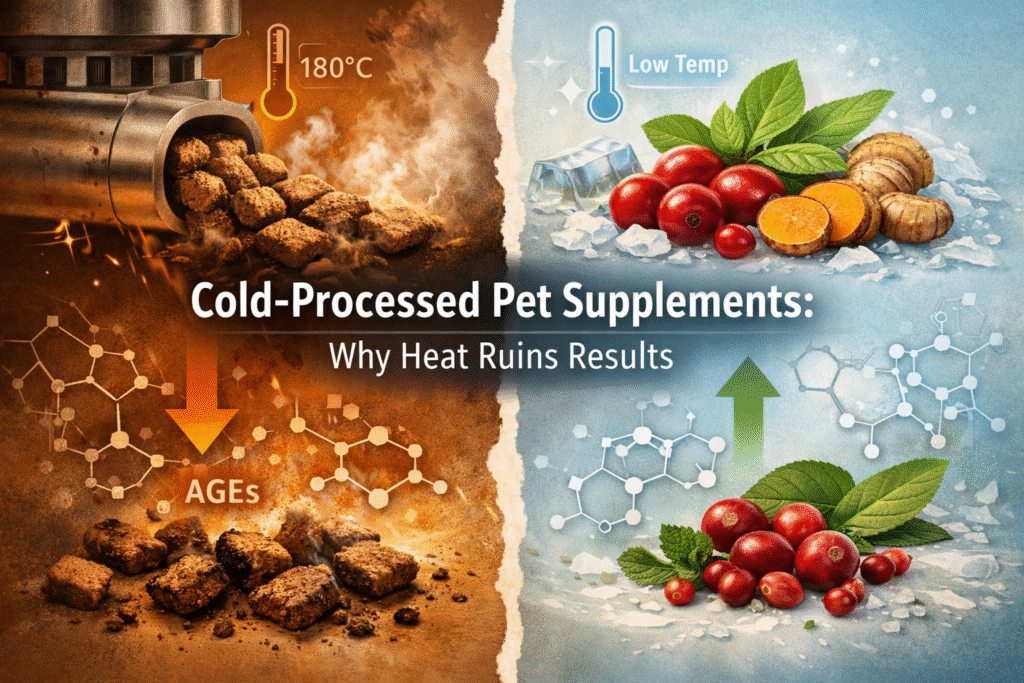
Cold-Processed Pet Supplements: Why Heat Ruins Results
Most pet supplement brands focus on what goes into a formula.
Very few talk about what happens after.
Ingredients don’t reach your dog or horse in their raw, pristine state. They are mixed, heated, shaped, stabilized, and stored before they ever reach a bowl. That manufacturing step—largely invisible to consumers—is often the single biggest factor determining whether a supplement works at all.
At Natural Ranch Products, we believe ingredients only matter if they survive processing intact. That belief is why we use cold-processing methods and why we openly question high-heat manufacturing practices common across the pet supplement industry.
This article explains what cold-processing actually means, how heat affects nutrients, and why manufacturing—not the ingredient list—is often the difference between results and disappointment.
The Hidden Step No One Talks About: Manufacturing
Pet supplement labels tell you what is included, but almost never explain how those ingredients were handled.
Most formulations are designed on paper:
- Ingredient sourcing
- Dosage targets
- Nutritional claims
But the final biological value of a supplement is determined during manufacturing. Temperature, pressure, moisture, and time all influence whether nutrients remain active or become degraded.
Two products can list nearly identical ingredients and still perform very differently in the body. The reason is not marketing—it’s physics and chemistry.
What High-Heat Extrusion Actually Is
High-heat steam extrusion is one of the most common manufacturing methods used in pet food and supplement production, particularly for soft chews and treats.
In simple terms:
- Ingredients are mixed into a dough
- Steam and pressure are applied
- Temperatures commonly exceed 160–180°C (320–356°F)
- The material is forced through a die to shape it
- The product is rapidly dried and stabilized
Extrusion is popular because it is:
- Fast
- Cost-efficient
- Scalable
- Shelf-stable
These advantages benefit manufacturers and distributors. They do not necessarily benefit sensitive nutrients.
What Heat Does to Nutrients (The Biology, Not the Marketing)
Heat is not inherently “bad,” but many biologically active compounds are heat-labile, meaning they degrade when exposed to high temperatures.
Enzymes
Enzymes are proteins. Heat denatures proteins by altering their structure, rendering them inactive. Once denatured, enzymes cannot be “re-activated” after processing.
Probiotics
Most probiotic strains are killed at temperatures far below those used in extrusion. Unless added after heating (and protected), many do not survive manufacturing at all.
Polyphenols and Phytonutrients
Plant compounds such as polyphenols—including cranberry proanthocyanidins (PACs)—are sensitive to heat and oxidation. Studies show thermal processing can significantly reduce their biological activity.
- Reference: Scalbert et al., Critical Reviews in Food Science and Nutrition
Fatty Acids
Omega-3 and omega-6 fatty acids are prone to oxidation when exposed to heat, light, and oxygen. Oxidized fats may lose efficacy and contribute to inflammatory stress rather than reduce it.
Heat doesn’t just reduce nutrient quantity. It can change nutrient function.
Why Labels Don’t Reflect Post-Processing Loss
This is where most consumers—and many veterinarians—are misled.
Ingredient lists reflect what was added before processing, not what survived afterward.
Current labeling regulations:
- Do not require disclosure of nutrient degradation during manufacturing
- Do not differentiate between intact vs. denatured compounds
- Do not require post-processing bioavailability testing
A supplement can legally list probiotics, enzymes, or plant extracts even if a significant portion was rendered inactive during production.
“Meets label claim” does not mean “biologically effective.”
What “Cold-Processed” Actually Means (And What It Doesn’t)
Cold-processing is often misunderstood or misused as a marketing term.
Cold-processed does not mean:
- Raw
- Unstable
- Unregulated
- Untreated
Cold-processing refers to manufacturing methods designed to:
- Avoid high temperatures
- Minimize thermal degradation
- Preserve molecular structure
- Protect heat-sensitive compounds
This often requires:
- Slower production timelines
- Smaller batch sizes
- More stringent handling
- Higher manufacturing costs
Cold-processing prioritizes nutrient integrity over speed.
Why Results Differ Even With Similar Ingredients
This is the question most pet owners eventually ask:
“Why didn’t this supplement work when the ingredients looked the same?”
The answer is bioavailability.
Bioavailability depends on:
- Molecular integrity
- Particle size
- Solubility
- Interaction with digestive enzymes
A degraded compound may still appear on a label but fail to interact properly with biological systems. In contrast, a preserved compound can be absorbed and utilized as intended.
In other words:
- Ingestion is not the same as absorption
- Labels do not guarantee function
When Cold-Processing Matters Most
Not every ingredient is equally sensitive to heat. Cold-processing is especially important for formulas supporting:
Urinary Health
Cranberry PACs, botanical extracts, and antioxidants rely on intact molecular structures to function effectively.
Inflammation & Joint Support
Omega fatty acids, plant polyphenols, and anti-inflammatory compounds degrade rapidly under heat.
Multivitamins
Vitamins may survive extrusion, but enzymes and cofactors often do not—reducing overall effectiveness.
Aging Dogs and Horses
Older animals often have reduced digestive efficiency, making nutrient preservation even more critical.
How We Apply Cold-Processing at Natural Ranch Products
We chose cold-processing because results—not convenience—matter.
That choice means:
- Accepting slower production
- Avoiding shortcuts common in mass manufacturing
- Designing formulas around survival, not just inclusion
We do not claim cold-processing is trendy or magical. We claim it is necessary when working with delicate, functional ingredients intended to support real biological systems.
Our standards exist because we expect supplements to do more than look good on paper.
The Bottom Line: Ingredients Only Work If They Survive
Most pet supplements fail quietly—not because the ingredients were wrong, but because the manufacturing process destroyed what made them useful.
Cold-processing is not about ideology. It’s about respecting biology.
If nutrients don’t survive processing, they can’t support health.
If supplements don’t function biologically, they don’t justify their claims.
That’s why manufacturing matters.
And that’s why we built our products around preservation, not speed.
References & Further Reading
- Scalbert A, et al. Polyphenols: Food Sources and Bioavailability. Critical Reviews in Food Science and Nutrition.
- Friedman M. Effect of Heat on Nutrient Stability. Journal of Agricultural and Food Chemistry.
- Fuller R. Probiotics in Man and Animals. Journal of Applied Bacteriology.
- NRC. Nutrient Requirements of Dogs and Cats. National Academies Press.
Frequently Asked Questions
Why does heat damage pet supplement ingredients?
Many biologically active nutrients are heat-sensitive. High temperatures can denature enzymes, kill probiotics, oxidize fatty acids, and alter plant compounds such as polyphenols. Once this damage occurs, nutrients may still appear on the label but no longer function properly in the body.
What is the Maillard Reaction, and why does it matter for pets?
The Maillard Reaction is a chemical reaction between amino acids and sugars that occurs during high-heat cooking and browning. While it creates flavor and color, it also produces Advanced Glycation End-products (AGEs), which are associated with inflammation and oxidative stress. In pet supplements and treats, this reaction can make products counterproductive for long-term health.
Why do supplements with similar ingredients produce different results?
Effectiveness depends on bioavailability, not just ingredients. Bioavailability is influenced by molecular integrity, particle size, solubility, and how nutrients interact with digestive enzymes. Heat-damaged compounds may be listed on a label but fail to be absorbed or used effectively by the body.
Why is cold-processing important for cranberry-based urinary supplements?
Cranberry proanthocyanidins (PACs) rely on specific molecular bond structures to help prevent bacterial adhesion in the urinary tract. High heat can reduce PAC levels and alter their structure, making them less effective. Preserving these compounds is critical for functional urinary support.
When does cold-processing matter most for pet health?
Cold-processing is especially important for supplements supporting urinary health, inflammation and joint function, multivitamins containing enzymes or cofactors, and aging dogs and horses with reduced digestive efficiency.
Written by [Natural Ranch Products Team ], Pet Wellness Advocate at Natural Ranch. Passionate about holistic dog care and high-quality nutrition.”