
Cranberry Seed Oil vs Fish Oil for Dogs: What’s the Difference?
Cranberry seed oil and fish oil are two of the most commonly recommended supplements for dogs — and they are also two of the most commonly confused. Both contain omega fatty acids. Both support skin and coat health. Both are used daily as wellness supplements. But they work through fundamentally different mechanisms, support different systems, and have different long-term use profiles.
Understanding what each one actually does — and when each one is the right choice — helps you make a more informed decision for your specific dog rather than choosing based on marketing claims.
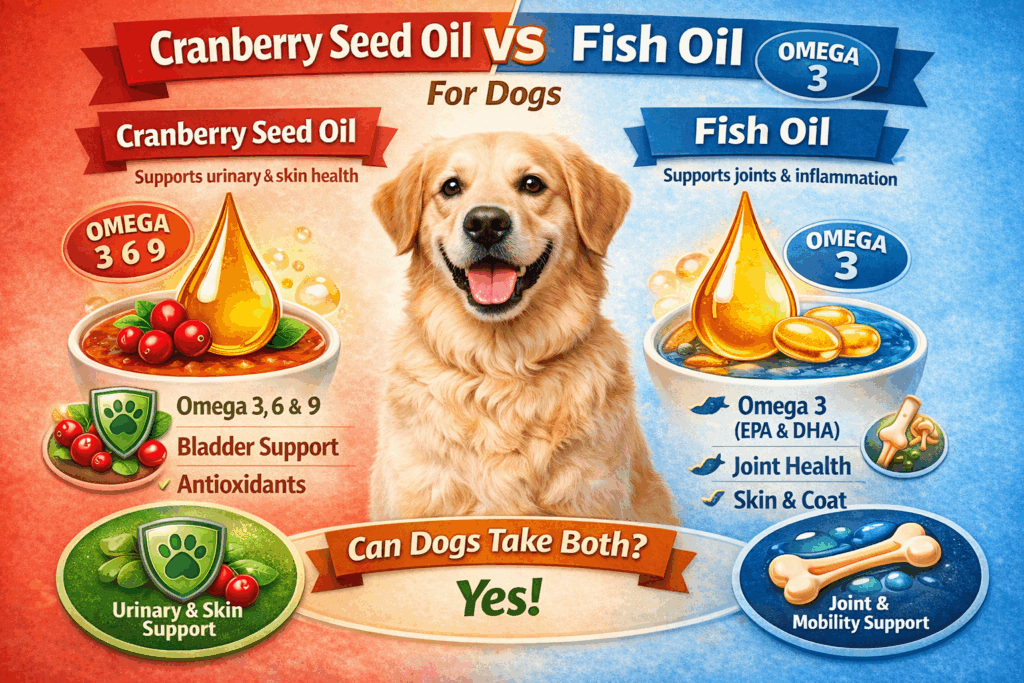
What Fish Oil Does for Dogs
Fish oil is derived from fatty fish — typically salmon, sardines, anchovies, or mackerel — and is rich in two specific omega-3 fatty acids: EPA (eicosapentaenoic acid) and DHA (docosahexaenoic acid). These are long-chain omega-3s that the body can use directly without conversion, which is why fish oil is so effective for conditions requiring rapid anti-inflammatory response.
EPA is the primary anti-inflammatory omega-3. It directly inhibits the production of pro-inflammatory compounds — prostaglandins and leukotrienes — that drive the inflammation behind joint pain, skin reactivity, and allergic responses. DHA supports neurological function and brain development, making it particularly relevant for cognitive health in senior dogs and neurological development in puppies.
Where Fish Oil Is Most Effective
- Joint stiffness and arthritis — EPA’s direct anti-inflammatory effect reduces the inflammation driving joint pain and stiffness in arthritic dogs
- Allergic skin conditions — systemic inflammation reduction helps with itching, redness, and skin reactivity driven by immune overresponse
- Cognitive health in senior dogs — DHA supports neurological function and may help maintain cognitive sharpness as dogs age
- Heart health — omega-3s support cardiovascular function and healthy triglyceride levels
Fish Oil Limitations and Long-Term Considerations
Oxidation and rancidity — fish oil is highly sensitive to air and light. Each time a bottle is opened, oxidation begins. Once oxidized, fish oil may actually promote inflammation rather than reduce it — the opposite of its intended effect. For long-term use, fish oil should be refrigerated, stored in dark bottles, and replaced regularly. The fishy smell that intensifies over time is a sign of oxidation, not quality.
Vitamin E depletion — high doses of fish oil over time can deplete a dog’s natural vitamin E stores, which are needed to protect cells from oxidative stress. Quality canine fish oils typically add vitamin E to offset this effect — check the label before assuming it’s included.
Heavy metal contamination — because fish accumulate environmental contaminants including mercury, fish oil from non-distilled sources can carry these contaminants into the supplement. For ongoing long-term use, look for fish oils labeled molecularly distilled and third-party tested for purity.
No urinary tract benefit — fish oil has no meaningful direct effect on the urinary environment, bacterial adhesion to the bladder wall, or the GAG layer that protects bladder tissue. For dogs with urinary health concerns, fish oil alone doesn’t address the relevant mechanisms.
What Cranberry Seed Oil Does for Dogs
Cranberry seed oil is cold-pressed from cranberry seeds — a byproduct of cranberry processing that is extraordinarily rich in omega fatty acids, antioxidants, and unique phytochemicals not found in most plant-based oils. It is fundamentally different from cranberry juice, cranberry extract, or cranberry PAC supplements — and understanding those differences explains why it serves a different purpose.
Unlike fish oil which is dominated by omega-3 EPA and DHA, cranberry seed oil provides a rare naturally balanced 1:1:1 ratio of omega-3, omega-6, and omega-9 fatty acids. This balance — which is the Canine Royal Oil™ profile in Natural Ranch Products formulas — is significantly different from most plant oils which are heavily weighted toward omega-6 or omega-9. The balanced ratio supports skin barrier lipid production, systemic inflammation management, and cellular health without the omega-6 overload that can occur with many vegetable oils.
Where Cranberry Seed Oil Is Most Effective
- Urinary tract health — cranberry seed oil contains proanthocyanidins (PACs) that help reduce bacterial adhesion to the bladder wall. Rather than altering urine pH, this supports the body’s natural flushing process and is particularly valuable for dogs prone to urinary issues or recurring infections.
- Skin barrier support — the balanced omega profile supports the lipid layer of the skin barrier, which is responsible for moisture retention and protection against allergens. Particularly beneficial for dogs with chronic dry skin, seasonal allergies, or recurring hotspots.
- Antioxidant protection — cranberry seed oil is naturally rich in vitamin E tocopherols and other antioxidants that protect cells from oxidative damage. This is both a health benefit and a stability advantage — the antioxidants that protect the oil from rancidity also protect the dog’s cells.
- Shelf stability for long-term daily use — unlike fish oil, cranberry seed oil is naturally resistant to oxidation due to its high antioxidant content. It does not require refrigeration and maintains potency significantly longer after opening — making it more suitable for consistent long-term supplementation without the rancidity management that fish oil requires.
What Cranberry Seed Oil Is Not
Cranberry seed oil is not the same as cranberry extract or cranberry PAC supplements. Cranberry extract and PAC supplements are used specifically for bacterial anti-adhesion in the urinary tract. Cranberry seed oil delivers a broader nutritional profile — omega fatty acids, antioxidants, and phytochemicals — with some PAC content but not at the concentrated levels of dedicated urinary health supplements.
Cranberry seed oil also does not significantly acidify urine — a common misconception about cranberry products generally. Its urinary benefit comes from the PAC content and the overall support for urinary tract tissue, not from pH alteration.
Cranberry Seed Oil vs Fish Oil: Side-by-Side Comparison
| Feature | Fish Oil | Cranberry Seed Oil |
| Primary omega content | High omega-3 (EPA and DHA) | Balanced omega-3, 6, and 9 (1:1:1) |
| Anti-inflammatory effect | Strong — direct EPA/DHA mechanism | Moderate — through balanced omega profile |
| Joint health | Strong support for arthritis and mobility | Limited direct joint benefit |
| Urinary tract health | No direct benefit | PAC content supports bladder wall health |
| Skin barrier support | Reduces systemic inflammation driving skin issues | Directly supports skin lipid layer and barrier integrity |
| Antioxidant content | Low — requires added vitamin E | High — naturally rich in tocopherols |
| Shelf stability | Low — prone to oxidation and rancidity | High — antioxidants prevent oxidation |
| Digestive tolerance | Can cause loose stools or fishy breath | Generally well tolerated — no fishy odor |
| Source | Marine — contamination monitoring needed | Plant-based — no heavy metal concerns |
| Long-term daily use | Requires monitoring for rancidity and purity | Stable for consistent long-term use |
Which Is Better for Your Dog? A Practical Decision Framework
Choose Fish Oil If:
- Your dog has diagnosed joint stiffness, arthritis, or significant mobility issues
- Your vet has specifically recommended EPA/DHA supplementation
- Systemic anti-inflammatory support is the primary goal
- Cognitive health support for a senior dog is a priority
Choose Cranberry Seed Oil If:
- Your dog struggles with recurring urinary issues or bladder sensitivity
- Skin barrier support and coat health are the primary goals
- Fish oil causes digestive upset or you want a plant-based omega source
- Long-term daily supplementation without rancidity management is the priority
- You want antioxidant support alongside omega fatty acids in a single ingredient
Use Both If:
Many dogs benefit from both supplements simultaneously — they support different systems and don’t compete with each other. A dog with both joint issues and recurring urinary problems, for example, could benefit from fish oil for the joint anti-inflammatory effect alongside cranberry seed oil for urinary tract and skin barrier support. Introduce one at a time and monitor digestive tolerance before combining.
How Cranberry Seed Oil Fits Into the Ranch Science Approach
Natural Ranch Products uses cold-pressed Canine Royal Oil™ — a proprietary cranberry seed oil — as the carrier oil in both the Daily Multivitamin and Bladder Guard Soft Chews. The cold-pressed processing is critical: heat extraction degrades the delicate omega fatty acid profile and destroys the antioxidants that make cranberry seed oil uniquely stable and effective.
Most pet supplement manufacturers use cheaper oils — corn oil, soybean oil, or low-grade fish oil — as carriers. These choices are driven by cost, not by what’s most beneficial to the dog. Cranberry seed oil as a carrier adds the omega profile, antioxidant protection, and urinary support benefit to every chew — not just the labeled active ingredients.
For a complete breakdown of how cold-pressed manufacturing preserves these active compounds: Why Cold-Processed Pet Supplements Preserve Nutrients Better
For the full science on why the 1:1:1 omega ratio in cranberry seed oil is significant: Type-A Proanthocyanidins and the Teflon Bladder: The Molecular Science of Urinary Health
→ See Bladder Guard Soft Chews — powered by Canine Royal Oil™
→ See the Natural Ranch Daily Multivitamin — powered by Canine Royal Oil™
Is cranberry seed oil the same as cranberry extract or cranberry PACs?
No — these are three different things. Cranberry extract and cranberry PAC supplements are concentrated specifically for the proanthocyanidins that prevent bacterial adhesion in the urinary tract. Cranberry seed oil is pressed from cranberry seeds and delivers a broad nutritional profile — balanced omega-3, 6, and 9 fatty acids, natural vitamin E tocopherols, and phytochemicals — with some PAC content but not at the concentrated levels of dedicated urinary health supplements. They serve complementary rather than identical purposes.
Can cranberry seed oil replace fish oil for dogs?
It depends on what health goals you are trying to address. Cranberry seed oil supports urinary tract health, skin barrier integrity, and provides a balanced omega profile with high antioxidant stability. Fish oil provides concentrated EPA and DHA for strong anti-inflammatory support particularly for joints and systemic inflammation. They work through different mechanisms and support different systems — many dogs benefit from both rather than choosing one over the other.
Is cranberry seed oil safe for long-term daily use in dogs?
Yes — cranberry seed oil is naturally stable due to its high antioxidant content, making it well-suited for consistent long-term supplementation. Unlike fish oil which is prone to oxidation and rancidity after opening, cranberry seed oil maintains potency significantly longer without refrigeration. It is plant-based so there are no heavy metal concerns associated with marine-source supplements. Dog-specific formulations and appropriate dosing should always be used.
Does cranberry seed oil acidify urine in dogs?
No. This is a common misconception about cranberry products generally. Cranberry juice and high-dose cranberry extract can affect urine pH, but cranberry seed oil does not meaningfully acidify urine. Its urinary benefit comes from the PAC content that supports the bladder wall environment and the overall anti-inflammatory and antioxidant profile — not from pH alteration. This makes it safe for dogs where urine pH changes could be problematic.
Is cranberry seed oil safe for puppies?
Dog-specific cranberry seed oil formulations are generally considered safe, but any supplementation for puppies should be discussed with your veterinarian. Puppies have different nutritional requirements and metabolism than adult dogs, and appropriate dosing depends on size, age, and overall diet composition.
Why does Natural Ranch Products use cranberry seed oil instead of fish oil?
Natural Ranch Products uses cold-pressed Canine Royal Oil™ — a proprietary cranberry seed oil — as the carrier oil in their supplement formulas because it delivers a balanced 1:1:1 omega-3, 6, 9 profile, naturally high antioxidant content, PAC compounds for urinary support, and superior shelf stability without the rancidity, heavy metal, and vitamin E depletion concerns associated with fish oil. The cold-pressed processing preserves these active compounds that heat extraction degrades.
References
Howell AB. “Bioactive Compounds in Cranberry and Their Role in Urinary Tract Health.” Advances in Nutrition.
National Research Council. Nutrient Requirements of Dogs and Cats. National Academies Press. 2006.
Lenox CE, Bauer JE. “Potential Adverse Effects of Omega-3 Fatty Acids in Dogs and Cats.” Journal of Veterinary Internal Medicine. 2013.
PubMed. “Effect of cranberry extract on E. coli adhesion in dogs.” 2016.
VCA Animal Hospitals. “Fish Oil for Dogs and Cats.” vcahospitals.com