
Why Urine pH Isn’t the Real Problem in Most Dog UTIs
If your dog has ever struggled with recurring urinary tract issues, you’ve probably heard a lot about urine pH. You may have been told to “acidify the urine,” switch diets, or chase a specific number on a test strip.
What causes most UTIs in dogs?
Most UTIs are caused by bacterial adhesion inside the bladder rather than urine pH alone.
But here’s the Ranch Science reality:
In most canine UTIs, urine pH is not the cause of the problem — it’s a symptom of an infection already in progress.
Focusing only on pH is like trying to put out a fire by cooling the smoke. To truly support urinary health, we need to look beyond chemistry and focus on the biology and physics happening inside the bladder.
What Urine pH Actually Tells Us
Urine pH measures how acidic or alkaline urine is at a given moment. In dogs, this number can fluctuate based on:
- Diet composition
- Hydration status
- Metabolism
- Time of day
- Active infection
Because it changes so easily, urine pH alone is a weak predictor of urinary health.
When Urine pH Does Matter
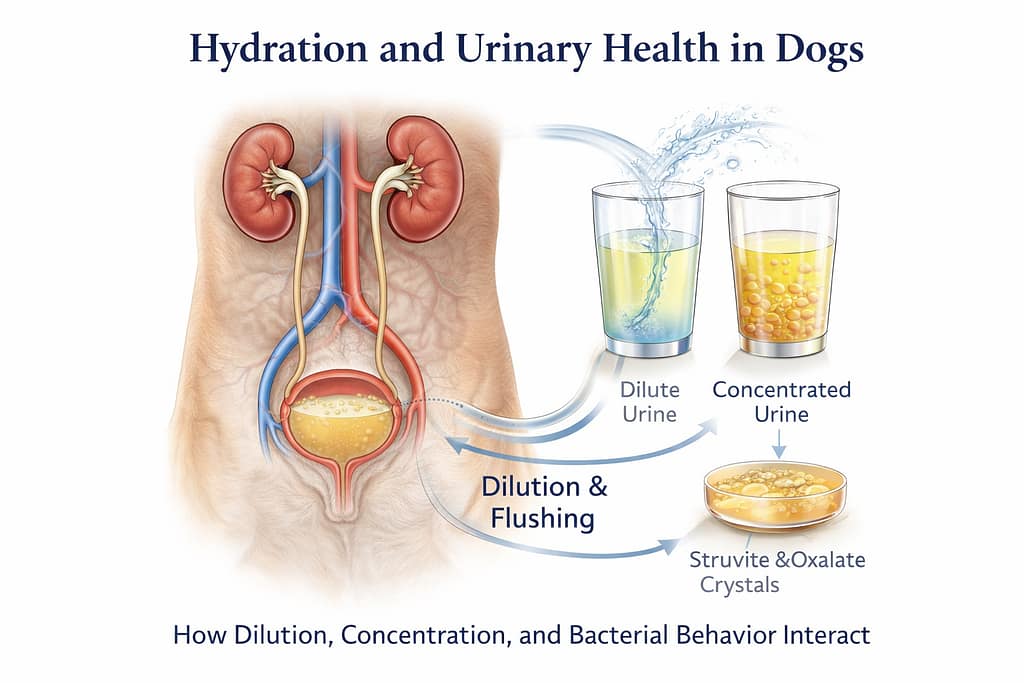
Urine pH can influence the formation of certain bladder stones, such as struvite or calcium oxalate stones. In these cases, pH management is important — but only under veterinary supervision.
However, stone formation and bacterial UTIs are not the same process, and treating them as if they are often leads to repeat infections.
The Real Driver of Most UTIs: Bacterial Adhesion
Most canine UTIs occur when bacteria migrate into the bladder and adhere to the bladder wall.
Once attached, bacteria can:
- Multiply rapidly
- Trigger inflammation of the bladder lining
- Form protective biofilms that resist antibiotics
At this stage, altering urine pH does very little. The bacteria are no longer floating freely — they are physically attached to inflamed tissue.
👉 This is where cranberry science becomes relevant. Certain plant compounds help interfere with the microscopic mechanisms bacteria use to cling to the bladder wall.
Learn more in Cranberry Proanthocyanidins and Urinary Tract Defense in Dogs, which explains how PACs work by reducing bacterial adhesion rather than trying to “kill” bacteria outright.https://naturalranchproducts.com/cranberry-proanthocyanidins-and-urinary-tract-defense-in-dogs/
Hydration: The Overlooked Defense Mechanism
One of the most underestimated factors in urinary health is urine concentration.
Concentrated urine:
- Irritates the bladder lining
- Slows bacterial flushing
- Increases inflammation
- Encourages bacterial attachment
Dogs eating primarily dry kibble often live in a state of mild, chronic dehydration — even when water bowls are always available.
Dilute urine is one of the body’s most effective natural defenses against infection.
Inflammation Changes the Bladder Environment
Inflammation fundamentally alters the bladder wall:
- The protective mucosal lining weakens
- Tissue becomes more permeable
- Bacteria gain easier attachment points
This creates a vicious cycle:
Inflammation → adhesion → infection → more inflammation
Antibiotics may clear active bacteria, but they do not repair the bladder lining or reduce susceptibility to future infections.
👉 Chronic inflammation often shows up as behavior changes before obvious urinary symptoms appear. Increased licking, restlessness, accidents, or anxiety can all be early warning signs.
This connection is explored further in How Inflammation and Physical Discomfort Affect Dog Behavior, which explains why behavioral shifts are often the first clue something is wrong.https://naturalranchproducts.com/how-inflammation-and-physical-discomfort-affect-dog-behavior/
Why Chasing pH Numbers Often Fails
Lowering or raising urine pH without addressing hydration, inflammation, and bacterial adhesion rarely works long-term.
In many cases:
- pH shifts because infection is present
- The infection is blamed on the pH
- The real cause is missed
Supporting the bladder environment is far more effective than forcing chemical changes.
A Smarter, Science-Backed Prevention Framework
Long-term urinary support focuses on four pillars:
- Hydration: Maintain dilute urine to flush bacteria
- Anti-adhesion strategies: Reduce bacterial attachment
- Inflammation support: Protect the bladder lining
- Early detection: Recognize subtle changes quickly
When these factors are addressed, urine pH often stabilizes naturally — without chasing numbers.
FAQ: Urine pH and Dog UTIs
Is urine pH the main cause of UTIs in dogs?
No. While urine pH can influence crystal formation, most canine urinary tract infections are caused by bacteria adhering to the bladder wall, not by urine acidity or alkalinity alone.
Should I try to change my dog’s urine pH to prevent UTIs?
Only under veterinary guidance. Adjusting pH without addressing hydration, inflammation, and bacterial adhesion often fails to prevent recurrence.
Why do UTIs keep coming back even after antibiotics?
Antibiotics may clear active bacteria, but they do not repair bladder inflammation or prevent bacteria from reattaching to the bladder wall.
The Ranch Science Takeaway
Urine pH is a signal, not the source.
True urinary health is built by supporting hydration, reducing inflammation, and disrupting bacterial adhesion — not by chasing test-strip numbers.
When you stop treating symptoms and start supporting biology, the cycle of recurring UTIs finally breaks.
Natural Ranch Products Team — Pet Wellness Advocates focused on evidence-based, ingredient-first nutrition for dogs and horses.
Educational content only. Always consult your veterinarian for diagnosis and treatment.