The Multivitamin Myth: Why Synthetic Nutrients Aren’t “Real” Food
Walk into any pet store and the supplement section offers dozens of dog multivitamins — all of them listing impressive arrays of vitamins and minerals on the label. Most of those products rely heavily on synthetic vitamin isolates — laboratory-produced versions of nutrients that look similar to natural forms on paper but behave differently in your dog’s body.
Understanding the difference between synthetic nutrients and naturally derived ones helps you evaluate any supplement more critically — and explains why two products listing identical ingredients can produce dramatically different outcomes.
What Are Synthetic Vitamins — And How Are They Made?
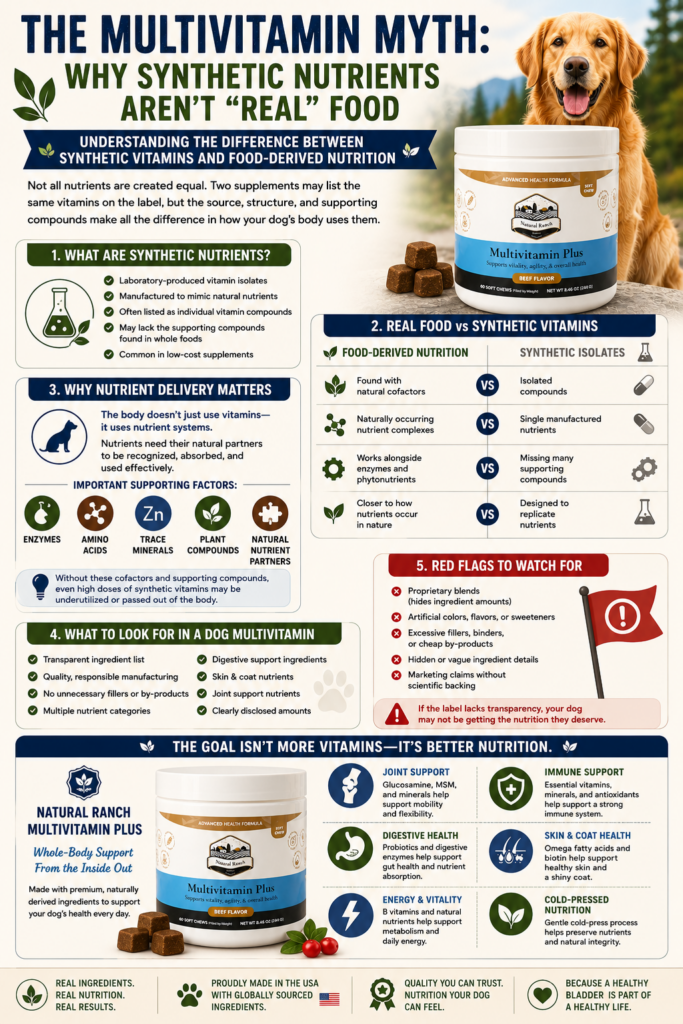
Synthetic vitamins are produced artificially in laboratory settings, replicating the chemical structure of naturally occurring nutrients. Most commercially available vitamin supplements rely heavily on synthetic vitamins. They are made by chemical processes in laboratories — often from petroleum-derived precursors or coal tar derivatives — and mimic the molecular structure of natural vitamins.
Synthetic vitamins are cheaper to produce at scale than naturally derived alternatives. They can be standardized to precise concentrations. And they can accurately be listed on a supplement label at stated amounts. These are genuine advantages from a manufacturing perspective.
The limitation is what they lack: the cofactors, enzymes, and phytonutrients that accompany vitamins in whole food sources and that influence how the body absorbs, transports, and utilizes them.
Why Cofactors Change Everything
In nature vitamins don’t exist in isolation. They are embedded in complex food matrices alongside cofactors — complementary compounds that support their absorption, activate their biological functions, and facilitate their transport across cell membranes.
Vitamin C in whole food sources isn’t just ascorbic acid — it’s accompanied by flavonoids like rutin and hesperidin that enhance its cellular uptake and antioxidant effect. Stripped of these companions in synthetic form, ascorbic acid behaves differently at the cellular level.
Natural vitamin E exists as a family of eight compounds — tocopherols and tocotrienols — working synergistically. Most synthetic multivitamins contain only dl-alpha-tocopherol, a single synthetic form. Some research suggests high doses of this synthetic form may actually interfere with the absorption of the natural tocopherol family members that work alongside it in biological systems.
Whole foods deliver nutrients in complex matrices alongside enzymes, minerals, cofactors, and phytonutrients that aid absorption and enhance bioavailability. Isolated synthetic nutrients lack this natural synergy — which is why supplements made with synthetic nutrients often contain extremely high doses to compensate for the poor absorption of the ingredients.
Natural vs Synthetic Vitamin Forms — The Specific Distinctions
Vitamin E — D-Alpha vs DL-Alpha
Natural Vitamin E is labeled d-alpha-tocopherol. Synthetic Vitamin E is labeled dl-alpha-tocopherol — the “dl” prefix indicating a racemic mixture of the d-form (bioactive) and l-form (less bioactive or inactive). Natural d-alpha-tocopherol is more bioavailable than its synthetic dl-alpha counterpart at equivalent doses. For fat-soluble vitamins like Vitamin E that accumulate in tissue, the form used in a supplement affects both efficacy and the dose calculation for safety.
B Vitamins — Active vs Inactive Forms
B12 as methylcobalamin (the active, naturally occurring form) is significantly more bioavailable than cyanocobalamin (the cheaper synthetic form that requires additional metabolic conversion steps before becoming active). Folate as methylfolate is more readily utilized than folic acid — the synthetic form that requires enzymatic conversion that some individuals cannot perform efficiently.
For dogs these distinctions matter particularly for B12 — methylcobalamin is the form that participates directly in cellular energy metabolism and neurological function without the conversion step required by cyanocobalamin.
Minerals — Chelated vs Oxide Forms
Mineral forms vary even more dramatically in bioavailability than vitamin forms. Zinc bisglycinate — a chelated form where zinc is bound to the amino acid glycine — absorbs significantly more efficiently than zinc oxide, the cheap form used in most mass-market supplements. The same principle applies across minerals: chelated or organic mineral forms consistently outperform oxide and inorganic salt forms in absorption studies.
A supplement can list zinc at an impressive milligram amount while using zinc oxide — delivering a fraction of that stated amount to the dog’s body compared to the same milligram amount from a chelated source.
The Whole-Food Nutrition Principle
The limitation of isolated synthetic nutrients isn’t just about cofactors — it’s about the biological principle that whole food nutrition operates as a system rather than a collection of individual compounds. Natural vitamins are typically bound to cofactors which increase the bioavailability and absorption of nutrients and facilitate their transport across cell membranes.
This is why whole-food-derived vitamin sources — where nutrients are extracted from actual plant or animal sources rather than synthesized chemically — tend to produce better absorption outcomes than equivalent synthetic doses. The complexity of whole-food nutrition isn’t inefficiency — it’s the biological architecture that the digestive and absorption systems evolved to work with.
For dogs on heavily processed commercial diets that have been heat-treated to eliminate naturally occurring food enzymes and cofactors, supplemental sources that preserve this complexity provide meaningfully more bioavailable nutrition than synthetic isolates at equivalent label doses.
Why This Matters for Dog Supplements Specifically
The distinction between synthetic and naturally derived nutrients is compounded in dog supplements by the manufacturing process. Most supplement chews are manufactured using high-heat steam extrusion — a process that further degrades heat-sensitive natural nutrients during production. The combination of synthetic starting materials and high-heat manufacturing produces a supplement that may accurately list every ingredient at stated amounts while delivering minimal biological benefit compared to what the label suggests.
Cold-pressed manufacturing preserves naturally derived nutrients in their biologically active forms. When a supplement uses naturally derived vitamin E (d-alpha-tocopherol), active B vitamin forms (methylcobalamin, methylfolate), chelated mineral forms (zinc bisglycinate), and is manufactured cold-pressed throughout — what’s on the label reflects what arrives in the dog’s body in a form it can actually use.
For the full science on how manufacturing temperature affects nutrient bioavailability: Why Cold-Processed Pet Supplements Preserve Nutrients Better
For the full science on bioavailability and why two identical-label supplements can produce different outcomes: The Science of Bioavailability: Why Your Dog’s Supplements Might Not Be Working
What to Look For in a Naturally Derived Dog Multivitamin
- Active B vitamin forms — methylcobalamin (B12) rather than cyanocobalamin, methylfolate rather than folic acid where disclosed
- Natural Vitamin E — d-alpha-tocopherol rather than dl-alpha-tocopherol
- Chelated minerals — zinc bisglycinate rather than zinc oxide, organic selenium rather than sodium selenite
- Vitamin D3 not D2 — D3 (cholecalciferol) is the more bioavailable animal-derived form versus D2 (ergocalciferol) which is plant-derived and requires additional conversion steps
- Whole food or fermentation-derived sources where disclosed — nutrients extracted from real food sources alongside their natural cofactors
- Cold-pressed manufacturing — preserving the biological activity of heat-sensitive compounds through the production process
- Quality carrier oil — naturally derived oils rich in cofactors and antioxidants rather than cheap synthetic carrier oils that add no nutritional value
The Natural Ranch Daily Multivitamin is formulated around these standards — active vitamin forms, chelated minerals, cold-pressed Canine Royal Oil™ from cranberry seed providing natural cofactors and a balanced omega profile, and cold-pressed manufacturing throughout to preserve biological activity from production to bowl.
→ See the Natural Ranch Daily Multivitamin
For the complete guide to evaluating any dog multivitamin on the market: Best Dog Multivitamin: What to Actually Look For
Are synthetic vitamins bad for dogs?
Synthetic vitamins are not inherently dangerous for dogs at appropriate doses — they can deliver the biological functions of their natural equivalents. The limitation is bioavailability: synthetic vitamin forms often lack the cofactors that accompany nutrients in whole food sources and that influence absorption and cellular utilization. Synthetic forms are also frequently cheaper, lower-bioavailability forms — zinc oxide versus chelated zinc, cyanocobalamin versus methylcobalamin, dl-alpha-tocopherol versus d-alpha-tocopherol. The gap between what’s listed on the label and what the dog’s body actually absorbs and uses tends to be larger with synthetic-heavy formulas than with naturally derived alternatives.
What is the difference between natural and synthetic vitamins for dogs?
Natural vitamins are derived from whole food sources and typically retain the cofactors, enzymes, and phytonutrients that enhance their absorption and biological activity. Synthetic vitamins are produced chemically in laboratories and lack these cofactors. The distinction also applies to specific forms: natural Vitamin E is d-alpha-tocopherol while synthetic Vitamin E is dl-alpha-tocopherol. Natural B12 is methylcobalamin while synthetic B12 is often cyanocobalamin. Chelated minerals where the mineral is bound to an amino acid absorb more efficiently than inorganic mineral salts like zinc oxide.
What are cofactors in vitamins and why do they matter?
Cofactors are complementary compounds — enzymes, minerals, phytonutrients, flavonoids — that naturally accompany vitamins in whole food sources. They influence how vitamins are absorbed, transported across cell membranes, and activated for biological use. Vitamin C in whole food comes with flavonoids like rutin and hesperidin that enhance its cellular uptake. Vitamin E in nature exists as a family of eight tocopherols and tocotrienols that work synergistically. Isolated synthetic vitamins lack these cofactors, which is why supplements made with synthetic nutrients often require higher doses to compensate for lower bioavailability.
Is methylcobalamin better than cyanocobalamin for dogs?
Yes — methylcobalamin is the active form of B12 that participates directly in cellular energy metabolism and neurological function. Cyanocobalamin is a synthetic form that requires enzymatic conversion to methylcobalamin before becoming biologically active — a conversion step that adds metabolic burden and reduces effective delivery. For dogs with elevated B12 needs — senior dogs with reduced stomach acid for B12 release, dogs with digestive conditions, or breeds with genetic B12 absorption challenges — the active methylcobalamin form provides more reliable bioavailability.
Why do some dog supplements list high vitamin amounts but produce few visible results?
The most common reasons are synthetic vitamin forms with lower bioavailability than their natural equivalents, inorganic mineral forms like zinc oxide that absorb poorly compared to chelated alternatives, high-heat manufacturing that degrades heat-sensitive nutrients before the product is sealed, and the absence of natural cofactors that enhance nutrient absorption and utilization. A supplement can accurately list impressive amounts of every ingredient while delivering a fraction of that stated value biologically if the forms used are poorly absorbed and the manufacturing process degraded them further.
What carrier oil should a dog multivitamin use?
Most manufacturers use cheap corn or soybean oil as a carrier — inert fillers that add calories without contributing nutritional value. A quality carrier oil should contribute meaningful functional nutrition to every chew. Cold-pressed cranberry seed oil — providing a naturally balanced 1:1:1 ratio of Omega-3, Omega-6, and Omega-9 alongside natural tocopherols — turns the carrier into an active nutritional contribution rather than a filler. The natural tocopherols in cold-pressed cranberry seed oil also protect the oil from oxidation, providing shelf stability without synthetic preservatives.
References
National Research Council. Nutrient Requirements of Dogs and Cats. National Academies Press. 2006.
MedicineNet. “What Are Considered To Be Natural Vitamins and Nutrients?” Updated January 2023.
The Naked Pharmacy. “Vitamins: Natural or Synthetic?” March 2026.
Dr. Berg. “Natural vs. Synthetic Vitamins — Why It Matters.” April 2026.
Hand MS, et al. Small Animal Clinical Nutrition, 5th Edition. Mark Morris Institute. 2010.
VCA Animal Hospitals. “Vitamins and Minerals for Dogs.” vcahospitals.com.