Cold-Pressed Cranberry Seed Oil for Dogs: A Natural Superfood for Skin, Coat & Health
Cranberry seed oil is one of the most quietly impressive ingredients in canine nutrition — and one of the least understood. Most owners associate cranberry with urinary health alone. But the oil pressed from cranberry seeds delivers a naturally balanced omega fatty acid profile, a rare antioxidant complex, and the same Type-A proanthocyanidins that make cranberry valuable for bladder health — all in a single cold-pressed ingredient. Incorporating cold pressed cranberry seed oil for dogs can enhance their overall health.
This guide covers what cranberry seed oil actually contains, how it compares to fish oil and other common omega sources, why it supports skin and coat health specifically, and why cold-pressed extraction is the manufacturing detail that determines whether any of these benefits reach your dog at all.
Understanding the benefits of cold pressed cranberry seed oil for dogs is crucial for any pet owner looking to improve their dog’s health.
Why Choose Cold Pressed Cranberry Seed Oil for Dogs?
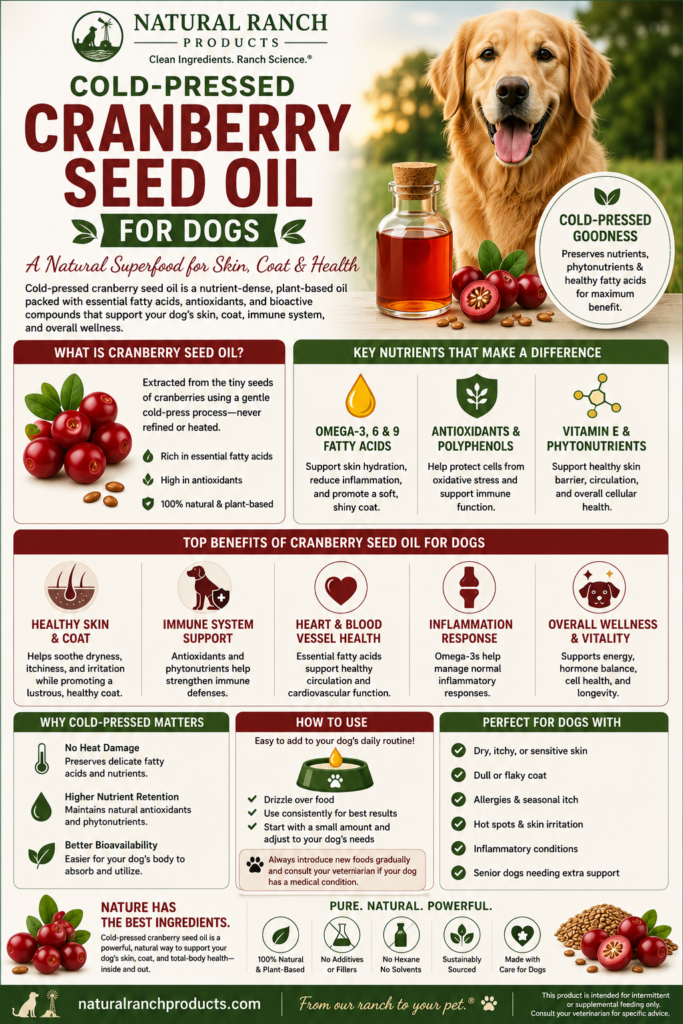
Cranberry seeds are tiny — roughly the size of a pinhead — but they are dense with nutrients that the juice and pulp of the cranberry don’t contain in meaningful concentrations. Cold-pressed cranberry seed oil is extracted directly from these seeds without heat, preserving a fatty acid and antioxidant profile that is genuinely unusual among plant oils.
The oil contains a naturally balanced ratio of Omega-3, Omega-6, and Omega-9 fatty acids — close to 1:1:1 — alongside phytosterols and a particularly rich antioxidant complex including eight isomers of vitamin E (tocopherols and tocotrienols). Cold-pressed cranberry seed oil’s natural antioxidant content gives it an unusually long shelf life — up to two years without refrigeration — and the same antioxidants that protect the oil from oxidation also provide cellular antioxidant benefit to the dog consuming it.
The Omega 1:1:1 Ratio — Why Balance Matters More Than Quantity
Most omega-3 conversations focus on quantity — how much EPA and DHA is in the supplement. But the skin barrier’s lipid matrix is built from a balance of fatty acids, not just omega-3 alone. There is a competitive relationship between the omega-6 and omega-3 pathways for the enzymes needed to convert dietary fats into the longer-chain forms the body actually uses — which means a balanced dietary ratio matters for ensuring both pathways function properly.
Cranberry seed oil’s naturally occurring 1:1:1 Omega-3, Omega-6, and Omega-9 ratio reflects this balance directly from a single source — rather than requiring a dog owner to combine multiple oils to approximate the ratio. Omega-6 fatty acids like linoleic acid are essential for skin cell membrane structure and are themselves required for healthy skin and coat — they are not the “bad” omega that needs to be minimized, but rather one part of a balance that most commercial diets already skew too heavily toward without the omega-3 and omega-9 to balance it.
Omega-9 oleic acid — while technically non-essential because the body can produce some on its own — offers real benefits for skin health and is a monounsaturated fat that supports the skin barrier alongside its polyunsaturated omega-3 and omega-6 counterparts. Cranberry seed oil provides all three in their natural balance.
For the full guide to omega-3 sources and why source matters: Omega-3 for Dogs: Why the Source Matters
How Cranberry Seed Oil Supports Skin and Coat Health
The skin barrier’s lipid matrix — the structure that holds skin cells together and prevents moisture loss while blocking allergen penetration — is built directly from dietary fatty acids. Omega fatty acids help dogs with dry, itchy skin and dull coats by providing the structural building blocks this matrix depends on.
Cranberry seed oil contributes to this in several specific ways. Its balanced omega profile supports lipid matrix production across all three fatty acid types rather than just one. Its phytosterol content has direct benefits for irritated, itchy, or scaly skin conditions — cranberry seed oil can aid in relief of conditions like eczema and the canine equivalents of chronically irritated skin. And its dense tocopherol complex provides antioxidant protection at the cellular level — protecting skin cell membranes from the oxidative stress that accelerates barrier breakdown.
For dogs with seasonal allergies or recurring skin irritation, a balanced omega source addressing the complete fatty acid picture — rather than omega-3 supplementation alone — supports the skin barrier’s ability to maintain itself and recover between flare-ups.
For the complete science on the skin barrier and what supports it: Why the Canine Skin Barrier Matters More Than Most Dog Owners Realize
Cranberry Seed Oil vs Fish Oil — Two Different Strengths
Fish oil provides anti-inflammatory omega-3s — EPA and DHA — that support skin, joint, heart, kidney, and brain health, and it has the strongest direct research base for these long-chain omega-3 effects. But fish oil is heavily weighted toward omega-3 without the omega-6 and omega-9 balance that lipid matrix production also requires, it oxidizes quickly after opening, and it carries heavy metal accumulation risk from marine sources without third-party testing.
Cranberry seed oil isn’t a replacement for EPA and DHA when those specific long-chain omega-3s are the goal — but as a daily carrier and foundational fatty acid source, it offers things fish oil doesn’t: a naturally balanced 1:1:1 omega ratio from a single source, natural tocopherol antioxidants that give it stability without refrigeration for up to two years, no heavy metal accumulation risk as a plant-based source, and — uniquely among omega oils — the Type-A proanthocyanidins that support urinary health alongside the fatty acid benefits.
For the full comparison: Cranberry Seed Oil vs Fish Oil for Dogs: What’s the Difference?
The Urinary Health Connection — PACs From the Same Seed
Cranberry seed oil’s value isn’t limited to its fatty acid profile. The same cold-pressed extraction that preserves the omega balance also preserves Type-A proanthocyanidins (PACs) — the polyphenols responsible for cranberry’s well-documented anti-adhesion effect in the urinary tract. When cold-pressed correctly, a single cranberry seed oil ingredient delivers both the omega fatty acid benefits for skin and the PAC benefits for bladder health — addressing two systems from one source.
This dual contribution is part of why Natural Ranch Products uses cold-pressed cranberry seed oil — branded as Canine Royal Oil™ — as the carrier in both Bladder Guard Soft Chews and the Daily Multivitamin. The carrier isn’t an inert filler. It’s an active nutritional contribution to both formulas.
For the full science on Type-A PACs and the Teflon Bladder mechanism: Type-A Proanthocyanidins and the Teflon Bladder: The Molecular Science of Urinary Health
Why Cold-Pressed Extraction Is Non-Negotiable
Every benefit described above depends on one manufacturing detail: cold-pressed extraction. Cranberry seed oil’s Type-A PACs and its tocopherol antioxidants are heat-sensitive compounds whose molecular structure determines their function. High-heat extraction — the standard method for most commercial oil production — denatures PACs, eliminating their anti-adhesion activity, and degrades tocopherols, reducing both the oil’s natural shelf stability and its antioxidant contribution.
A cranberry seed oil that wasn’t cold-pressed may list the same fatty acid percentages on a label — fatty acid content itself is relatively heat-stable — but the PACs and the antioxidant complex that make cranberry seed oil distinctive rather than just another omega oil are the components most affected by processing temperature. This is why manufacturing method matters as much as ingredient sourcing.
For the full science on cold-pressed manufacturing: Why Cold-Processed Pet Supplements Preserve Nutrients Better
Canine Royal Oil™ in Natural Ranch Products
Canine Royal Oil™ is Natural Ranch Products’ cold-pressed cranberry seed oil — used as the carrier in both Bladder Guard Soft Chews and the Daily Multivitamin. In Bladder Guard it contributes Type-A PAC anti-adhesion activity alongside the formula’s D-Mannose, marshmallow root, NAG, pumpkin seed, and probiotics. In the Daily Multivitamin it contributes the balanced 1:1:1 omega profile and tocopherol antioxidants alongside the formula’s B-Complex, chelated minerals, digestive enzymes, and probiotics.
Both formulas are cold-pressed throughout — preserving not just the Canine Royal Oil’s PACs and antioxidants, but every heat-sensitive active ingredient in the formula.
→ See Bladder Guard Soft Chews
→ See the Natural Ranch Daily Multivitamin
For dogs where skin and coat is the primary focus: → See the Skin and Coat Defense Duo
What does cranberry seed oil do for dogs?
Cranberry seed oil provides a naturally balanced 1:1:1 ratio of Omega-3, Omega-6, and Omega-9 fatty acids that support skin barrier lipid production and coat health, a dense antioxidant complex including eight isomers of vitamin E that protects cells from oxidative stress, and — when cold-pressed — Type-A proanthocyanidins that support urinary health through bacterial anti-adhesion. It is one of the few single ingredients that addresses skin, coat, and urinary health simultaneously.
Is cranberry seed oil better than fish oil for dogs?
They serve different purposes. Fish oil provides concentrated EPA and DHA — long-chain omega-3s with the strongest direct research base for anti-inflammatory effects. Cranberry seed oil provides a naturally balanced 1:1:1 omega-3, 6, and 9 ratio from a single plant source, natural antioxidant stability without refrigeration, no heavy metal risk, and Type-A PACs for urinary health. For dogs needing concentrated EPA/DHA for a specific condition, fish oil may be preferred. As a daily foundational fatty acid source and supplement carrier, cranberry seed oil offers a broader functional profile.
Why is cold-pressed cranberry seed oil better than regular cranberry seed oil?
Cold-pressed extraction preserves the heat-sensitive compounds that make cranberry seed oil distinctive — Type-A proanthocyanidins and the tocopherol antioxidant complex. High-heat extraction denatures PACs, eliminating their anti-adhesion activity for urinary health, and degrades tocopherols, reducing both the oil’s natural shelf stability and its antioxidant benefit. A cranberry seed oil that wasn’t cold-pressed may have similar fatty acid percentages on the label but lacks the components that distinguish cranberry seed oil from generic omega oils.
How does cranberry seed oil help with dog skin allergies?
Cranberry seed oil’s balanced omega profile supports the skin barrier’s lipid matrix — the structure that holds skin cells together and limits allergen penetration. Its phytosterol content has documented benefits for irritated, itchy, or scaly skin. Its tocopherol antioxidants protect skin cell membranes from oxidative stress that accelerates barrier breakdown during allergic flare-ups. For dogs with seasonal allergies, a balanced fatty acid foundation supports the barrier’s ability to recover between episodes rather than addressing just one omega type.
Does cranberry seed oil need to be refrigerated?
No — cold-pressed cranberry seed oil’s naturally high tocopherol (vitamin E) content gives it unusual oxidative stability, with a shelf life of up to two years without refrigeration. This is a meaningful advantage over fish oil, which oxidizes rapidly after opening and requires refrigeration to maintain its anti-inflammatory benefit. The same antioxidants that stabilize the oil also provide cellular antioxidant benefit to the dog consuming it.
What is Canine Royal Oil?
Canine Royal Oil™ is Natural Ranch Products’ proprietary cold-pressed cranberry seed oil, used as the active carrier in both Bladder Guard Soft Chews and the Daily Multivitamin. It contributes a balanced 1:1:1 Omega-3, 6, 9 ratio and tocopherol antioxidants for skin and cellular health, plus Type-A proanthocyanidins for urinary anti-adhesion support — making the carrier oil a functional ingredient rather than an inert filler in both formulas.
References
Smiling Blue Skies Editorial. “Omega Fatty Acids and How They Boost Pet Health.” 2025.
Richards TL, et al. “Effects of dietary camelina, flaxseed, and canola oil supplementation on inflammatory and oxidative markers, transepidermal water loss, and coat quality in healthy adult dogs.” Frontiers in Veterinary Science. 2023.
Chewy Editorial. “Omega Fatty Acids for Dogs: What They Are, Benefits, and More.” April 2025.
Howell AB, et al. “A-type cranberry proanthocyanidins and uropathogenic bacterial anti-adhesion activity.” Phytochemistry. 2005.
PetMD Editorial. “Fish Oil for Dogs: Benefits, Dosage, and Vet Pick.” Updated June 2025.
VCA Animal Hospitals. “The Importance of Your Pet’s Skin and Coat and the Role of Diet.” vcahospitals.com.