
Why Antibiotics Sometimes Fail in Recurring Dog UTIs
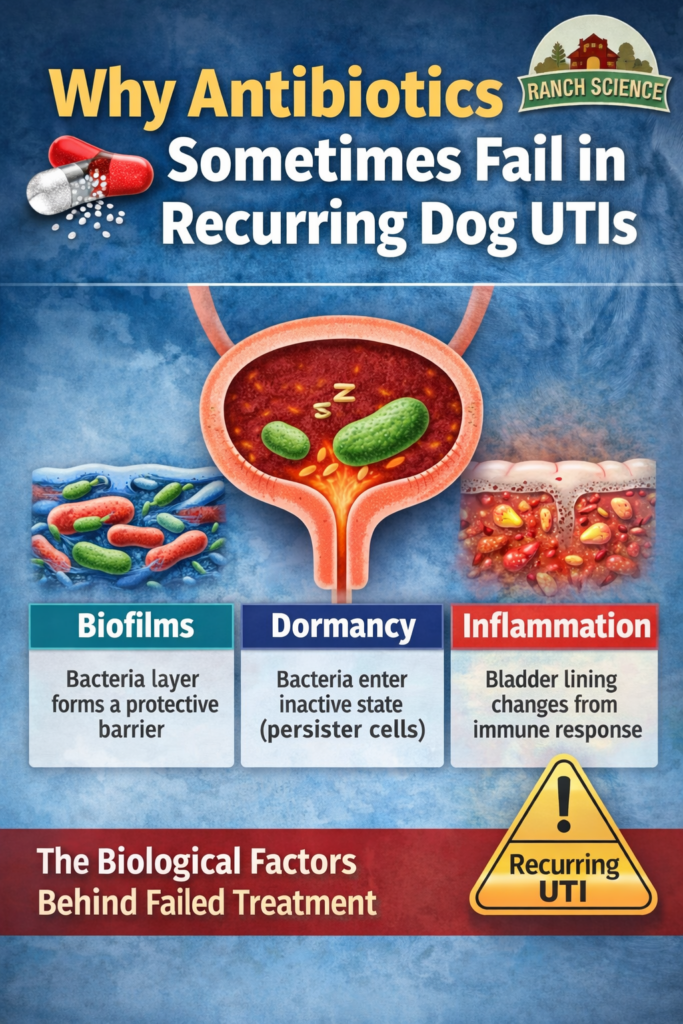
When a dog develops a urinary tract infection, antibiotics are usually the first line of treatment. In many cases they work well, clearing the infection and restoring normal bladder function.
But in some dogs, urinary infections return weeks or months later.
Veterinarians often refer to these as recurrent UTIs, and the reasons behind them can be complex. While antibiotics remain an important treatment tool, several biological mechanisms inside the bladder can influence how bacteria respond to therapy.
Understanding these mechanisms helps explain why some infections appear to resolve but later return.
How Antibiotics Work Against Bacteria
Antibiotics are designed to disrupt essential bacterial processes such as:
- Cell wall formation
- Protein synthesis
- DNA replication
- Metabolic pathways
When bacteria are actively growing and dividing, these drugs can be very effective. In uncomplicated infections, the immune system and antibiotic therapy often work together to eliminate the pathogen.
However, bacterial behavior inside the bladder environment is not always straightforward.
Some bacterial populations can shift into biological states that make them less susceptible to antibiotic exposure.
Biofilms and Protective Bacterial Communities
One factor that may influence treatment response is the formation of biofilms.
A biofilm is a structured bacterial community attached to a surface and embedded within a self-produced extracellular matrix. This matrix can act as a physical and chemical barrier.
In urinary infections, certain bacteria — including strains of Escherichia coli — may attach to the bladder lining and begin forming these communities.
Research suggests that bacteria inside biofilms can behave differently from free-floating bacteria. Within the biofilm structure:
- Antibiotic penetration may be reduced
- Bacterial metabolism can slow
- Cells may enter protective states
https://naturalranchproducts.com/biofilms-in-canine-utis-why-some-infections-keep-coming-back/
These characteristics may influence how bacteria respond to antimicrobial therapy.
Studies examining urinary pathogens have found that biofilm formation can occur on bladder surfaces and urinary catheters, particularly in persistent infections.
Scientific reference:
Costerton JW et al., 1999
“Bacterial Biofilms: A Common Cause of Persistent Infections”
Science
https://www.science.org/doi/10.1126/science.284.5418.1318
Dormant Bacteria and Reduced Metabolic Activity
Another factor that may contribute to recurrence is bacterial dormancy.
Some bacteria can temporarily reduce their metabolic activity and enter a dormant or slow-growing state. In this condition, they are sometimes referred to as persister cells.
Because many antibiotics target processes associated with active growth, bacteria in these low-activity states may be less affected during treatment.
Once conditions in the bladder become favorable again, these dormant bacteria may reactivate.
Research exploring intracellular bacterial reservoirs has suggested that urinary pathogens can persist within bladder tissues even after symptoms improvehttps://naturalranchproducts.com/why-some-dog-utis-return-the-role-of-dormant-bacteria-in-the-bladder/.
Scientific reference:
Mulvey MA et al., 2001
“Establishment of a Persistent Escherichia coli Reservoir during the Acute Phase of a Bladder Infection”
Infection and Immunity
https://journals.asm.org/doi/10.1128/IAI.69.7.4572-4579.2001
The Role of Bladder Surface Changes
Inflammation can also influence the bladder environment during infection.
When bacteria attach to the bladder lining, the immune system releases signaling molecules called cytokines. These signals recruit immune cells and trigger inflammatory responses aimed at clearing pathogens.
However, inflammation can temporarily alter the surface characteristics of bladder tissue.
Changes may include:
- Increased epithelial permeability
- Disruption of protective surface layers
- Exposure of new bacterial binding sites
These structural changes can potentially influence how bacteria interact with the bladder lining during and after infection.
Scientific reference:
Hannan TJ et al., 2012
“Intracellular bacterial communities: a potential etiology for chronic urinary tract infection”
Nature Reviews Microbiology
https://www.nature.com/articles/nrmicro2768
Why Recurring UTIs Are Often Multifactorial
It is important to note that recurrent UTIs rarely have a single cause.
Instead, they often involve a combination of factors such as:
- bacterial persistence mechanisms
- host immune response
- bladder surface integrity
- urinary concentration and hydration status
This is why veterinarians may use several strategies when managing recurring infections, including diagnostic testing, culture and sensitivity analysis, and addressing underlying health factors.
The Importance of Bladder Environment
Beyond antimicrobial treatment, the overall bladder environment can influence how bacteria behave.
Factors that may affect the urinary environment include:
- hydration levels
- urine concentration
- bladder surface stability
- immune signaling responses
These variables can shape the conditions bacteria encounter inside the bladder.
Maintaining a healthy urinary environment is therefore an important part of long-term urinary health management.
Continuing Research in Canine Urinary Health
Veterinary researchers continue to study the complex interactions between bacteria and the bladder lining.
Areas of ongoing investigation include:
- biofilm development
- intracellular bacterial persistence
- immune signaling pathways
- bladder surface protective layers
As understanding improves, it may lead to more targeted approaches for managing recurring urinary infections in dogs.
For pet owners and veterinarians alike, recognizing the biological complexity behind these infections can help explain why recurrence sometimes occurs even after appropriate treatment.
In addition to microbial factors, the overall bladder environment can also influence urinary health. Hydration levels and urine concentration may affect how the bladder lining responds during infection.
For a deeper look at this relationship, see our Ranch Science article:https://naturalranchproducts.com/why-hydration-determines-whether-urinary-health-strategies-work-in-dogs/
Why do antibiotics sometimes fail in dog UTIs?
Antibiotics can be highly effective, but certain bacterial behaviors — such as biofilm formation or reduced metabolic activity — may influence how bacteria respond to treatment in some infections.
What are bacterial persister cells?
Persister cells are bacteria that temporarily enter a low-activity state. Because many antibiotics target actively growing bacteria, persister cells may survive treatment and later reactivate.
Can biofilms affect antibiotic effectiveness?
Biofilms are structured bacterial communities embedded in a protective matrix. This structure may influence how antibiotics reach bacteria within the community.
Are recurring UTIs in dogs caused only by antibiotic resistance?
Not necessarily. Recurrence may involve multiple factors, including bacterial persistence mechanisms, bladder surface changes, and host immune responses.
Written by [Natural Ranch Products Team ], Pet Wellness Advocate at Natural Ranch. Passionate about holistic dog care and high-quality nutrition.”