
Dog Urinary Health: The Complete Guide to Keeping Your Pup’s Bladder Happy
Quick Answer: Canine urinary health depends on three factors working together — a bladder lining with an intact GAG layer that resists bacterial adhesion, urine that is dilute enough to flush bacteria before they establish, and an immune environment that resists infection between antibiotic courses. Cranberry Type-A PACs and D-Mannose reduce bacterial adhesion. Adequate hydration dilutes urine. Daily probiotic support maintains the gut-immune connection that protects the urinary tract. No single supplement addresses all three layers — effective prevention requires a multi-mechanism approach.
Your dog urinary health affects their comfort, behavior, and quality of life every single day. When it’s working well you don’t notice it. When something goes wrong — straining, accidents, blood in the urine, strong smell — it becomes impossible to ignore. Understanding how to support your dog’s bladder health before problems develop, and what to do when they do, is one of the most practical things you can do as a dog owner.
This guide covers how your dog’s urinary system works, which dogs are most vulnerable to urinary problems, the early warning signs most owners miss, daily habits that genuinely reduce risk, and what a complete long-term support strategy looks like.
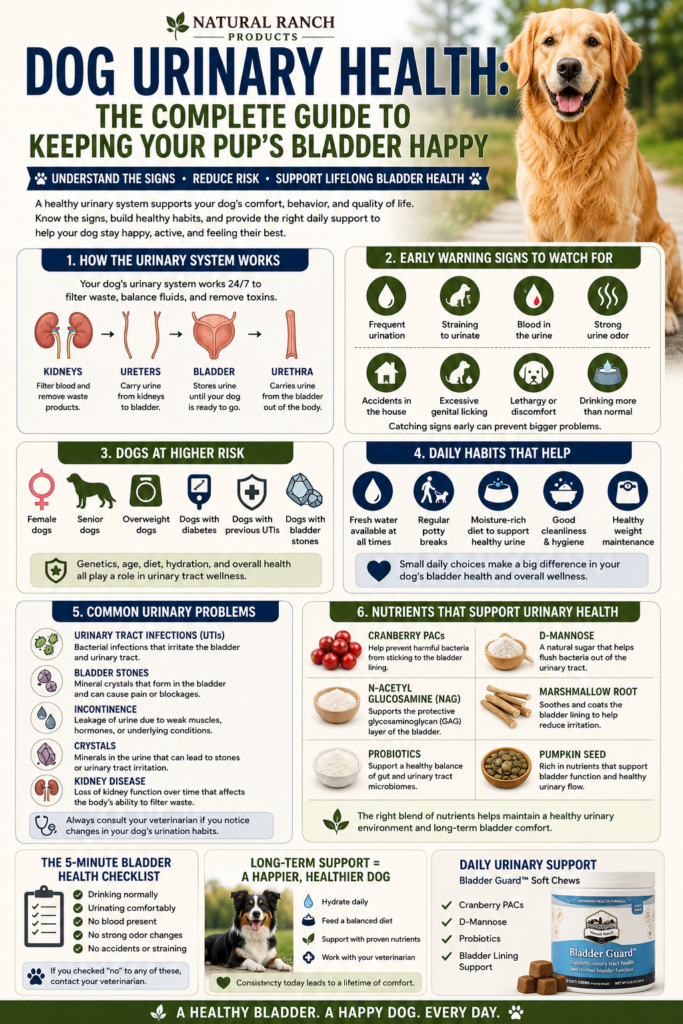
How Your Dog’s Urinary System Works
A dog’s urinary system consists of the kidneys, ureters, bladder, and urethra — each playing a specific role in filtering waste and maintaining fluid balance. The kidneys continuously filter blood, producing urine that carries dissolved waste products. Urine travels through the ureters to the bladder where it is stored until urination. The urethra carries urine from the bladder out of the body.
The bladder is more than a passive storage container. Its inner surface is lined with a specialized protective coating — the glycosaminoglycan (GAG) layer — that acts as a barrier between urine and the bladder tissue. This layer limits bacterial adhesion, buffers chemical irritation from concentrated urine, and helps maintain the structural integrity of the bladder wall. When this layer is intact the urinary environment is resilient. When it is compromised through repeated infections, chronic inflammation, or inadequate hydration, vulnerability to UTIs and recurring problems increases significantly.
Urinary tract infections occur when bacteria — most commonly E. coli from the surrounding environment — travel up the urethra and establish in the bladder. UTIs are common in dogs, affecting approximately 14% of all dogs at some point in their lives. Female dogs are significantly more susceptible than males due to their shorter, wider urethra giving bacteria a shorter path to the bladder.
Which Dogs Are Most Vulnerable to Urinary Problems
While any dog can develop a UTI, certain factors significantly increase risk:
- Female dogs — shorter urethra and proximity of the vulva to the anal area gives bacteria easier access to the bladder and more constant fecal bacterial exposure at the urethral opening.
- Senior dogs — immune function declines with age, sphincter muscle tone weakens, and hormonal changes in spayed females reduce urethral resistance. Dogs aged 7 and above face compounding risk factors that make daily urinary support increasingly important.
- Dogs with underlying health conditions — diabetes, Cushing’s disease, and kidney disease all alter the urinary environment in ways that increase bacterial susceptibility. Diabetic dogs have glucose in their urine that provides a bacterial substrate, making recurring UTIs a common complication.
- Dogs on long-term steroids or immunosuppressive medications — these reduce the immune response that normally controls bacterial populations in the urinary tract.
- Dogs with anatomical factors — recessed or hooded vulva, urethral abnormalities, or bladder stones that create surfaces where bacteria can persist between antibiotic courses.
- Dogs on exclusively dry kibble diets — chronically low moisture intake produces concentrated urine that creates a more favorable bacterial environment and reduces natural flushing frequency.
Early Warning Signs of Dog Urinary Problems
Dogs are stoic animals — they often hide discomfort until it becomes significant. By the time obvious symptoms appear the infection is usually well established. These early signals are worth watching for before the obvious signs develop:
- More frequent trips outside with smaller urine output — the inflamed bladder signals urgency before it’s actually full
- Hesitating or squatting longer than usual during urination
- Licking at the genital area more frequently than normal
- Urine that smells noticeably stronger or different than usual
- Cloudier urine than normal
- Mild behavioral changes — restlessness, reluctance to settle, slight irritability
- Accidents in a previously house-trained dog without an obvious trigger
The more obvious signs that warrant same-day veterinary contact include blood in the urine, straining without producing urine, fever or lethargy alongside urinary symptoms, and vomiting alongside urinary symptoms which suggests potential kidney involvement.
For the full guide on recognizing early recurrence signals: Signs Your Dog’s UTI Is Coming Back (And What to Do Before It Gets Worse)
Hydration — The Single Most Important Daily Habit
The more fluid your dog consumes the more urine they produce — and increased urine volume helps flush out toxins and bacteria from the bladder and urethra, reducing the risk of infections. Dogs that do not drink enough water are more prone to UTIs, crystals, and stones as concentrated urine irritates the bladder and allows bacteria and minerals to build up.
Most dogs on exclusively dry kibble diets are chronically under-hydrated — kibble contains approximately 10% moisture versus 75% in wet food. Practical strategies that meaningfully increase daily water intake include adding warm water or low-sodium broth to every meal, using a pet water fountain (many dogs drink significantly more from moving water), placing multiple water bowls in accessible locations throughout the house, and adding a portion of wet food to dry kibble meals.
Consistent hydration is the foundation that makes every other prevention strategy more effective. Supplements, dietary changes, and hygiene practices all work better in a dog that maintains adequately dilute urine.
For the full science on why hydration is the foundation of urinary health strategies: Why Hydration Determines Whether Urinary Health Strategies Work in Dogs
Daily Habits That Reduce UTI Risk
Regular bathroom breaks. Dogs who hold urine for extended periods allow bacteria that entered the bladder to remain in contact with the bladder wall rather than being flushed out during urination. Frequent opportunities to urinate prevent bacteria from settling. Most dogs benefit from bathroom breaks every 4-6 hours during waking hours — senior dogs and dogs prone to UTIs benefit from even more frequent opportunities.
Hygiene maintenance. Keeping the genital area clean and trimmed reduces the bacterial load at the urethral opening. For female dogs with recessed vulvas — particularly common in overweight dogs and certain breeds — regular cleaning of skin folds near the vulva prevents the warm moist bacterial environment that drives ascending infections.
Diet quality. High-carbohydrate, grain-heavy diets promote alkaline urine that is more favorable for bacterial growth and crystal formation. Diets built around quality animal protein tend to support a more acidic urine pH less hospitable to bacterial persistence. Avoiding excessive magnesium and phosphorus reduces struvite crystal formation risk.
Weight management. Overweight female dogs face compounding UTI risk from skin folds near the vulva that trap moisture and bacteria, and from difficulty fully squatting during urination which allows incomplete bladder emptying.
For the complete daily prevention guide: Dog UTI Prevention: Daily Habits That Actually Matter
Supplement Support — What the Evidence Actually Shows
Daily supplement support addresses the specific biological mechanisms that determine whether bacteria establish in the bladder. The ingredients with the strongest evidence base for urinary health in dogs are:
Cranberry Type-A PACs — proanthocyanidins that prevent E. coli bacteria from adhering to the bladder wall. Cold-pressed cranberry PACs are the effective form — heat-processed cranberry extract or juice has degraded PAC content that produces minimal anti-adhesion activity. Cranberry PACs are prevention tools not treatment — they work best as a consistent daily supplement rather than reactively when symptoms appear.
D-Mannose — a natural sugar that gives E. coli bacteria an alternative binding target, making them more likely to be flushed out during urination rather than attaching to the bladder wall. Works alongside cranberry PACs through a complementary mechanism. Particularly effective for the E. coli-driven UTIs that account for the majority of canine cases.
Marshmallow Root and NAG — support bladder lining integrity and GAG layer maintenance. Each UTI episode degrades the GAG layer that protects the bladder wall — ongoing support with these ingredients helps maintain the tissue-level defense that bacterial anti-adhesion compounds work alongside.
Pumpkin Seed Powder — supports bladder muscle tone and urethral sphincter function. Particularly relevant for senior dogs and spayed females experiencing age-related or hormonal bladder control changes.
Probiotics — gut microbiome health directly influences systemic immune function including the immune cells lining the urinary tract. Probiotic support is especially important for dogs who have been on repeated antibiotic courses that disrupt the microbiome alongside the bacteria they target.
Bladder Guard Soft Chews from Natural Ranch Products combines all of these ingredients in a single cold-pressed daily formula — preserving the biological activity of heat-sensitive compounds like cranberry PACs and probiotics that high-heat manufacturing destroys.
→ See Bladder Guard Soft Chews
For a complete evaluation of what makes a urinary supplement worth buying: Best Dog UTI Supplement: What to Actually Look For
When to See the Vet — And What to Expect
Any dog showing active UTI symptoms warrants veterinary evaluation rather than home management. Antibiotics are required for active bacterial infections — no supplement or home remedy treats an established UTI. The veterinary diagnostic process typically includes urinalysis to check for bacteria, white blood cells, red blood cells, and crystals, and ideally urine culture and sensitivity testing to identify the specific bacteria and appropriate antibiotic.
Follow-up urinalysis 7-14 days after completing the antibiotic course confirms full clearance — without it there is no way to know whether the infection resolved or is persisting at sub-clinical levels. Dogs with three or more UTIs in twelve months warrant investigation beyond repeated treatment — including imaging to rule out bladder stones, anatomical assessment, and systemic health screening.
For a complete science-based overview of how UTIs develop, recur, and are managed: Dog Urinary Tract Health: A Complete Guide to UTIs, Prevention, and Long-Term Support
How do I keep my dog’s bladder healthy?
The most impactful daily habits for dog bladder health are consistent hydration to dilute urine and flush bacteria, regular bathroom breaks every 4-6 hours to prevent bacterial accumulation, hygiene maintenance around the genital area, quality diet with adequate animal protein supporting appropriate urine pH, and daily supplement support with cranberry PACs, D-Mannose, and probiotics addressing the biological mechanisms that determine bacterial adhesion in the bladder.
What are the signs of urinary problems in dogs?
Early signs include more frequent urination with smaller output, hesitating during urination, increased genital licking, stronger or different smelling urine, and mild behavioral changes like restlessness. More obvious signs requiring veterinary contact include blood in the urine, straining without producing urine, accidents in a house-trained dog, cloudy urine, and fever or lethargy alongside urinary symptoms. Vomiting alongside urinary symptoms suggests potential kidney involvement requiring urgent veterinary care.
Which dogs are most prone to UTIs?
Female dogs are most susceptible due to their shorter urethra giving bacteria easier bladder access. Senior dogs face compounding risk from declining immune function and weakened sphincter tone. Dogs with diabetes, Cushing’s disease, or kidney disease have altered urinary environments that increase bacterial susceptibility. Dogs with anatomical factors like recessed vulva, bladder stones, or urethral abnormalities face elevated risk. Dogs on exclusively dry kibble diets who are chronically under-hydrated produce concentrated urine that creates more favorable conditions for bacterial growth.
Does hydration really affect dog UTI risk?
Yes — hydration is the single most impactful daily variable in urinary health. More water intake means more urine volume, more frequent flushing of bacteria before they can attach to the bladder wall, and less concentrated urine that creates a less favorable bacterial environment. Dogs on exclusively dry kibble diets are often chronically under-hydrated. Adding warm water or broth to every meal, using a pet water fountain, and incorporating wet food all meaningfully increase daily moisture intake and reduce UTI frequency over time.
What supplements help with dog urinary health?
The ingredients with the strongest evidence base are cranberry Type-A PACs for bacterial anti-adhesion, D-Mannose for a complementary anti-adhesion mechanism, marshmallow root and NAG for bladder lining and GAG layer support, pumpkin seed powder for bladder muscle tone, Vitamin C for urine pH support and immune function, and probiotics for gut microbiome health that influences urinary immune defense. These work best as a complete daily formula rather than individual supplements — and cold-pressed manufacturing is essential for preserving the heat-sensitive compounds like PACs and probiotics.
When should I take my dog to the vet for urinary symptoms?
Any dog showing active UTI symptoms — straining, blood in urine, accidents, or obvious discomfort — should be evaluated by a vet rather than managed with home remedies. Active bacterial infections require antibiotic treatment that no supplement can replace. Contact your vet same-day if your dog is straining without producing urine, showing fever or lethargy alongside urinary symptoms, or vomiting alongside urinary symptoms. Dogs with three or more UTIs in twelve months need diagnostic investigation beyond repeated antibiotic courses.
References
PetMD Editorial. “UTI in Dogs: Signs, Causes, and Treatment.” Updated December 2025.
Animal Wellness Magazine. “Tips to Prevent Urinary Tract Infections in Dogs.” July 2025.
Cornell University College of Veterinary Medicine. “Urinary Tract Infections.”
Byron JK. “Urinary Tract Infection.” Veterinary Clinics of North America: Small Animal Practice. 2019.
Howell AB, et al. “A-type cranberry proanthocyanidins and uropathogenic bacterial anti-adhesion activity.” Phytochemistry. 2005.
VCA Animal Hospitals. “Urinary Tract Infections (UTIs) in Dogs.” vcahospitals.com