
Biofilms in Canine UTIs: Why Some Infections Keep Coming Back
Most discussions about canine urinary tract infections focus on bacteria — identification, antibiotics, clearance.
But in some recurring cases, bacteria are only part of the story.
After initial adhesion to the bladder lining and activation of the inflammatory response, certain bacterial populations may transition into a more organized survival strategy: biofilm formation. These structured communities can influence persistence patterns and help explain why some infections reappear despite appropriate treatment.
To understand recurrence, we have to move beyond free-floating bacteria and examine what happens on the bladder surface itself.
What Is a Biofilm?
A biofilm is a structured community of microorganisms attached to a surface and embedded within a self-produced extracellular matrix. This matrix — often referred to as extracellular polymeric substance (EPS) — consists primarily of polysaccharides, proteins, lipids, and extracellular DNA.
Inside a biofilm, bacteria behave differently than planktonic (free-floating) cells. They communicate chemically, alter gene expression, and often shift into slower metabolic states. Rather than functioning as isolated organisms, they operate as a coordinated community.
In the canine bladder, the epithelial surface provides a potential substrate for attachment — particularly if the protective barrier has already been disrupted.
How Biofilms Form in the Bladder
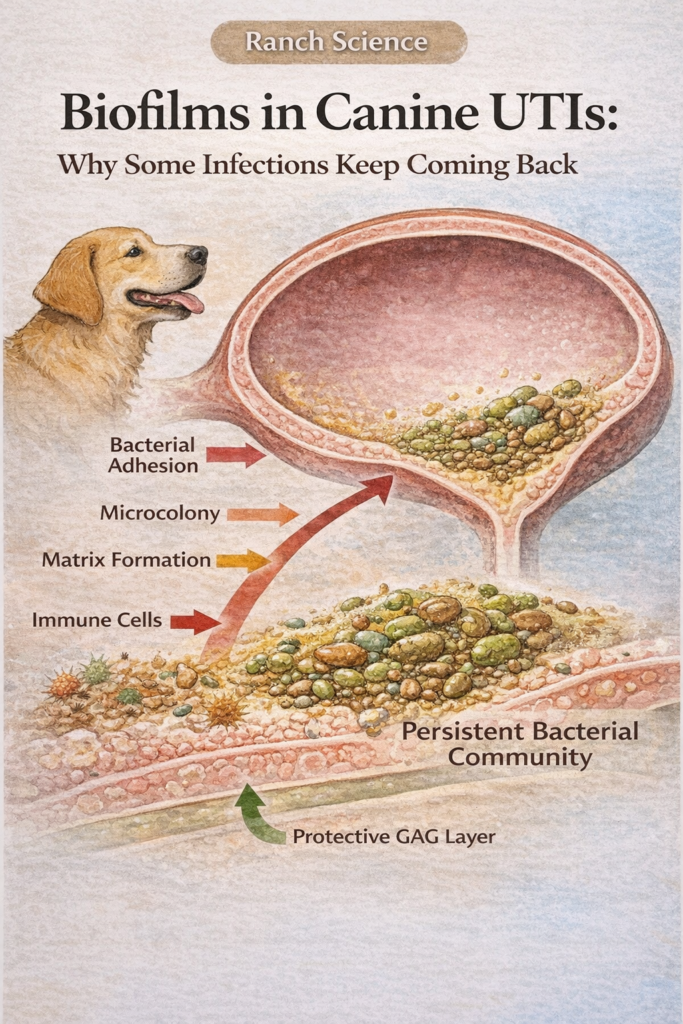
Biofilm development typically follows a predictable sequence:
1. Initial Adhesion
Bacteria attach to epithelial receptors on the bladder wall. Adhesion likelihood increases when surface integrity is compromised — especially when the protective GAG layer of the bladder is disrupted.
2. Microcolony Formation
Attached bacteria replicate and form small clusters.
3. Matrix Production
The developing community secretes extracellular polymeric substances, anchoring itself more securely to the surface.
4. Structural Maturation
The biofilm evolves into a three-dimensional architecture with channels that facilitate nutrient flow and waste exchange.
This process builds directly on earlier events such as bacterial adhesion to the bladder lining and subsequent immune activation.
(Insert internal link here to your adhesion blog.)
Biofilms are not an immediate event — they are a progression.
The Inflammatory Environment and Biofilm Risk
Inflammation is protective. When bacteria attach, the bladder initiates a coordinated immune response — as detailed in our discussion of the inflammatory cascade inside the canine bladder.
Cytokines are released. Immune cells are recruited. Vascular permeability increases.
These events help eliminate pathogens. However, prolonged inflammation can also alter epithelial tight junctions and disrupt the surface barrier.
When surface integrity declines:
- Receptor exposure increases
- Adhesion becomes easier
- Structural instability persists
Biofilm formation is more likely in environments where surface disruption has already occurred.
This is why recurrence is often not just about bacterial presence — it is about surface condition.
Why Biofilms Complicate Treatment
Biofilms do not make bacteria invulnerable. However, they can alter responsiveness.
Several mechanisms contribute:
Reduced Antimicrobial Penetration
The extracellular matrix may slow diffusion of antimicrobial agents into deeper layers of the biofilm.
Altered Metabolic States
Bacteria within biofilms often enter slower-growing or dormant phases. Many antibiotics are most effective against actively dividing cells.
Community-Based Survival
Through chemical signaling (quorum sensing), bacteria coordinate stress responses and resource allocation.
These adaptations can influence persistence patterns in certain cases of recurrent UTI.
Not every recurrence involves biofilm formation. Reinfection, anatomical factors, incomplete clearance, and systemic influences may also contribute. Biofilms represent one potential mechanism among several.
Hydration and Environmental Stability
Hydration does not “dissolve” biofilms. However, it plays a role in shaping the urinary environment.
As discussed in our examination of how hydration influences urinary health strategies, adequate fluid intake affects urine concentration and epithelial stress.
Concentrated urine increases osmotic and chemical stress on already inflamed tissue. Over time, this may influence barrier resilience.
Surface stability is multi-factorial:
- Barrier integrity
- Controlled inflammation
- Environmental dilution
- Timely intervention
The bladder is not simply a container. It is an active barrier organ.
Persistence vs. Reinfection
It is important to distinguish between:
- Reinfection (new bacterial exposure)
- Relapse (incomplete clearance)
- Persistence mechanisms such as biofilm formation
Biofilms are not present in every recurrent UTI. However, experimental and clinical literature in both human and veterinary medicine supports their potential role in chronic or relapsing urinary patterns, particularly involving uropathogenic Escherichia coli.
Oversimplifying recurrence to “stronger bacteria” misses the structural component of disease.
The Structural Perspective on Urinary Health
The progression from adhesion to inflammation to potential biofilm formation highlights a larger principle:
Urinary health is structural.
When the bladder’s protective interface remains intact:
- Adhesion opportunities decrease
- Inflammatory disruption resolves more efficiently
- Persistence mechanisms are less likely to establish
When surface integrity is chronically compromised, recurrence risk may increase.
As research continues to explore biofilm behavior in recurrent urinary patterns, one theme remains consistent: surface stability matters. Supporting bladder barrier integrity, maintaining appropriate hydration, and addressing early inflammatory disruption may influence how susceptible the urinary environment becomes over time. Chronic recurrence is rarely about bacteria alone — it is often about the surface they encounter.
Frequently Asked Questions
What is a biofilm in dogs?
A biofilm is a structured community of bacteria attached to a surface and embedded in a protective matrix. In canine urinary infections, biofilms may form along the bladder lining in certain cases of recurrence.
Can biofilms cause recurring UTIs in dogs?
Biofilms are one possible contributor to recurrence. Their structure may influence bacterial persistence in some infections.
Do antibiotics eliminate biofilms?
Antibiotics can be effective, but bacteria within biofilms may respond differently than free-floating bacteria due to protective matrix structure and altered metabolic activity.
How do biofilms form in the bladder?
Biofilms typically develop after initial bacterial adhesion, followed by clustering, matrix production, and structural maturation on the bladder surface.
References
- Flores-Mireles AL, Walker JN, Caparon M, Hultgren SJ. Urinary tract infections: epidemiology, mechanisms of infection and treatment options. Nat Rev Microbiol. 2015;13(5):269–284.
- Hannan TJ, et al. Host–pathogen checkpoints and population bottlenecks in persistent and intracellular uropathogenic E. coli bladder infection. FEMS Microbiol Rev. 2012.
- Anderson GG, et al. Intracellular bacterial biofilm-like pods in urinary tract infections. Science. 2003;301(5629):105–107.
- Jacobsen SM, et al. Complicated catheter-associated urinary tract infections due to biofilm-forming pathogens. Clin Microbiol Rev. 2008.
- Veterinary Internal Medicine literature on recurrent UTI mechanisms and persistence patterns.
Written by [Natural Ranch Products Team ], Pet Wellness Advocate at Natural Ranch. Passionate about holistic dog care and high-quality nutrition.”