The Bladder’s Protective Barrier: Understanding the GAG Layer in Dogs
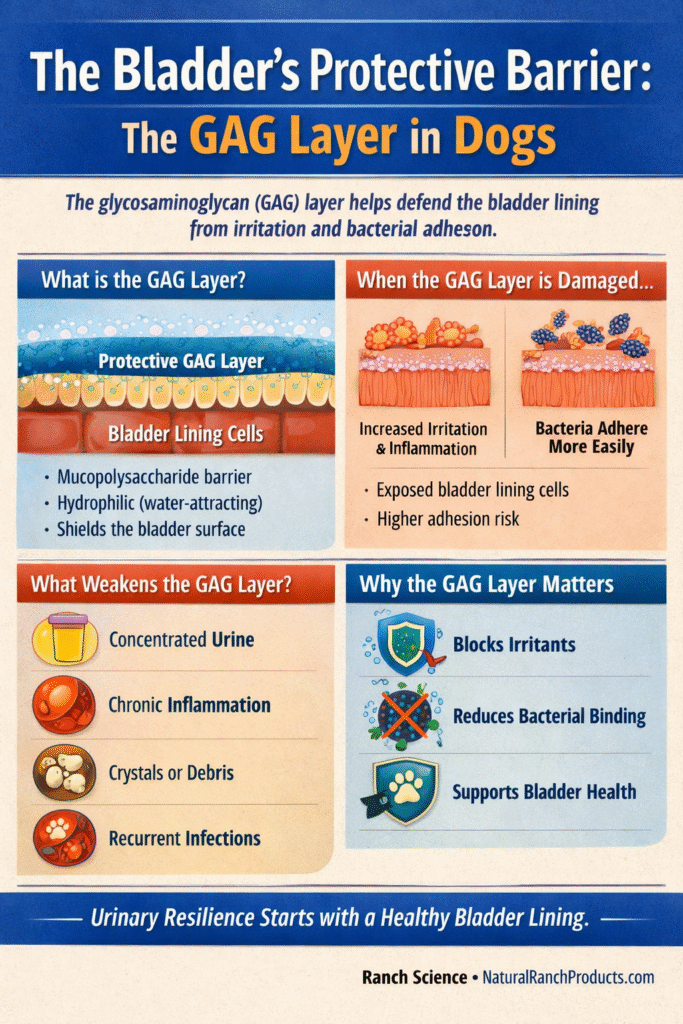
The bladder’s glycosaminoglycan (GAG) layer in dogs acts as a protective barrier against irritation and bacterial adhesion. When this lining is compromised, inflammation and recurring urinary issues become more likely.
When dogs experience recurring urinary issues, the focus often turns to bacteria, urine pH, or supplements. But none of those address the surface those bacteria must attach to in the first place.
The inside of the bladder is not a passive container. It is lined with a specialized protective coating known as the glycosaminoglycan (GAG) layer — a biochemical barrier that plays a critical role in urinary resilience. When this layer is intact, it helps defend against irritation and bacterial adhesion. When it becomes disrupted, the environment shifts in favor of inflammation and recurrence.
Understanding the GAG layer reframes urinary health from “eliminating bacteria” to preserving tissue integrity — and explains why some dogs stay stuck in the recurring UTI cycle despite appropriate treatment.
What Is the GAG Layer in Dogs?
The GAG layer refers to a mucopolysaccharide-rich coating that lines the surface of the bladder epithelium — the inner cellular lining of the bladder wall. Glycosaminoglycans are long-chain sugar molecules that form a gel-like defensive interface between the bladder’s interior environment and the underlying tissue.
This layer serves several protective functions simultaneously. It reduces direct contact between concentrated urine and bladder tissue, buffers chemical irritation from dissolved waste products, limits the availability of bacterial binding sites on epithelial cells, and helps maintain the hydration and structural integrity of the bladder surface.
Importantly this is not simply mucus. It is a structured defensive interface that contributes to bladder homeostasis — and its integrity directly influences how vulnerable the bladder is to infection and inflammation.
Why the GAG Layer Matters for Recurring Dog UTIs
The bladder is regularly exposed to urine containing dissolved waste products that, in high concentrations, can stress and irritate epithelial cells. The GAG layer is what stands between that chemical exposure and the tissue underneath.
When the GAG layer is intact it maintains a stable barrier that limits bacterial adhesion, reduces chemical irritation, and supports normal bladder function. Urine passes through and bacteria are more likely to be flushed out during urination before establishing a persistent presence.
When the GAG layer becomes compromised the picture changes significantly. Bacterial binding sites on the epithelial surface become more accessible. Chemical irritation from concentrated urine reaches tissue more directly. Inflammation becomes more likely — and inflammation itself further damages the barrier, creating a self-reinforcing cycle.
This helps explain why recurring urinary issues often follow an initial inflammatory event — the first infection creates conditions that make the second easier. Each episode can leave the GAG layer in a more degraded state than before.
As discussed in: How Bacteria Adhere to the Bladder Wall in Dogs (and Why Recurring UTIs Keep Coming Back)
What Damages the GAG Layer?
1. Concentrated Urine
When hydration is inadequate, urine becomes more concentrated. Higher solute density increases chemical irritation and osmotic stress on the bladder lining. Over time, repeated exposure to highly concentrated urine contributes to surface disruption — which is why chronic low water intake is a risk factor for urinary issues beyond just creating a favorable bacterial environment.
For a full explanation of how hydration affects the urinary environment: Why Hydration Determines Whether Urinary Health Strategies Work in Dogs
2. Recurrent Inflammation
Inflammation releases cytokines and immune mediators that can damage epithelial integrity. While inflammation is part of the immune defense response, chronic or repeated activation progressively impairs barrier function. Each UTI episode triggers an inflammatory response — and that inflammatory response contributes to GAG layer degradation, setting up the conditions for the next infection.
For the science behind what happens in the bladder after bacterial adhesion: What Happens After Bacteria Stick? The Inflammatory Cascade Inside the Canine Bladder
3. Mechanical Irritation
Bladder crystals, mineral debris, or prolonged contact time between concentrated urine and the bladder surface increases mechanical stress on the GAG layer. Dogs prone to struvite or calcium oxalate crystals face an additional source of surface irritation beyond bacterial infection — which is why crystal management and infection management often need to be addressed simultaneously.
4. Repeated Infection Cycles
Bacterial adhesion triggers immune response. Immune response triggers inflammation. Inflammation thins and disrupts the GAG layer. A disrupted GAG layer increases adhesion opportunities for the next bacterial exposure. This creates a self-reinforcing cycle that becomes harder to break with each episode:
Adhesion → Inflammation → Barrier Disruption → Increased Adhesion
Breaking that cycle requires supporting tissue recovery and barrier integrity — not just eliminating bacteria from the current episode.
The Adhesion Connection — Why Barrier Integrity Determines Infection Risk
Many urinary strategies focus on antimicrobial action — killing or suppressing bacteria directly. But adhesion is a prerequisite for persistent infection. Bacteria that can’t attach are far more likely to be cleared during normal urination before establishing a foothold.
Certain bacteria use fimbriae — hair-like surface projections — to attach to receptors on bladder epithelial cells. When the GAG layer is intact these receptors are largely covered and inaccessible, reducing the opportunity for attachment. When the GAG layer is disrupted those receptors become exposed and bacterial adhesion becomes significantly easier.
This is why compounds such as cranberry Type A proanthocyanidins (PACs) are studied for their ability to interfere with bacterial adhesion rather than kill bacteria directly — they work at the surface level, competing for binding sites and reducing adhesion regardless of bacterial species.
But their effectiveness depends in part on the condition of the underlying tissue. A severely compromised GAG layer changes the surface environment in ways that anti-adhesion compounds alone cannot fully compensate for.
For the molecular science behind anti-adhesion: Type-A Proanthocyanidins and the Teflon Bladder: The Molecular Science of Urinary Health
Can the GAG Layer Be Supported?
In both veterinary and human research, maintaining epithelial barrier integrity is considered central to urinary resilience. While no single strategy guarantees restoration, several foundational factors directly influence barrier stability.
Consistent hydration reduces urine concentration and limits chemical irritation to the bladder surface — one of the most impactful and most overlooked factors in GAG layer preservation.
N-Acetyl Glucosamine (NAG) is a precursor compound involved in the synthesis of glycosaminoglycans. Supplementing with NAG supports the body’s ability to produce and maintain the GAG layer — particularly relevant for dogs with chronic or recurring urinary issues where the layer has been progressively degraded.
Marshmallow root contains mucilage — a gel-like compound that coats and soothes the bladder lining directly. While it doesn’t rebuild the GAG layer structurally, it provides a degree of protective buffering for irritated tissue and supports the conditions needed for recovery.
Reducing inflammatory cycles by breaking the recurring infection pattern allows the GAG layer time to recover between episodes. This is why consistent daily prevention — rather than reactive treatment only — supports barrier integrity over time.
In human medicine, compounds such as hyaluronic acid and chondroitin sulfate have been investigated for bladder barrier support. Research in veterinary applications is ongoing and these approaches require veterinary oversight.
Why This Explains “The Supplements Didn’t Work”
A common frustration among dog owners is that urinary supplements seemed ineffective — they tried cranberry, D-Mannose, or other products and saw little result.
The GAG layer explanation is often the missing piece. If the GAG layer is significantly compromised, bacterial binding sites are highly exposed and the urinary environment is chronically unstable. In that context, even well-designed anti-adhesion supplements are working against a compromised surface — they can reduce adhesion at the margin but can’t fully compensate for the underlying tissue condition.
Urinary resilience depends on three things working together: consistent hydration to reduce chemical irritation, tissue support to maintain and restore the barrier layer, and targeted ingredients to influence bacterial behavior within that environment. Supplements function within that environment — they do not replace it.
For a deeper explanation of why supplements sometimes fail in inflamed bladder conditions: Why Urinary Supplements Fail When the Bladder Lining Is Inflamed in Dogs
Resilience Is Built at the Surface
Urinary health is often framed as a battle against bacteria. But the bladder is not sterile, and elimination is not the only goal. Resilience comes from maintaining a surface environment where bacteria struggle to establish — not just from clearing them when they do.
The GAG layer represents a critical component of that resilience. When tissue health is prioritized alongside microbial management — through consistent hydration, barrier-supporting ingredients, and daily prevention rather than reactive treatment — long-term stability becomes more achievable.
Understanding the GAG layer shifts the focus from reaction to prevention — from eradication to preservation. For dogs stuck in the recurring UTI cycle, that shift is often where lasting improvement begins.
For a complete daily prevention strategy built around these principles: Dog UTI Prevention: Daily Habits That Actually Matter
For a practical evaluation of supplement formulas that support the GAG layer alongside bacterial adhesion: Best Dog UTI Supplement: What to Actually Look For
What is the GAG layer in dogs?
The glycosaminoglycan (GAG) layer is a protective coating lining the inside of the bladder wall. It is made up of long-chain sugar molecules that form a gel-like barrier reducing bacterial adhesion, limiting chemical irritation from urine, and protecting the underlying bladder tissue from direct exposure.
Can a damaged bladder lining cause recurring UTIs in dogs?
Yes. A compromised GAG layer exposes more bacterial binding sites on the bladder wall, making adhesion easier and infection more likely to establish. Each UTI episode can further degrade the layer through the inflammatory response it triggers, creating a cycle where recurrence becomes progressively more likely.
Does hydration help protect the bladder lining in dogs?
Yes. Adequate hydration reduces urine concentration, which limits the chemical irritation and osmotic stress on the bladder surface that contributes to GAG layer degradation over time. Chronic low water intake is one of the most overlooked contributors to bladder lining vulnerability.
What ingredients support the GAG layer in dogs?
N-Acetyl Glucosamine (NAG) is a precursor involved in glycosaminoglycan synthesis and supports the body’s ability to maintain the GAG layer. Marshmallow root provides direct soothing support for irritated bladder lining. Consistent hydration reduces the chemical stress that degrades the layer over time.
Why did my dog’s urinary supplement not work?
If the GAG layer is significantly compromised, the urinary environment may be too unstable for anti-adhesion ingredients like cranberry PACs to fully compensate. Supplements work within the bladder environment — they don’t replace it. Supporting barrier integrity through hydration, tissue-support ingredients like NAG and marshmallow root, alongside anti-adhesion compounds produces more consistent results.
Is the GAG layer the same as the bladder lining?
The GAG layer is a specialized coating on top of the bladder’s cellular lining (urothelium). It is not the cell layer itself but a protective surface interface — sometimes described as the bladder’s first line of defense against irritation and bacterial adhesion.
Scientific References
Parsons CL. “The role of the glycosaminoglycan layer in bladder defense.” Urology.
Hanno PM. “Pathophysiology of interstitial cystitis.” Urology.
Flores-Mireles AL, et al. “Urinary tract infections: mechanisms of pathogenesis.” Nature Reviews Microbiology.
Howell AB, et al. “A-type cranberry proanthocyanidins and anti-adhesion activity.” Advances in Nutrition.
VCA Animal Hospitals. “Urinary Tract Infections (UTIs) in Dogs.” vcahospitals.com
Written by [Natural Ranch Products Team ], Pet Wellness Advocate at Natural Ranch. Passionate about holistic dog care and high-quality nutrition.”