
What Happens After Bacteria Stick? The Inflammatory Cascade Inside the Canine Bladder
When discussing urinary tract issues in dogs, most conversations stop at bacterial presence. But bacteria floating in urine are not the primary problem. Attachment is.
Once bacteria adhere to the bladder wall, a biological sequence begins that determines whether the bladder returns to stability — or enters a cycle of recurring inflammation. This sequence is known as the inflammatory cascade, and understanding it explains why recurrence happens, why timing matters, and why tissue integrity is central to long-term urinary health.
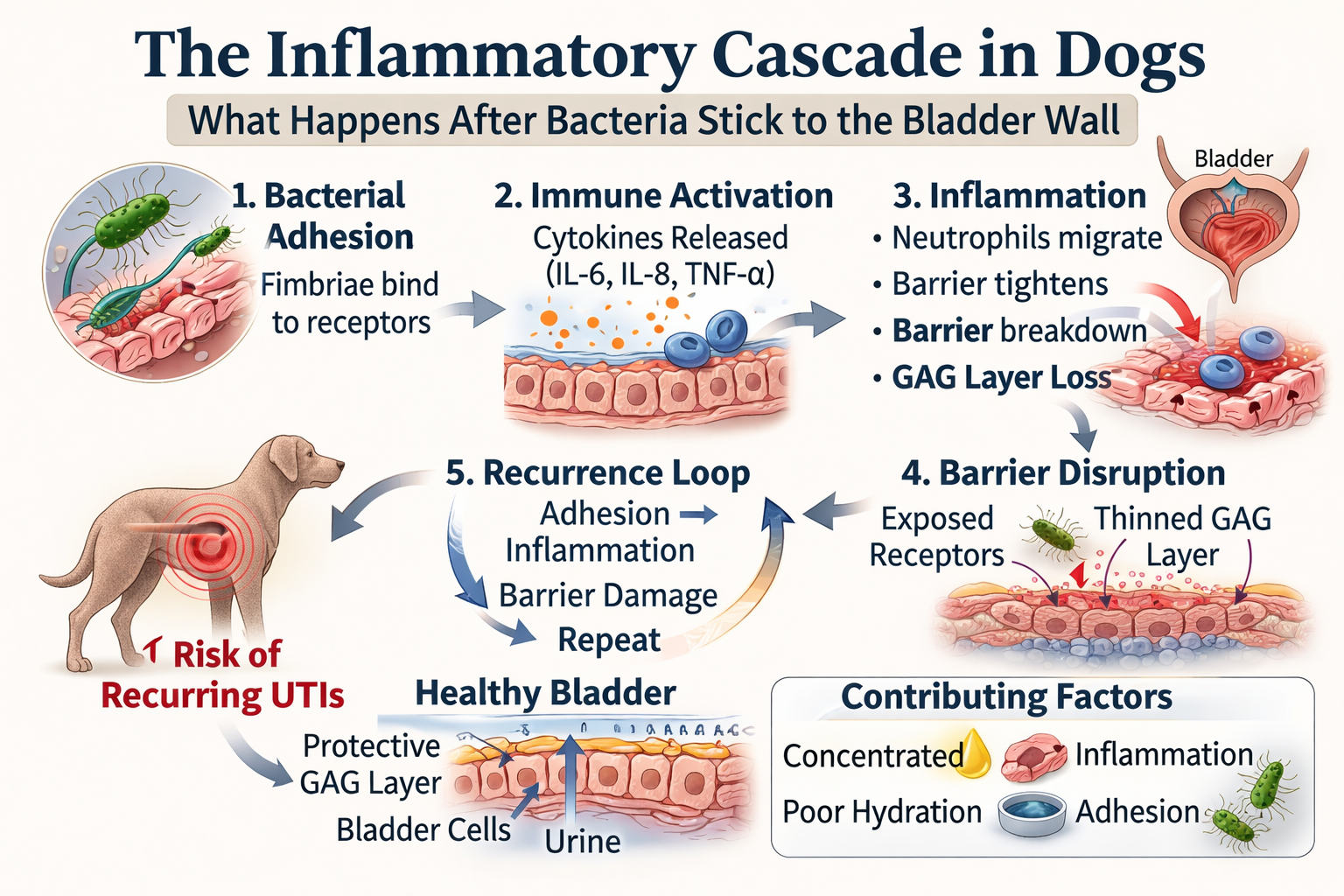
Step 1: Adhesion Triggers Immune Recognition
The bladder is lined with specialized epithelial cells called urothelial cells. These cells are not passive surfaces — they actively monitor the bladder environment and respond to threats.
When bacteria attach to the bladder surface — typically using fimbriae, hair-like projections, to bind to cellular receptors — urothelial cells detect that attachment immediately. They respond by releasing signaling molecules called cytokines, the chemical messengers of the immune system.
The most common inflammatory mediators released include Interleukin-6 (IL-6), Interleukin-8 (IL-8), and Tumor Necrosis Factor-alpha (TNF-α). These cytokines serve a clear purpose: they recruit immune cells — particularly neutrophils — to the site of infection to fight the bacterial presence.
This is protective biology. But it comes with consequences for the bladder tissue itself.
Step 2: Inflammation Increases Bladder Permeability
Inflammation alters the physical properties of the bladder lining in ways that go beyond fighting the immediate infection. As immune cells accumulate and cytokine signaling intensifies, tight junctions between epithelial cells loosen, surface permeability increases, and fluid shifts occur within the tissue.
At the same time the protective glycosaminoglycan (GAG) layer — the gel-like surface coating that acts as the bladder’s first line of defense — begins to thin and lose structural integrity under the stress of inflammatory signaling.
The GAG layer functions as a hydrophilic barrier between urine and bladder cells. When inflammatory stress increases, this barrier can be disrupted — leaving the underlying epithelial receptors more exposed, the tissue more sensitive to urine solutes, and the bladder more vulnerable to subsequent bacterial adhesion.
For the full science on the GAG layer and how it protects the bladder: The Bladder’s Protective Barrier: Understanding the GAG Layer in Dogs
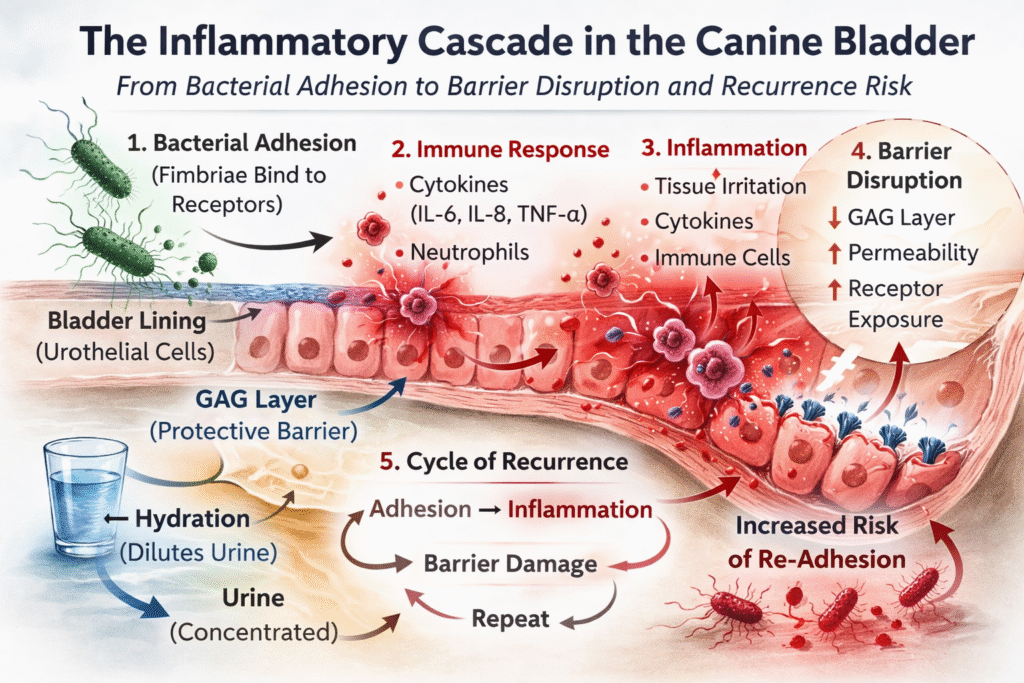
Step 3: Nerve Sensitization and Surface Irritation
Inflammatory mediators don’t only affect immune recruitment — they also influence local nerve endings in the bladder wall. As inflammatory signaling increases, sensory nerves become more reactive, urgency behaviors increase, and discomfort becomes more pronounced. This explains why dogs with active bladder inflammation show behavioral signs like frequent attempts to urinate, straining, and restlessness even when the bacterial load may be relatively low.
When the epithelial surface becomes more permeable, urine solutes — urea, salts, and metabolic waste products — gain greater access to the underlying tissue. If urine is concentrated, chemical irritation intensifies significantly. This is where hydration intersects directly with inflammation — dilute urine reduces the osmotic stress on already inflamed tissue, while concentrated urine amplifies it.
For a full explanation of how hydration affects the urinary environment during inflammation: Why Hydration Determines Whether Urinary Health Strategies Work in Dogs
Step 4: Barrier Disruption Creates Surface Vulnerability
This is the step where recurrence becomes possible — and where the inflammatory cascade becomes more than just a defense response. It becomes a modifier of future susceptibility.
When inflammation disrupts the epithelial barrier, cellular receptors become more exposed, the GAG layer becomes compromised, and surface integrity decreases. Exposed receptors create significantly more opportunities for bacterial fimbriae to bind during the next bacterial exposure — even if the current infection has been cleared.
The sequence becomes cyclical: Adhesion → Inflammation → Barrier Disruption → Increased Adhesion Opportunity. Each loop can make subsequent episodes easier to trigger. A dog who has had two UTIs has a progressively more vulnerable bladder surface than a dog who has had none — not because they are unlucky, but because the biology of each episode creates the conditions for the next.
This is the same adhesion mechanism explored in: How Bacteria Adhere to the Bladder Wall in Dogs (and Why Recurring UTIs Keep Coming Back)
Step 5: Why Recurrence Happens After Treatment
Many dog owners report that urinary issues return weeks or months after treatment. The antibiotics worked — symptoms resolved, urine culture cleared — but the infection came back. This pattern usually reflects tissue vulnerability rather than treatment failure.
If inflammation resolved incompletely after the previous episode, barrier integrity may remain weakened, surface receptors may remain more accessible, and urine concentration may still be elevated. Under those conditions, a new bacterial exposure has an easier path to reattachment — and the inflammatory cascade begins again from a starting point that’s already compromised.
Treatment addresses the bacteria present in the current episode. It doesn’t restore the tissue environment that determines how vulnerable the bladder is to the next one. That’s the gap that daily prevention strategies are designed to fill.
For a full breakdown of why antibiotics don’t always prevent recurrence: Why Antibiotics Sometimes Fail in Recurring Dog UTIs
Where Adhesion-Interference Compounds Fit In
Certain compounds — including cranberry-derived Type A proanthocyanidins (PACs) — have been studied for their ability to interfere with bacterial adhesion. PACs may reduce the ability of bacteria to bind to bladder epithelial cells by competing for the same receptor sites that bacterial fimbriae target.
However, adhesion interference works within the context of tissue condition. If inflammation is severe and barrier integrity is significantly compromised, the surface environment is already unstable — with more receptor exposure than anti-adhesion compounds alone can fully compensate for.
This doesn’t negate the mechanism — cranberry PACs remain one of the most well-studied urinary health ingredients available. But it underscores why tissue support alongside anti-adhesion strategies produces more consistent results than either approach alone.
For the molecular science behind anti-adhesion: Type-A Proanthocyanidins and the Teflon Bladder: The Molecular Science of Urinary Health
Environment Over Eradication
It is tempting to frame urinary health as a battle to eliminate bacteria. But the bladder is a dynamic tissue environment — and the goal isn’t a sterile bladder, it’s a resilient one.
Long-term stability depends on surface integrity through a healthy GAG layer, controlled inflammatory signaling that doesn’t chronically damage the barrier, adequate hydration that reduces chemical irritation, reduced receptor exposure through anti-adhesion support, and limited adhesion opportunities through consistent daily prevention.
Eradication addresses the present episode. Environment determines the next one. This is why the most effective long-term approaches to recurring UTIs treat the tissue condition and the immune environment — not just the bacteria currently present.
The Order of Operations: What the Inflammatory Cascade Teaches Us
The inflammatory cascade teaches an important practical lesson: biology operates in sequence. Adhesion occurs first. Immune signaling activates in response. Barrier integrity shifts as a consequence. Tissue vulnerability changes as a result. Intervening effectively requires understanding where in that sequence the bladder currently exists — and addressing the right factors at the right time.
Without addressing barrier health and environmental stressors alongside bacterial management, recurrence risk may remain elevated regardless of how appropriate the antibiotic treatment was. Resilience is not achieved by suppressing one variable. It is built by restoring surface stability across the whole system.
For a complete daily prevention strategy built around these principles: Dog UTI Prevention: Daily Habits That Actually Matter
For a practical evaluation of supplement formulas that address both adhesion and tissue support: Best Dog UTI Supplement: What to Actually Look For
What is the inflammatory cascade in dogs?
The inflammatory cascade refers to the sequence of immune signaling events triggered when bacteria attach to the bladder wall. Urothelial cells release cytokines including IL-6, IL-8, and TNF-alpha, which recruit immune cells to the infection site. This response fights bacteria but also increases bladder permeability and can disrupt the protective GAG layer, raising the risk of recurring infection.
How does bladder inflammation increase UTI recurrence risk in dogs?
Inflammation disrupts the protective GAG layer and loosens tight junctions between bladder cells, exposing more bacterial binding sites on the epithelial surface. Under these conditions a new bacterial exposure finds the bladder significantly more vulnerable — which is why recurrence often follows a previous infection even after successful antibiotic treatment.
Does hydration affect bladder inflammation in dogs?
Yes. When urine is concentrated, the solutes it contains — urea, salts, waste products — have greater chemical and osmotic impact on already inflamed bladder tissue. Adequate hydration dilutes urine and significantly reduces that irritation, supporting the recovery of the bladder surface after an inflammatory episode.
What causes UTIs in dogs?
Most canine UTIs are caused by bacteria — primarily E. coli — ascending from the external environment into the bladder. Bacterial adhesion to the bladder wall is what allows infection to establish. Factors that influence susceptibility include GAG layer integrity, hydration levels, anatomical factors, underlying health conditions, and gut microbiome health.
Why do dog UTIs keep coming back after antibiotics?
Antibiotics eliminate the bacteria present in the current infection but don’t restore the bladder tissue conditions that allowed the infection to establish. If the GAG layer remains compromised and the urinary environment remains unstable after treatment, the next bacterial exposure finds a surface that’s more vulnerable — not less.
How can I support my dog’s bladder health after a UTI?
Consistent hydration to dilute urine and reduce tissue irritation, daily supplement support with ingredients like NAG and marshmallow root to support GAG layer recovery, cranberry PACs and D-Mannose for ongoing anti-adhesion support, and probiotic support to restore gut microbiome balance disrupted by antibiotics all contribute to bladder recovery and reduced recurrence risk.
Scientific References
Flores-Mireles AL, et al. “Urinary tract infections: mechanisms of pathogenesis.” Nature Reviews Microbiology.
Hanno PM. “Pathophysiology of epithelial dysfunction in bladder inflammation.” Urology.
Parsons CL. “Role of the glycosaminoglycan layer in bladder defense.” Urology.
Veterinary Clinics of North America: Small Animal Practice. “Canine Lower Urinary Tract Disease.”
VCA Animal Hospitals. “Urinary Tract Infections (UTIs) in Dogs.” vcahospitals.com