
How Bacteria Adhere to the Bladder Wall in Dogs (and Why Recurring UTIs Keep Coming Back)
Introduction
If your dog keeps getting urinary tract infections (UTIs), it’s natural to assume the problem is lingering bacteria — or that antibiotics simply “didn’t work.”
But recurrent UTIs in dogs are rarely about bacteria alone.
The real issue often lies in how bacteria physically attach to the bladder wall, evade flushing, and re-establish infection — even after treatment appears successful.
Understanding bacterial adhesion explains:
- Why UTIs return
- Why urine pH changes don’t fix the root problem
- Why hydration, inflammation control, and bladder lining integrity matter more than most people realize
What Is Bacterial Adhesion?
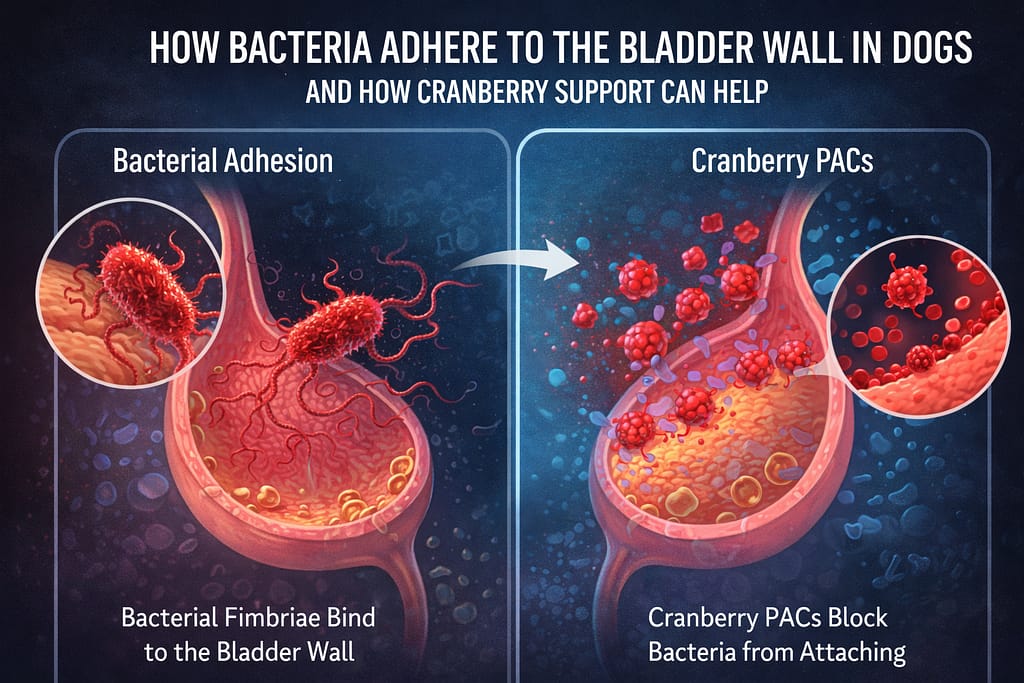
Bacterial adhesion is the physical process by which bacteria attach themselves to the bladder lining instead of being flushed out with urine.
Certain UTI-causing bacteria (especially E. coli) use microscopic hair-like structures called fimbriae to latch onto bladder cells. Once attached, they can:
- Resist being flushed during urination
- Multiply along the bladder wall
- Trigger inflammation
- Re-infect the bladder even after antibiotics
This is the foundation of recurring UTIs.
Why the Bladder Wall Is the Real Battleground
The bladder is lined with a protective layer called the glycosaminoglycan (GAG) layer.
This layer acts like a non-stick coating, preventing bacteria from binding to bladder tissue.
When the bladder lining is healthy:
- Bacteria struggle to attach
- Urine flow washes microbes away naturally
When the lining is compromised:
- Adhesion becomes easier
- Infection risk increases dramatically
How Inflammation Makes Adhesion Worse
Inflammation damages the bladder’s protective surface.
Sources of inflammation include:
- Concentrated urine from poor hydration
- Prior infections
- Mechanical irritation
- Immune overactivation
Inflamed tissue becomes more permeable and “sticky,” giving bacteria more surface area to attach.
This connection between tissue irritation and vulnerability is explored further in
👉 How inflammation and discomfort (including urinary stress) affect behavior
https://naturalranchproducts.com/blog/how-inflammation-and-physical-discomfort-affect-dog-behavior
Why Antibiotics Don’t Stop Recurrence
Antibiotics can kill free-floating bacteria, but they do not:
- Repair the bladder lining
- Reduce inflammation
- Prevent future bacterial attachment
Some bacteria also form biofilms — protective communities that shield them from antibiotics and immune response.
Once antibiotics stop, surviving bacteria can reattach and restart the cycle.
This is why many dogs experience:
- Temporary improvement
- Followed by relapse weeks or months later
Urine pH: Symptom, Not Cause
Urine pH often changes because of infection — not before it.
While pH can influence crystal formation, it does not stop bacteria from attaching to an inflamed bladder wall.
This misconception is covered in depth here:
👉 urine pH changes are often a symptom, not the cause
Chasing pH numbers alone ignores the physical mechanics of infection.
The Role of Hydration in Preventing Adhesion
Hydration directly affects bacterial adhesion risk.
Dilute urine:
- Flushes bacteria more effectively
- Reduces bladder irritation
- Lowers bacterial concentration
Concentrated urine:
- Increases contact time with the bladder wall
- Promotes inflammation
- Encourages adhesion
Hydration is the first mechanical defense against UTIs.
Where Cranberry Proanthocyanidins (PACs) Fit
Cranberry does not kill bacteria.
Instead, specific compounds called proanthocyanidins (PACs) interfere with bacterial fimbriae — making it harder for bacteria to attach to the bladder wall.
This mechanism is explored here:
👉 interfere with bacterial adhesion to the bladder wall
https://naturalranchproducts.com/cranberry-proanthocyanidins-and-urinary-tract-defense-in-dogs/
PACs support prevention by:
- Reducing adhesion probability
- Supporting bladder defense without antibiotics
- Helping lower recurrence risk when used preventively
Prevention Is Physical, Not Chemical
Recurring UTIs are best addressed by restoring structure and flow, not just chemistry.
Science-backed prevention focuses on:
- Maintaining dilute urine (hydration)
- Supporting bladder lining integrity
- Reducing chronic inflammation
- Limiting bacterial attachment opportunities
This approach works with the body instead of forcing chemical corrections.
FAQ
What causes recurring UTIs in dogs?
Recurring UTIs are often caused by bacteria adhering to a damaged or inflamed bladder wall, not incomplete antibiotic treatment.
Can bacteria survive antibiotics in the bladder?
Yes. Some bacteria form biofilms or remain attached to bladder tissue, allowing reinfection after treatment ends.
Does urine pH prevent UTIs?
No. Urine pH may influence crystals but does not stop bacteria from attaching to the bladder lining.
How does hydration help prevent UTIs?
Hydration dilutes urine, reduces irritation, and physically flushes bacteria before they can adhere.
Do cranberry supplements kill bacteria?
No. Cranberry PACs interfere with bacterial adhesion but do not act as antibiotics.
Conclusion
Recurring UTIs aren’t random — they’re mechanical.
When bladder defenses are compromised, bacteria gain the upper hand by attaching, hiding, and returning.
Understanding bacterial adhesion shifts prevention away from chasing numbers and toward protecting the bladder itself.
That’s where long-term urinary resilience begins.
Scientific References
- Hooton TM et al., New England Journal of Medicine — “Pathogenesis of urinary tract infections”
- Flores-Mireles AL et al., Nature Reviews Microbiology — “Urinary tract infections: epidemiology, mechanisms”
- Howell AB et al., Journal of Nutrition — “Anti-adhesion activity of cranberry PACs”
- Veterinary Clinics of North America — “Recurrent UTIs in Dogs”
What causes recurring UTIs in dogs?
Recurring UTIs are often caused by bacteria adhering to a damaged or inflamed bladder wall, not incomplete antibiotic treatment.
Can bacteria survive antibiotics in the bladder?
Yes. Some bacteria form biofilms or remain attached to bladder tissue, allowing reinfection after treatment ends.
Does urine pH prevent UTIs?
No. Urine pH may influence crystals but does not stop bacteria from attaching to the bladder lining.
How does hydration help prevent UTIs?
Hydration dilutes urine, reduces irritation, and physically flushes bacteria before they can adhere.
Do cranberry supplements kill bacteria?
No. Cranberry PACs interfere with bacterial adhesion but do not act as antibiotics.
Natural Ranch Products Team — Pet Wellness Advocates focused on evidence-based, ingredient-first nutrition for dogs and horses.