
Type-A Proanthocyanidins and the “Teflon Bladder”: The Molecular Science of Urinary Healthi
How PACs prevent bacterial adhesion and protect the bladder wall without altering urine pH
Most pet owners are taught to focus on urine pH when their dog or horse experiences urinary crystals or recurrent infections. But focusing on pH is like worrying about a car’s paint job while the engine is failing.
The real foundation of long-term urinary health is not the chemistry of the urine itself — it is the integrity of the bladder wall.
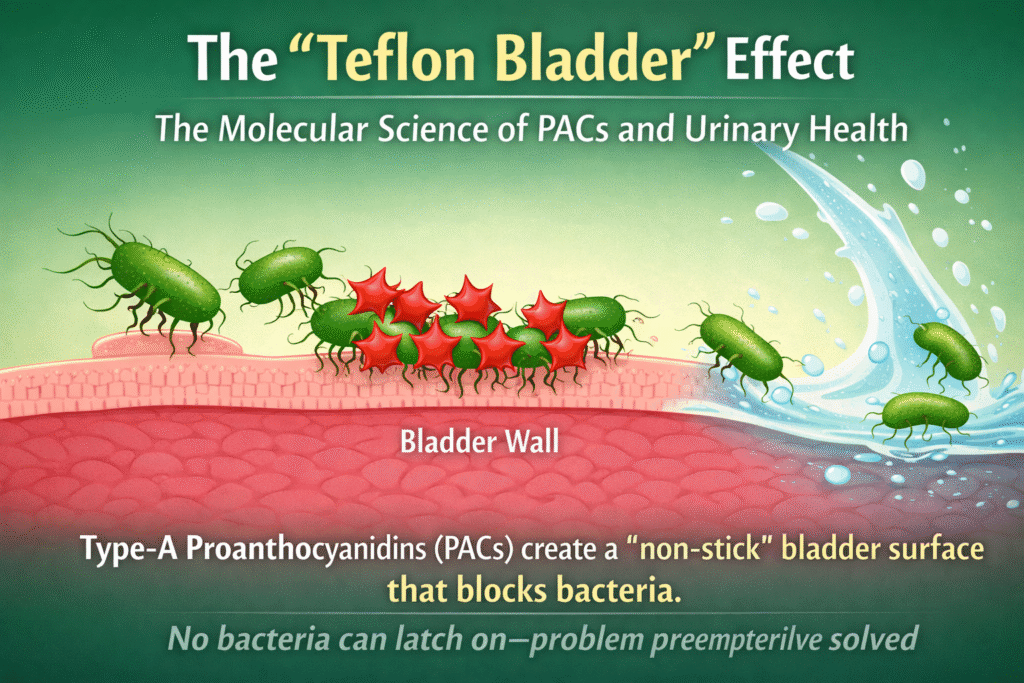
At Natural Ranch Products, we refer to this principle as the “Teflon Bladder” Effect. It describes a biological process in which the bladder lining becomes resistant to bacterial attachment, allowing harmful microbes to be flushed out naturally before they can trigger inflammation or infection.
This effect does not require harsh acids, antibiotics, or extreme pH manipulation. Instead, it relies on a very specific class of plant compounds: Type-A Proanthocyanidins (PACs).
Why PACs Are Different From Cranberry Juice
Not all cranberry products support urinary health in the same way.
Cranberry juice, powders, and many commercial supplements are often diluted, sweetened, or processed using heat — all of which significantly reduce their therapeutic value.
Type-A Proanthocyanidins (PACs) are structurally distinct polyphenols found primarily in the cranberry seed and skin, not in the sugary juice. These compounds are responsible for cranberry’s well-documented anti-adhesion effect — the ability to prevent bacteria from attaching to the bladder wall.
Most cranberry juices contain:
- Minimal Type-A PACs
- High sugar content (which may promote bacterial growth)
- Heat-damaged polyphenols from pasteurization
In contrast, cold-processed cranberry seed preserves the delicate molecular structure of Type-A PACs. This preservation is critical, because PACs must maintain their three-dimensional shape in order to interact with bacterial attachment structures.
Without intact Type-A PACs, cranberry products may taste good — but they do not protect the bladder.
How UTIs Really Happen: Grappling Hooks on the Bladder Wall
Urinary tract infections are not caused by bacteria simply floating passively in urine.
Pathogens such as Escherichia coli are active colonizers. They use microscopic, hair-like structures called fimbriae — best described as molecular grappling hooks — to latch onto the bladder lining (urothelium).
Once attached, bacteria can:
- Multiply rapidly
- Trigger inflammation
- Form biofilms that resist antibiotics
If bacteria cannot attach, infection cannot establish. They remain free-floating and are removed during normal urination.
This mechanical reality is the basis of the Teflon Bladder Effect.
PACs: Nature’s Molecular Non-Stick Coating
Cranberries contain Type-A Proanthocyanidins (PACs), a rare class of polyphenols uniquely suited to prevent bacterial adhesion.
When a dog or horse consumes a high-quality, cold-processed cranberry supplement, PACs are absorbed through the digestive tract, metabolized, and excreted through the urine. As they pass through the bladder, they perform three critical functions:
- Neutralize the Hooks
PAC molecules bind directly to bacterial fimbriae. - Prevent Adhesion
Once capped by PACs, bacteria lose their ability to attach to the bladder wall. - Create the “Teflon” Effect
The bladder lining becomes effectively non-stick, allowing bacteria to be flushed out naturally.
Bladder inflammation weakens this protective surface, which is why hydration, urine flow, and inflammation control are central to long-term urinary health.
(For a deeper look at hydration and inflammation, see:
How PACs Reach the Bladder Intact
The effectiveness of PACs depends on their ability to survive digestion and metabolism:
- Absorption in the Gut
PACs are absorbed in the small intestine without losing critical structure. - Metabolism in the Liver
While partially modified, Type-A PACs retain the bonds responsible for anti-adhesion. - Excretion via Urine
PACs enter the bladder intact, where they directly interfere with bacterial attachment.
Any break in this chain — low dosing, poor sourcing, or heat damage — reduces efficacy.
Anti-Adhesion vs. Antimicrobial Approaches
Most conventional urinary products rely on antimicrobial strategies: killing bacteria or altering urine chemistry.
While antimicrobials can be effective short-term, repeated use may:
- Promote microbial resistance
- Disrupt beneficial microbiota
- Fail to address recurring infections
Anti-adhesion strategies work differently.
Rather than killing bacteria, Type-A PACs prevent bacteria from anchoring to the bladder wall in the first place. This allows the body to eliminate microbes naturally through normal urination.
This distinction matters because anti-adhesion:
- Does not promote resistance
- Supports normal bladder physiology
- Avoids altering urine pH
- Works synergistically with hydration
This is why PAC-based urinary support is often used preventively, especially in pets prone to recurrent issues.
Heat, Processing, and the Maillard Reaction: Why Manufacturing Matters
Type-A PACs are heat-sensitive molecules.
High-heat manufacturing methods — including steam extrusion commonly used to produce soft chews — can denature PACs, altering their molecular shape. Once distorted, PACs can no longer bind bacterial fimbriae.
Heat exposure also accelerates the Maillard Reaction, a chemical reaction between amino acids and sugars that creates advanced glycation end-products (AGEs). While this reaction contributes to browning and flavor, AGEs are associated with inflammation and reduced nutrient functionality.
A cranberry supplement exposed to high heat may retain color and flavor, but it loses biological activity.
Cold-processing preserves:
- PAC structure
- Polyphenol integrity
- Anti-adhesion functionality
This is the difference between a functional supplement and a cranberry-flavored treat.
Type-A vs. Type-B PACs: A Critical Distinction
Not all PACs are equal.
- Type-A PACs (found in cranberries) prevent bacterial adhesion
- Type-B PACs (found in many fruits) do not
Many low-quality supplements rely on mixed or unspecified PAC sources, resulting in minimal urinary benefit. Effective urinary support requires standardized, concentrated Type-A PACs delivered intact.
Supporting the GAG Layer: The Bladder’s Secret Shield
Beyond bacterial defense, a healthy bladder relies on its Glycosaminoglycan (GAG) layer — a mucus-like lining that protects the bladder wall from irritation.
Chronic inflammation or sterile cystitis often occurs when this layer thins.
Cold-processed PACs and supportive botanicals help maintain:
- Intact GAG Layer: Reduced inflammation, comfort, resilience
- Thinned GAG Layer: Urgency, discomfort, higher infection risk
Protecting this layer is essential for long-term bladder health.
Choosing the Right Cranberry Supplement
When evaluating urinary supplements, look for:
- Cold-Processed Formulas
Heat destroys PACs. Processing matters as much as ingredients. - Verified Type-A PAC Content
Products should specify standardized PAC concentration. - Clean Formulation
Avoid fillers, sugars, and low-grade extracts. - Consistency
Daily supplementation is often necessary for chronic support.
FAQ
What are Type-A Proanthocyanidins (PACs)?
Type-A PACs are cranberry-derived polyphenols that prevent bacteria from attaching to the bladder wall by disabling fimbriae.
How long does it take for cranberry supplements to work?
Many pets show improvement within 7–14 days. Chronic cases benefit from long-term daily use.
Why does cold-processing matter?
Heat damages PAC structure. Cold-processing preserves their ability to bind bacteria and support the bladder lining.
How do PACs reach the bladder intact?
PACs are absorbed in the gut, metabolized without losing critical bonds, and excreted through urine where they act locally.
The Ranch Science Bottom Line
Urinary health is not about killing bacteria or forcing pH changes.
It is about mechanical prevention.
By supplying cold-processed, high-quality Type-A PACs, we help maintain a non-stick bladder lining, protect the GAG layer, and allow the body to do what it does best.
If bacteria can’t hook on, the problem can’t start.
References & Scientific Grounding
- Howell, A. B. et al. A-type cranberry proanthocyanidins and uropathogenic bacterial anti-adhesion activity. Phytochemistry.
- American Journal of Veterinary Research. Inhibition of adherence of Escherichia coli to feline bladder cells by a cranberry extract.
- Chou, H.I. et al. Effects of cranberry extract on prevention of urinary tract infection in dogs. Veterinary Medicine and Science.
- Scalbert, A. et al. Polyphenols: Food Sources and Bioavailability. Critical Reviews in Food Science and Nutrition.
Written by [Natural Ranch Products Team ], Pet Wellness Advocate at Natural Ranch. Passionate about holistic dog care and high-quality nutrition.”