Why Urinary Supplements Fail When the Bladder Lining Is Inflamed in Dogs
You’ve been giving your dog a urinary supplement consistently. The ingredients look right — cranberry, D-Mannose, marshmallow root. The brand is reputable. But the UTIs keep coming back, or the bladder discomfort persists between infections. Why Urinary Supplements Fail .
In most cases the supplement isn’t failing because the ingredients are wrong. It’s failing because the biological environment it’s supposed to work in has been compromised — and that compromised environment is actively undermining the mechanisms those ingredients depend on. Understanding why changes how you approach the problem entirely.
The Bladder Lining — Why It’s the Foundation of Everything
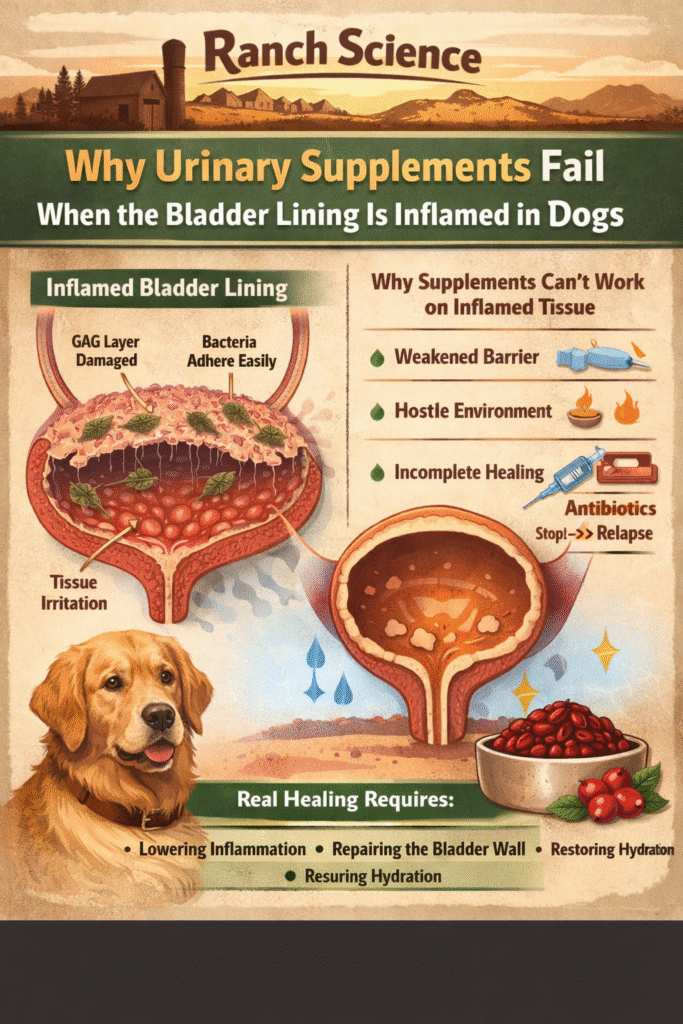
The inner surface of the bladder is not bare tissue. It is covered by a specialized protective coating called the glycosaminoglycan layer — the GAG layer — a mucus-like barrier composed of complex polysaccharides that performs several critical functions simultaneously.
The GAG layer limits bacterial adhesion by coating the receptor sites that bacteria use to attach to bladder wall cells. It buffers the bladder tissue from direct chemical irritation by concentrated urine solutes. It reduces friction during bladder filling and emptying. And it maintains the structural integrity of the urothelium — the cell layer beneath it that lines the bladder wall.
When the GAG layer is intact and functioning, it is the bladder’s primary passive defense. Bacteria that would otherwise establish infection are unable to attach. Urine chemicals that would otherwise irritate sensitive tissue are buffered. The bladder maintains its structural integrity through repeated filling and emptying cycles.
When the GAG layer is damaged or degraded — through repeated infections, chronic inflammation, concentrated urine, or mechanical injury — the bladder loses this foundational defense. This is where urinary supplements begin to fail.
For the full science on the GAG layer and why it matters: The Bladder’s Protective Barrier: Understanding the GAG Layer in Dogs
How Bladder Inflammation Undermines Supplement Effectiveness
The anti-adhesion mechanism of cranberry PACs depends on intact urothelial receptor sites being present — sites that PACs can coat and block before bacteria arrive. When the bladder lining is inflamed, the urothelium becomes more permeable. The tight junctions between urothelial cells loosen. Bacteria gain access not just to the surface receptor sites that PACs target but to deeper tissue layers that PAC-mediated surface coating cannot reach.
Inflammation also increases the expression of certain receptor types on bladder cells that actually facilitate bacterial adhesion — a mechanism by which the inflamed bladder becomes more susceptible to infection rather than less, despite supplement use. The very inflammatory state that results from a UTI creates conditions that make the next UTI easier to establish.
D-Mannose faces a similar limitation in severely inflamed bladder tissue. Its mechanism — providing E. coli bacteria with an alternative binding target so they are swept out during urination rather than attaching to bladder wall cells — requires urothelial cells that present the binding competition effectively. A severely compromised urothelium changes the surface chemistry in ways that reduce the competitive binding advantage D-Mannose provides.
The Accumulating Damage Cycle — Why Each Infection Makes the Next More Likely
Every bacterial UTI episode in a dog degrades the GAG layer through two mechanisms. The bacteria themselves produce enzymes that directly break down GAG layer components. And the immune response to infection — the inflammatory cascade that clears bacteria — produces reactive oxygen species and inflammatory cytokines that damage the urothelium and GAG layer alongside the bacteria they’re targeting.
The result is a bladder that is progressively more vulnerable after each infection than it was before. The first UTI damages the GAG layer. The second UTI finds a bladder with less GAG layer protection than the first one did. Supplements that would have provided meaningful anti-adhesion protection in an intact bladder provide decreasing protection in a bladder whose surface architecture is progressively compromised.
This is one of the central reasons dogs with recurring UTIs typically experience infections with increasing frequency over time — not because the bacteria become more aggressive, but because the bladder becomes progressively more hospitable to bacterial establishment with each episode.
For the full science on why recurring UTIs compound over time: Why Some Dogs Keep Getting UTIs (And What Actually Helps Long-Term)
What Bladder Lining Inflammation Looks Like — Signs the GAG Layer Is Compromised
GAG layer compromise is not always obvious from external symptoms. These patterns suggest bladder lining involvement beyond simple bacterial infection:
- Urinary symptoms that persist after antibiotic treatment confirms bacterial clearance — discomfort, urgency, or frequency that continues after urine culture shows no bacteria suggests bladder wall irritation independent of active infection.
- Symptoms that are triggered by certain foods or dietary changes — a healthy GAG layer buffers urine chemistry against tissue. When the layer is compromised, dietary components that alter urine composition produce direct tissue irritation.
- Very rapid UTI recurrence after completing antibiotics — recurring within days to two weeks of completing a full antibiotic course suggests the bladder lining is sufficiently compromised that bacterial establishment requires very little time to reestablish.
- Sterile cystitis — urinary symptoms with no bacteria detected on urinalysis. The bladder lining itself is producing discomfort independent of active infection — a direct indicator of GAG layer compromise and urothelial inflammation.
- Chronic mild symptoms between acute episodes — persistent low-grade urgency, mild discomfort, or slight urinary frequency between clear infection episodes suggests ongoing bladder wall inflammation rather than intermittent discrete UTIs.
Why Anti-Adhesion Supplements Are Prevention Tools — Not Repair Tools
This is the most important practical implication of bladder lining biology for supplement use: cranberry PACs and D-Mannose are prevention mechanisms, not treatment mechanisms. They work most effectively in a bladder whose surface architecture is intact — where the surface receptor sites they coat or compete for are organized and accessible.
Starting a urinary supplement reactively when symptoms appear — the most common pattern — means introducing anti-adhesion ingredients at the point of maximum bladder lining compromise. The bacteria are already established. The inflammation is already active. The surface architecture is already disrupted. The supplement is arriving after the conditions it’s designed to prevent have already occurred.
Consistent daily supplementation between infections — maintaining PAC and D-Mannose presence in the urine continuously rather than reactively — is what the mechanism actually requires. The supplement needs to be present before bacteria attempt adhesion, not after they’ve established.
For the full science on anti-adhesion mechanisms and why consistency matters: Type-A Proanthocyanidins and the Teflon Bladder: The Molecular Science of Urinary Health
The Complete Approach — Anti-Adhesion Plus Bladder Lining Repair
Addressing recurring UTIs in a dog with established bladder lining compromise requires a two-layer approach — anti-adhesion prevention and active bladder lining support — working simultaneously rather than relying on anti-adhesion ingredients alone.
Anti-adhesion layer — cranberry Type-A PACs and D-Mannose maintaining continuous anti-adhesion coverage between infections, ideally started immediately after completing antibiotic treatment while the bacteria count is at its lowest and the window for re-establishing surface coating is most open.
Bladder lining support layer — NAG (N-Acetyl Glucosamine) and marshmallow root directly support GAG layer integrity and bladder tissue soothing. NAG is a precursor to the glycosaminoglycans that make up the GAG layer — providing the structural building blocks for its repair and maintenance. Marshmallow root’s mucilage content soothes irritated urothelial tissue and provides a temporary surface coating that supplements the compromised GAG layer while repair proceeds.
Systemic support layer — adequate hydration to dilute urine and reduce direct chemical irritation to the compromised lining, Vitamin C for immune function and urine pH support, and probiotics for gut microbiome balance that directly influences the urinary immune environment. Without the systemic foundation in place the anti-adhesion and lining support layers work less effectively.
Bladder Guard Soft Chews from Natural Ranch Products combines all three layers — cranberry PACs and D-Mannose for anti-adhesion, marshmallow root and NAG for bladder lining support, Vitamin C for pH and immune function, pumpkin seed for bladder muscle tone, and probiotics for systemic immune reinforcement — in a single cold-pressed daily formula that preserves the biological activity of heat-sensitive compounds through production.
→ See Bladder Guard Soft Chews
For the complete daily prevention protocol that addresses all layers simultaneously: Dog UTI Prevention: Daily Habits That Actually Matter
For the science on how biofilms compound the bladder lining problem: Biofilms in Canine UTIs: Why Some Infections Keep Coming Back
Why do urinary supplements stop working for dogs with recurring UTIs?
Urinary supplements most commonly appear to stop working when the bladder lining has been progressively damaged by repeated infections. The GAG layer — the bladder’s primary passive defense — degrades with each infection cycle. Cranberry PACs and D-Mannose work most effectively on an intact bladder surface. As the surface architecture becomes increasingly compromised, the anti-adhesion mechanism becomes less effective even at consistent dosing. The solution is adding bladder lining support ingredients like NAG and marshmallow root alongside the anti-adhesion compounds rather than just increasing the dose of PACs.
What is the GAG layer in a dog’s bladder?
The GAG layer (glycosaminoglycan layer) is a mucus-like protective coating on the inner surface of the bladder made of complex polysaccharides. It limits bacterial adhesion by coating receptor sites bacteria use to attach to bladder wall cells, buffers bladder tissue from direct urine chemical irritation, and maintains structural integrity of the urothelium beneath it. When intact it is the bladder’s primary passive defense. When damaged by repeated infections or chronic inflammation, the bladder becomes progressively more vulnerable to bacterial establishment regardless of supplement use.
When should I start giving my dog urinary supplements?
Urinary supplements work best as consistent daily prevention rather than reactive treatment when symptoms appear. Cranberry PACs and D-Mannose are anti-adhesion mechanisms — they need to be present in the urine before bacteria attempt adhesion to be effective. Starting supplements when symptoms appear means introducing anti-adhesion ingredients at the point of maximum bladder lining compromise, after bacteria have already established. The most effective window to start consistent daily supplementation is immediately after completing antibiotic treatment while bacterial counts are at their lowest.
What is sterile cystitis in dogs?
Sterile cystitis is bladder inflammation without detectable bacteria — urinary symptoms including urgency, frequency, and discomfort with no bacterial infection confirmed on urinalysis. It indicates bladder wall inflammation and GAG layer compromise independent of active infection. The compromised bladder lining is producing irritation directly from urine contact rather than from bacterial activity. Sterile cystitis is a strong indicator that bladder lining support with NAG and marshmallow root should be part of the management approach alongside anti-adhesion prevention.
What ingredients support bladder lining repair in dogs?
NAG (N-Acetyl Glucosamine) is a precursor to the glycosaminoglycans that make up the GAG layer — providing the structural building blocks for its repair and maintenance. Marshmallow root’s mucilage content soothes irritated urothelial tissue and provides a temporary surface coating that supplements the compromised GAG layer while repair proceeds. Together they address the tissue-level bladder lining repair that anti-adhesion ingredients like cranberry PACs and D-Mannose don’t directly target. All four ingredients together — PACs, D-Mannose, NAG, and marshmallow root — address the complete biological picture.
Why does bladder inflammation make UTIs more likely rather than less?
Bladder inflammation increases the expression of certain receptor types on urothelial cells that facilitate bacterial adhesion — meaning the inflamed bladder is actually more susceptible to infection than a healthy one, not less. Inflammation also makes the urothelium more permeable, allowing bacteria to access deeper tissue layers beyond the surface where anti-adhesion supplements provide coverage. The tight junctions between urothelial cells loosen under inflammatory stress. And the immune response that clears bacteria simultaneously damages the GAG layer through reactive oxygen species — creating a cycle where each infection leaves the bladder more vulnerable than before.
References
Interstitial Cystitis Association. “Understanding the GAG Layer.” ichelp.org.
Howell AB, et al. “A-type cranberry proanthocyanidins and uropathogenic bacterial anti-adhesion activity.” Phytochemistry. 2005.
Byron JK. “Urinary Tract Infection.” Veterinary Clinics of North America: Small Animal Practice. 2019.
Flores-Mireles AL, et al. “Urinary tract infections: epidemiology, mechanisms of infection and treatment options.” Nature Reviews Microbiology. 2015.
Intimate Rose. “Best Supplements for Interstitial Cystitis.” intimaterose.com.
VCA Animal Hospitals. “Urinary Tract Infections (UTIs) in Dogs.” vcahospitals.com