
Type-A Proanthocyanidins and the “Teflon Bladder”: The Molecular Science of Urinary Healthi
Most pet owners are taught to focus on urine pH when their dog experiences urinary crystals or recurrent infections. But focusing on pH is like worrying about a car’s paint job while the engine is failing. The real foundation of long-term urinary health is not the chemistry of the urine itself — it is the integrity of the bladder wall and whether bacteria can attach to it in the first place.
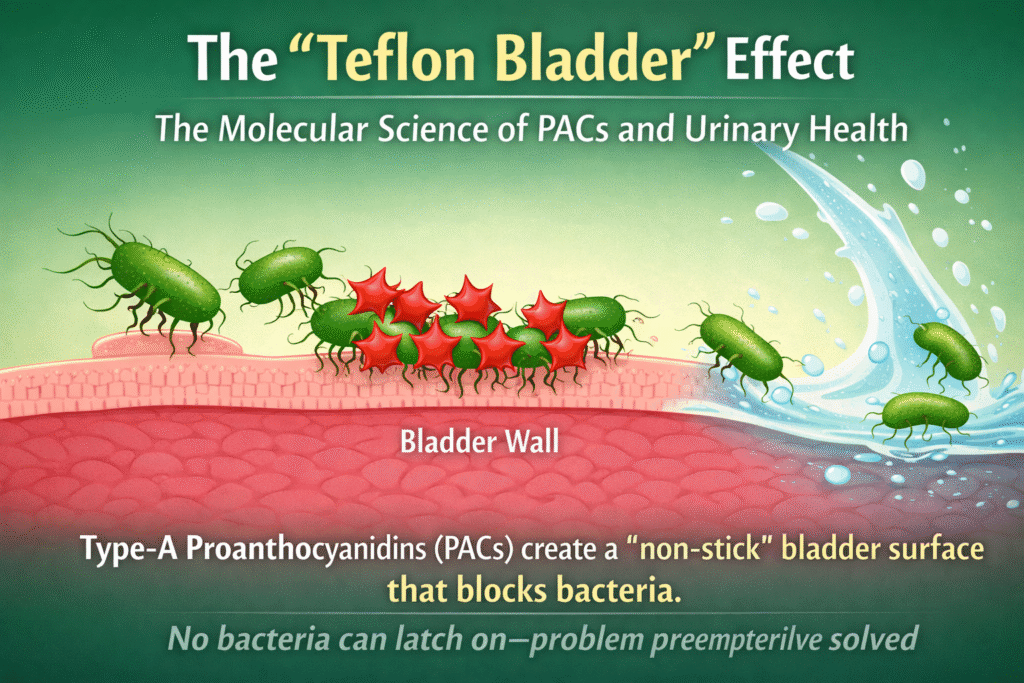
At Natural Ranch Products we refer to this principle as the Teflon Bladder Effect. It describes a biological process in which the bladder lining becomes resistant to bacterial attachment — allowing harmful microbes to be flushed out naturally before they can trigger inflammation or infection. This effect does not require harsh acids, antibiotics, or extreme pH manipulation. It relies on a very specific class of plant compounds: Type-A Proanthocyanidins — PACs.
How UTIs Actually Happen — The Grappling Hook Problem
Urinary tract infections are not caused by bacteria simply floating passively in urine. Pathogens like Escherichia coli are active colonizers. They use microscopic hair-like structures called fimbriae — essentially molecular grappling hooks — to latch onto the bladder lining. Once attached, bacteria can multiply rapidly, trigger inflammation, and form biofilms that resist antibiotic treatment.
The critical insight: if bacteria cannot attach, infection cannot establish. They remain free-floating in the urine and are removed during normal urination. This mechanical reality — the adhesion step as the gateway to infection — is the basis of the Teflon Bladder Effect and the reason anti-adhesion strategies have become an increasingly important part of urinary health management in both human and veterinary medicine.
For the full science on how bacterial adhesion leads to infection and recurring UTIs: How Bacteria Adhere to the Bladder Wall in Dogs (and Why Recurring UTIs Keep Coming Back)
What Are Type-A Proanthocyanidins — And Why Are They Unique?
Proanthocyanidins are polyphenolic compounds found in many plants. But not all PACs are equal — and this distinction is critical for urinary health applications.
Type-A PACs — found primarily in cranberry seeds and skin — have a unique doubly linked molecular structure that gives them their anti-adhesion activity. This structure allows them to bind directly to bacterial fimbriae, neutralizing the grappling hooks that bacteria use to attach to the bladder wall.
Type-B PACs — found in most other fruits including grapes, apples, and blueberries — have a different molecular structure that does not produce meaningful anti-adhesion activity. Many low-quality supplements rely on mixed or unspecified PAC sources, resulting in minimal urinary benefit despite having “cranberry” on the label.
Effective urinary support requires standardized, concentrated Type-A PACs delivered intact — not generic cranberry extract, not cranberry juice powder, and not PAC sources derived from fruits other than cranberry.
Why PACs Are Completely Different From Cranberry Juice
This is the most common misunderstanding in dog urinary health — the assumption that cranberry juice and cranberry PAC supplements are interchangeable. They are not.
Cranberry juice contains minimal Type-A PACs. The PAC content is primarily in the seed and skin — not the juice fraction. Commercial cranberry juice products are predominantly juice with high sugar content, minimal therapeutic PAC levels, and heat-damaged polyphenols from pasteurization. Sugar in a urinary supplement is specifically counterproductive — it provides a substrate that can fuel bacterial growth rather than inhibiting it.
Effective cranberry PAC supplementation requires cold-processed extraction from the whole cranberry — particularly the seed — to preserve the Type-A PAC structure that produces anti-adhesion activity. Cold-pressed cranberry seed retains the intact three-dimensional molecular structure that Type-A PACs must maintain to interact with bacterial fimbriae. Once this structure is damaged through heat — which occurs during juice processing, spray drying, and standard supplement extrusion — the anti-adhesion activity is significantly reduced regardless of what the label says.
How Type-A PACs Create the Teflon Bladder Effect
When a dog consumes a high-quality cold-processed cranberry supplement, Type-A PACs are absorbed through the digestive tract, metabolized, and excreted through the urine. As they pass through the bladder they perform three critical functions:
Step 1 — Neutralize the fimbriae. PAC molecules bind directly to bacterial fimbriae — the attachment structures E. coli and other uropathogens use to anchor to bladder tissue. This binding caps the fimbriae and prevents them from making contact with bladder wall receptors.
Step 2 — Prevent adhesion. Once capped by PACs, bacteria lose their ability to attach to the bladder lining. They remain planktonic — free-floating in the urine — rather than establishing a surface-adherent population that could grow into a clinical infection.
Step 3 — Create the Teflon Effect. The bladder lining becomes effectively non-stick. Bacteria that are unable to attach are carried out of the bladder during normal urination before they can reach the numbers required to trigger infection or inflammatory response.
This mechanism works without altering urine pH, without creating selection pressure for antibiotic resistance, and without disrupting the gut microbiome. It works with normal physiology rather than against it.
How PACs Reach the Bladder Intact — The Bioavailability Chain
The effectiveness of Type-A PACs depends on their ability to survive digestion and metabolism with their active molecular structure intact. This is why sourcing and processing matter as much as ingredient inclusion.
Absorption in the gut — Type-A PACs are absorbed in the small intestine. Their doubly linked molecular bonds are more resistant to digestive degradation than Type-B PACs, which is one reason Type-A specifically produces urinary effects while Type-B does not.
Metabolism in the liver — while PACs are partially modified during hepatic metabolism, Type-A PACs retain the structural bonds responsible for anti-adhesion activity through this process. The metabolites that reach the bladder maintain meaningful anti-adhesion functionality.
Excretion via urine — PAC metabolites enter the bladder through the urine and interact directly with bacteria at the bladder wall surface. This local action is the endpoint of the entire bioavailability chain — any break in the chain reduces the concentration of active compounds reaching the site of action.
Any compromise in this chain — low dose, poor sourcing, heat damage during manufacturing — reduces the concentration of active PACs reaching the bladder and proportionally reduces the anti-adhesion effect.
Why Manufacturing Temperature Is the Most Overlooked Quality Factor
Type-A PACs are heat-sensitive molecules. High-heat manufacturing methods — including steam extrusion commonly used to produce soft chews — can denature PACs by altering their three-dimensional molecular shape. Once distorted, PACs can no longer bind bacterial fimbriae with the specificity required for anti-adhesion activity.
Heat exposure also accelerates the Maillard Reaction — a chemical reaction between amino acids and sugars that creates advanced glycation end-products (AGEs). While this reaction contributes to browning and flavor development, AGEs are associated with inflammation and reduced nutrient functionality. A cranberry supplement exposed to high-heat manufacturing may retain cranberry color and flavor while losing the biological activity that makes cranberry therapeutically meaningful.
Cold-pressed manufacturing preserves PAC structure, polyphenol integrity, and anti-adhesion functionality — which is why manufacturing method is a quality signal as important as the ingredient list itself. A cold-pressed cranberry supplement and a heat-extruded cranberry supplement with identical labels can have dramatically different therapeutic outcomes.
For the full science on why cold-pressed manufacturing produces better outcomes: Why Cold-Processed Pet Supplements Preserve Nutrients Better
Anti-Adhesion vs. Antimicrobial — Why the Approach Matters
Most conventional urinary management relies on antimicrobial strategies — killing bacteria directly or altering urine chemistry to create conditions less favorable for bacterial growth. These approaches are appropriate and necessary when infection is already established. But they share limitations that become significant when the goal is long-term prevention rather than acute treatment.
Repeated antibiotic use creates selection pressure that promotes resistant bacterial strains over time. Antimicrobial approaches that target active bacteria don’t address the adhesion mechanism that allows bacteria to establish in the first place. And pH manipulation strategies that acidify urine can irritate an already inflamed bladder lining in dogs with chronic urinary issues.
Anti-adhesion strategies work at a different level entirely. Rather than targeting bacteria after they’ve established, Type-A PACs prevent the initial adhesion step that infection requires. Because they don’t kill bacteria but simply prevent attachment, they create no selection pressure for resistance. They don’t alter urine pH. They don’t disrupt the gut microbiome. And they work synergistically with hydration — which flushes the non-adherent bacteria out of the bladder during normal urination.
This is why PAC-based urinary support is used preventively — particularly in dogs prone to recurrent UTIs where the goal is reducing the frequency of episodes rather than treating each one after it occurs.
For the science on why antibiotics alone are insufficient for long-term recurring UTI management: Why Antibiotics Sometimes Fail in Recurring Dog UTIs
Supporting the GAG Layer — The Bladder’s Secondary Defense
Beyond bacterial anti-adhesion, a healthy bladder relies on its glycosaminoglycan (GAG) layer — a mucus-like protective coating on the bladder wall that reduces bacterial access to the underlying epithelial cells and buffers chemical irritation from urine solutes. When this layer thins or becomes disrupted — through repeated infection cycles, inflammation, or chronic irritation — the bladder becomes both more susceptible to bacterial attachment and more sensitive to urine chemistry.
Cold-processed cranberry PACs work alongside GAG layer support ingredients like NAG (N-Acetyl Glucosamine) and marshmallow root to address both the anti-adhesion defense and the tissue-level protection that long-term bladder health requires. PACs reduce the bacterial load attempting to attach. The GAG layer support ingredients maintain the surface integrity that makes PAC anti-adhesion activity more effective.
For the full science on the GAG layer and how to support it: The Bladder’s Protective Barrier: Understanding the GAG Layer in Dogs
What to Look for in a Cranberry Supplement for Dogs
Given the distinctions above, evaluating a cranberry supplement requires looking beyond the label claim:
- Type-A PAC specification — the label or product page should specify Type-A PACs or A-type proanthocyanidins. Generic “cranberry extract” without this specification may be Type-B or a mixed PAC source without meaningful anti-adhesion activity.
- Cold-pressed or cold-processed manufacturing — the most important quality signal for PAC preservation. If manufacturing method isn’t disclosed, assume standard high-heat processing.
- No added sugars in the formula — sugar in a urinary supplement is counterproductive. Check the inactive ingredient list for cane sugar, molasses as a primary sweetener, or corn syrup.
- Disclosed milligram amounts — the PAC dose should be specified rather than hidden in a proprietary blend. Without knowing the dose, there is no way to evaluate whether the amount is therapeutically meaningful.
- Complete formula context — PACs work best alongside D-Mannose for complementary anti-adhesion, NAG and marshmallow root for GAG layer support, and probiotics for immune function. Single-ingredient cranberry supplements address one mechanism while leaving others unaddressed.
Bladder Guard Soft Chews from Natural Ranch Products is built around cold-pressed cranberry PACs alongside D-Mannose, marshmallow root, NAG, pumpkin seed powder, Vitamin C, and probiotics — addressing the full range of mechanisms that determine urinary environment quality rather than just the anti-adhesion layer alone.
→ See Bladder Guard Soft Chews
For a complete evaluation of what to look for in any dog urinary supplement: Best Dog UTI Supplement: What to Actually Look For
What are Type-A Proanthocyanidins (PACs)?
Type-A PACs are cranberry-specific polyphenols with a unique doubly linked molecular structure that enables them to bind directly to bacterial fimbriae — the attachment structures bacteria use to adhere to the bladder wall. By neutralizing these fimbriae, Type-A PACs prevent bacteria from attaching, allowing them to be flushed out during normal urination rather than establishing infection. They are structurally distinct from Type-B PACs found in other fruits, which do not produce meaningful anti-adhesion activity.
How long does it take for cranberry PAC supplements to work?
The anti-adhesion effect of cranberry PACs occurs with each dose as PACs are excreted through the urine. Most dogs show improvement in urinary comfort within 7-14 days of consistent daily use. The full preventive benefit — meaningful reduction in UTI recurrence frequency — typically becomes apparent after 60-90 days of consistent daily supplementation. PACs work as a prevention tool rather than an acute treatment, so consistent daily use rather than reactive dosing when symptoms appear is essential for meaningful results.
Why does cold-processing matter for cranberry supplements?
Type-A PACs are heat-sensitive molecules whose anti-adhesion activity depends on maintaining their three-dimensional molecular structure. High-heat manufacturing methods — including the steam extrusion used for most pet supplement chews — denature PACs by altering their shape. Once distorted, PACs can no longer bind bacterial fimbriae with the specificity required for anti-adhesion activity. Cold-pressed manufacturing preserves PAC structure, polyphenol integrity, and anti-adhesion functionality — making manufacturing method as important a quality signal as the ingredient list itself.
How do PACs reach the bladder intact?
Type-A PACs are absorbed in the small intestine, metabolized in the liver while retaining their critical structural bonds, and excreted through the urine where they interact directly with bacteria at the bladder wall surface. The doubly linked molecular structure of Type-A PACs makes them more resistant to digestive degradation than Type-B PACs — which is part of why Type-A specifically produces urinary anti-adhesion effects. Any break in this chain — low dose, poor sourcing, heat damage — reduces the concentration of active PACs reaching the bladder.
Is cranberry juice the same as cranberry PAC supplements for dogs?
No — they are fundamentally different. Cranberry juice contains minimal Type-A PACs (which are primarily in the seed and skin, not the juice), high sugar content that is counterproductive for urinary health, and heat-damaged polyphenols from pasteurization. Effective cranberry PAC supplementation requires cold-processed extraction from whole cranberry — particularly the seed — to preserve the Type-A PAC structure that produces anti-adhesion activity. Giving a dog cranberry juice is not a substitute for a cold-processed canine-specific PAC supplement.
What is the difference between Type-A and Type-B PACs?
Type-A PACs are found primarily in cranberries and have a unique doubly linked molecular structure that enables them to bind bacterial fimbriae and prevent bladder wall adhesion. Type-B PACs are found in most other fruits — grapes, apples, blueberries, dark chocolate — and have a different singly linked structure that does not produce meaningful anti-adhesion activity in the urinary tract. Many pet supplements list generic cranberry extract or unspecified PAC sources that may be primarily Type-B, providing label appeal without therapeutic urinary benefit. Look specifically for Type-A or A-type PAC specification.
References
Howell AB, et al. “A-type cranberry proanthocyanidins and uropathogenic bacterial anti-adhesion activity.” Phytochemistry. 2005.
Chou HI, et al. “Effects of cranberry extract on prevention of urinary tract infection in dogs.” Veterinary Medicine and Science. 2016.
PubMed. “Dietary cranberry supplementation and bacteria binding reduction in canine urinary cells.” 2023.
Scalbert A, et al. “Polyphenols: Food Sources and Bioavailability.” Critical Reviews in Food Science and Nutrition.
Flores-Mireles AL, et al. “Urinary tract infections: epidemiology, mechanisms of infection and treatment options.” Nature Reviews Microbiology. 2015.
VCA Animal Hospitals. “Urinary Tract Infections (UTIs) in Dogs.” vcahospitals.com