Why Cold-Extruded Supplements Preserve Nutrients Better Than High-Heat Processing
When you buy a supplement for your dog you’re usually focused on the ingredient list — probiotics, enzymes, omega fatty acids, cranberry PACs. But there’s a critical factor most labels never mention: manufacturing temperature. Even the highest-quality ingredients can lose their biological value long before they reach your dog’s bowl — and the process responsible is one most supplement buyers never think to ask about.
This is the difference between a supplement that works and one that looks impressive on the label while delivering a fraction of its stated value to your dog’s body.
The Heat-Processed Industry Standard — And What It Costs
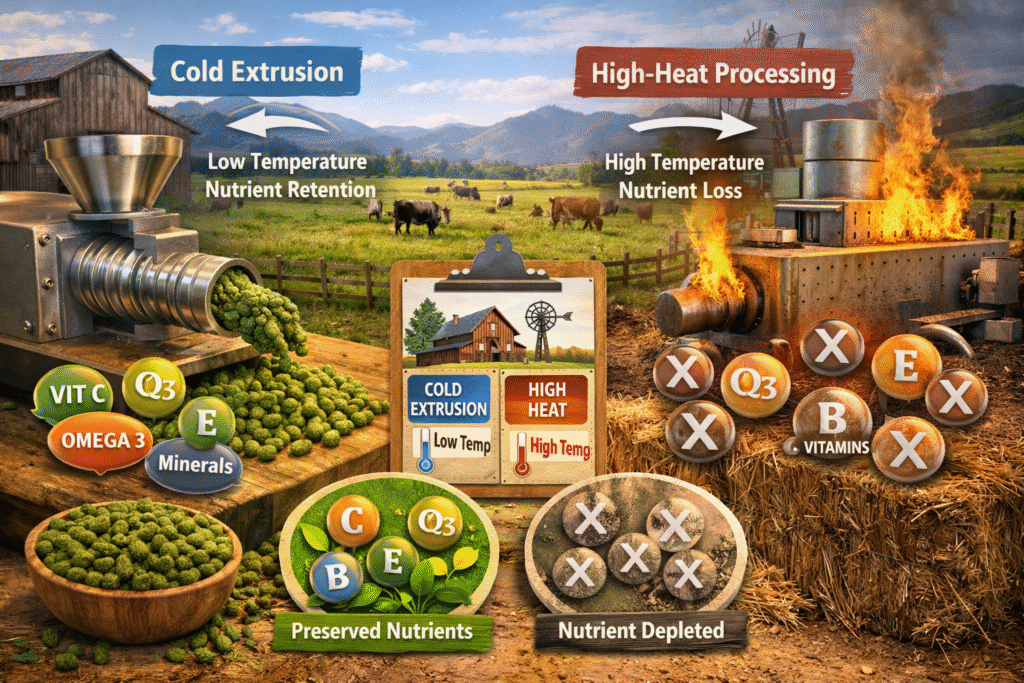
Most pet supplements are manufactured using high-heat steam extrusion — a process that uses heat, moisture, and pressure to shape soft chews into their final form. Depending on the formulation and equipment, temperatures during extrusion can exceed 150-180°C (300-356°F). This method is fast, cost-efficient, and produces the consistent texture and appearance that mass-market supplement buyers expect.
But it comes at a significant biological cost that never appears on the label.
- Probiotics — most beneficial bacterial strains lose viability above approximately 45°C. At extrusion temperatures of 150°C+, probiotic populations are effectively eliminated. A product listing live probiotics that was manufactured through high-heat extrusion may contain no viable probiotic organisms whatsoever by the time it reaches the consumer.
- Enzymes — heat denatures protein structures, rendering enzymes inactive. Digestive and metabolic enzymes are biological proteins whose function depends on maintaining their three-dimensional shape. High-heat processing unfolds these structures permanently.
- Omega fatty acids — fragile unsaturated fats oxidize under heat, converting from anti-inflammatory compounds into pro-inflammatory ones. Oxidized omega oils in a supplement don’t just fail to deliver their benefit — they actively contribute to the inflammation they were intended to reduce.
- Cranberry PACs — Type-A proanthocyanidins are heat-sensitive polyphenols whose anti-adhesion activity depends on maintaining their three-dimensional molecular structure. High-heat processing alters this structure, eliminating the fimbriae-binding capability that makes PACs therapeutically valuable for urinary health.
- B vitamins — Vitamins B1, B6, B12, and folate are heat-sensitive. Meaningful degradation occurs at processing temperatures well below those used in standard extrusion. Manufacturers compensate by over-fortifying — but the margin is not always sufficient, particularly for dogs with elevated needs.
Once damaged these ingredients may still appear on the label at their stated amounts — because the label reflects what went in, not what survived the manufacturing process. The gap between these two numbers is what determines whether your dog actually benefits from the supplement you’re paying for.
What Is Cold-Extrusion and Why Does It Preserve Nutrients?
Cold-extrusion — sometimes called cold-pressing or cold-form manufacturing — is a low-temperature manufacturing process that shapes supplement chews without exposing ingredients to the heat that degrades sensitive compounds. The process uses mechanical pressure rather than steam heat to form the chew matrix, keeping temperatures low enough throughout production to preserve molecular integrity.
At Natural Ranch Products our cold-extrusion process has been verified through lab testing to maintain temperatures that protect heat-sensitive ingredients throughout production. This isn’t just a manufacturing preference — it’s the foundation of the Ranch Science commitment that what’s on the label is what’s biologically active in the product your dog receives.
When nutrients stay structurally intact the body recognizes them as food rather than metabolic waste. This distinction determines bioavailability — how much of a stated nutrient is actually absorbed and utilized versus filtered out and eliminated.
Bioavailability — Where Supplements Succeed or Fail
Bioavailability is the percentage of a nutrient that is absorbed and used by the body. In dogs absorption doesn’t begin in the bloodstream — it begins at the gut lining. Nutrients must remain structurally intact long enough to pass through intestinal cells and into circulation in a form the body can use.
When nutrients are heat-damaged during high-temperature extrusion, the body often fails to recognize them as usable compounds. Altered proteins and denatured polyphenols may be flagged as unstable structures and routed through the liver and kidneys for elimination rather than being absorbed into circulation. This creates an ironic situation where a dog consuming a supplement labeled with impressive nutrient amounts is receiving minimal biological benefit while simultaneously increasing the metabolic burden on the organs responsible for clearing the unusable compounds.
Cold-extruded nutrients behave differently. Because their molecular structure remains intact the body recognizes them as food — absorbing fat-soluble compounds including omega fatty acids and plant-based antioxidants through lipid pathways rather than filtering them out. Heat-sensitive B vitamins retain the co-enzyme forms that participate in cellular metabolism. Probiotics arrive at the gut with viable populations that can colonize rather than inert cellular debris.
This is why two products with identical labels — same ingredients, same stated amounts — can produce dramatically different outcomes in the same dog. The difference isn’t what’s on the label. It’s what survived the manufacturing process.
The Maillard Reaction — Heat Damage You Can See and Smell
High-heat extrusion also accelerates the Maillard Reaction — a chemical reaction between amino acids and reducing sugars that creates advanced glycation end-products (AGEs). While this reaction produces the browning and flavor development that makes heat-processed foods smell appealing, AGEs are associated with inflammation and oxidative stress. They increase the metabolic burden on the liver and kidneys processing them, and they have been studied in the context of accelerated aging and inflammation in both human and veterinary medicine.
You can often identify high-heat processing by appearance and smell: very hard or brittle texture, darkened color beyond what ingredient color alone would produce, and a burnt or caramelized odor. Cold-extruded chews typically maintain a softer texture, a lighter natural appearance that reflects the actual color of their ingredients, and a fresher aroma from intact oils and botanicals that haven’t been scorched through high-heat exposure.
Why Cold-Extrusion Is Rare — The Economics of Manufacturing
If cold-extrusion produces a significantly more bioavailable supplement, why don’t all manufacturers use it? The answer is straightforward: it is slower, more expensive, and requires specialized equipment that most high-volume supplement manufacturers have not invested in.
High-heat steam extrusion is the dominant industry method because it is fast and cost-efficient. Production throughput is significantly higher. Equipment costs are lower. And because labels reflect what went in rather than what survived, the finished product can claim the same ingredient profile regardless of what the manufacturing process destroyed. There is no regulatory requirement to disclose manufacturing temperature or verify that labeled nutrients are biologically active in the final product.
This information asymmetry — where buyers assume labeled ingredients are active and manufacturers have no obligation to demonstrate that they are — is one of the most significant quality gaps in the pet supplement industry.
Cold-Pressed Cranberry Seed Oil — Shelf Stability as a Quality Signal
Cold-processing provides an additional benefit beyond nutrient preservation: shelf stability through natural antioxidants rather than chemical preservatives. Cranberry seed oil — the carrier oil in Natural Ranch Products formulas — is naturally rich in tocopherols (Vitamin E) and other antioxidants that protect the oil from oxidation and rancidity. These same antioxidants that protect the oil during storage also contribute to cellular antioxidant protection in the dog consuming the supplement.
High-heat processing destroys these natural antioxidants — which is why heat-processed supplements often require added synthetic preservatives like BHA or BHT to achieve acceptable shelf life. Cold-pressed cranberry seed oil retains its natural preservation system, producing a more shelf-stable product without the synthetic preservative additions.
For the full science on Type-A PACs and why cold-pressed cranberry specifically supports urinary health: Type-A Proanthocyanidins and the Teflon Bladder: The Molecular Science of Urinary Health
The Ranch Science Standard — What Cold-Pressed Manufacturing Means in Practice
Every Natural Ranch Products formula — Bladder Guard Soft Chews, the Daily Multivitamin, and the Total Defense System — is cold-pressed throughout production. This isn’t a marketing claim. It’s a manufacturing commitment that we verify through lab testing because it directly determines whether the ingredients we’ve formulated around are biologically active when they reach your dog.
The cranberry PACs that create the anti-adhesion effect arrive at the bladder with their molecular structure intact. The probiotics arrive with viable populations. The omega fatty acids from cold-pressed Canine Royal Oil arrive unoxidized. The B vitamins retain their co-enzyme forms. What’s on the label is what’s working.
→ See Bladder Guard Soft Chews — Cold-Pressed Urinary Defense
→ See the Natural Ranch Daily Multivitamin — Cold-Pressed Nutritional Foundation
→ See the Total Defense System
Why does processing temperature matter in pet supplements?
Processing temperature directly determines whether heat-sensitive active ingredients survive manufacturing in a biologically active form. Probiotics lose viability above 45°C. Enzymes are denatured by heat that unfolds their protein structures. Omega fatty acids oxidize under heat, converting from anti-inflammatory to pro-inflammatory compounds. Cranberry PACs lose their molecular structure and anti-adhesion activity. B vitamins degrade. A supplement can accurately list these ingredients on the label — because the label reflects what went in — while delivering minimal biological benefit because high-heat manufacturing destroyed them before the product was sealed.
What is the difference between cold-extruded and heat-extruded supplements?
Heat-extruded supplements are manufactured using steam at temperatures of 150-180°C, which degrades probiotics, enzymes, omega fatty acids, cranberry PACs, and heat-sensitive vitamins. Cold-extruded supplements use mechanical pressure at low temperatures to form the chew without heat exposure, preserving the molecular structure and biological activity of sensitive compounds. Two products with identical labels can produce dramatically different outcomes because of this manufacturing difference — and there is currently no regulatory requirement to disclose manufacturing temperature on supplement labels.
Does cold-extrusion improve bioavailability in dogs?
Yes — when nutrients remain structurally intact after cold-extrusion, the body recognizes and absorbs them more efficiently than heat-damaged alternatives. Structurally intact proteins, polyphenols, and fatty acids are processed through appropriate absorption pathways rather than being flagged as altered compounds and routed to the kidneys for elimination. This is why two supplements with identical ingredient labels can produce different outcomes — the difference isn’t what’s stated, it’s what survived the manufacturing process and arrived in the dog’s body in a form it can use.
Are cold-extruded supplements less shelf-stable?
No — cold-extruded supplements that use natural antioxidant-rich carrier oils like cranberry seed oil are often more shelf-stable than heat-processed alternatives, not less. Cold-pressing preserves the natural tocopherols and antioxidants in the oil that protect against oxidation and rancidity. Heat processing destroys these natural antioxidants — which is why many heat-processed supplements require synthetic preservatives like BHA or BHT to achieve acceptable shelf life. Cold-pressed cranberry seed oil retains its natural preservation system, eliminating the need for synthetic preservative additions.
Why don’t all supplement companies use cold-extrusion?
Cold-extrusion is slower, more expensive, and requires specialized equipment that most high-volume manufacturers have not invested in. High-heat steam extrusion dominates the industry because it produces faster throughput at lower equipment cost. Since labels reflect what went in rather than what survived manufacturing, companies using high-heat processes can list the same ingredient profile as cold-pressed competitors without disclosing that the manufacturing process degraded significant portions of those ingredients. There is currently no regulatory requirement to disclose manufacturing temperature or verify that labeled nutrients are biologically active in the final product.
How can I tell if a pet supplement was heat-processed?
Visual and sensory indicators of high-heat processing include a very hard or brittle texture, darkened color beyond what ingredient color alone would produce, and a burnt or caramelized odor. Cold-extruded chews typically have a softer texture, lighter natural appearance that reflects actual ingredient colors, and a fresher aroma from intact oils and botanicals. The most reliable indicator is whether the manufacturer discloses their processing method — look specifically for cold-pressed, cold-extruded, or cold-form manufacturing on the label or product page. If manufacturing method isn’t disclosed, assume standard high-heat processing.
References
Veterinary Medicine and Science. “Effects of cranberry extract on prevention of urinary tract infection in dogs.” 2016.
Journal of Animal Science. “Effect of processing temperature on probiotic viability in canine soft chews.” 2023.
Howell AB, et al. “A-type cranberry proanthocyanidins and uropathogenic bacterial anti-adhesion activity.” Phytochemistry. 2005.
Scalbert A, et al. “Polyphenols: Food Sources and Bioavailability.” Critical Reviews in Food Science and Nutrition.
National Research Council. Nutrient Requirements of Dogs and Cats. National Academies Press. 2006.
VCA Animal Hospitals. “Vitamins and Minerals for Dogs.” vcahospitals.com