Why Urinary Supplements Fail When the Bladder Lining Is Inflamed in Dogs
Introduction
Many dog owners try urinary supplements after a UTI diagnosis — cranberry, herbs, chews, powders — only to conclude “they didn’t work.”
But in many cases, the supplement didn’t fail.
The bladder environment did.
When the bladder lining is inflamed, even well-designed urinary supplements struggle to work as intended. To understand why, we need to look beyond bacteria counts and urine tests — and focus on the bladder wall itself.
The Bladder Lining Is an Active Organ (Not Just a Container)
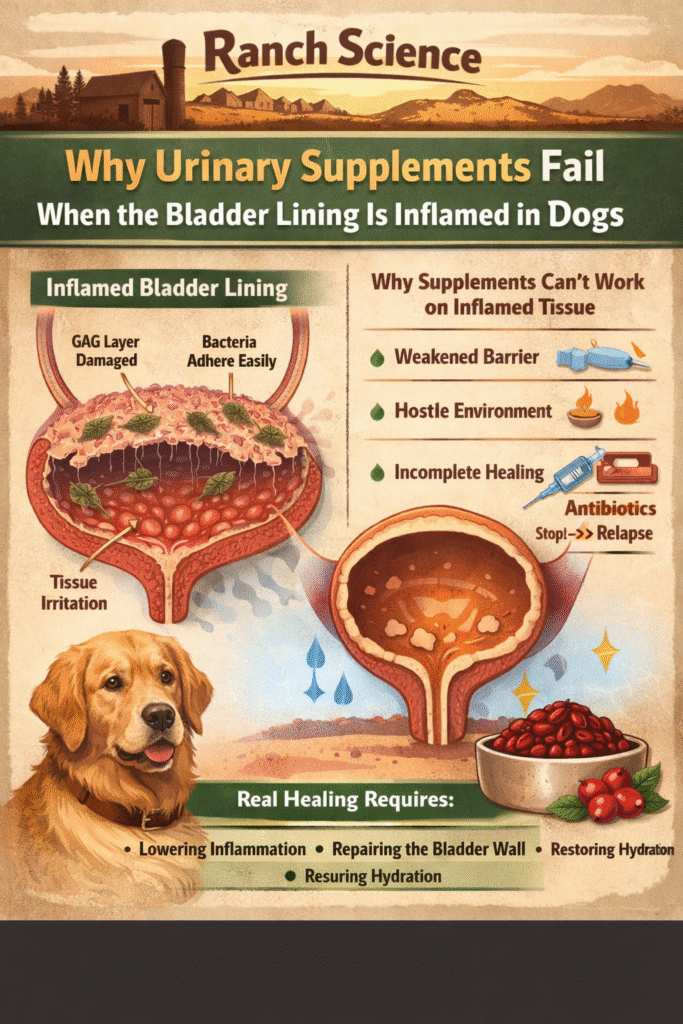
The inside of the bladder is protected by a specialized surface called the glycosaminoglycan (GAG) layer.
This layer:
- Acts as a non-stick barrier
- Shields underlying tissue from urine irritation
- Makes it harder for bacteria to attach
When the GAG layer is intact, the bladder can defend itself mechanically.
When it’s damaged, everything changes.
This surface-level battle is explained in detail here:
👉 How Bacteria Adhere to the Bladder Wall in Dogs
https://naturalranchproducts.com/how-bacteria-adhere-to-the-bladder-wall-in-dogs
How Inflammation Changes the Rules
Inflammation alters the physical structure of the bladder lining.
An inflamed bladder wall:
- Becomes porous and uneven
- Loses its protective GAG coating
- Exposes binding sites bacteria can latch onto
Inflamed tissue is biologically hostile — not just to bacteria, but to healing itself.
Even if bacteria are reduced, the surface remains vulnerable.
Why Urinary Supplements Don’t Work During Active Inflammation
Most urinary supplements are designed to prevent adhesion, not repair damaged tissue.
When inflammation is present:
- Bacteria can still attach to exposed tissue
- Anti-adhesion compounds have fewer intact surfaces to act on
- Supplements appear ineffective, even when they aren’t
This is why people say “cranberry didn’t work” — when the real issue was timing and tissue condition.
Antibiotics vs. Tissue Recovery (Why Relapse Happens)
Antibiotics reduce bacterial load.
They do not:
- Restore the GAG layer
- Repair inflamed tissue
- Normalize bladder surface integrity
Once antibiotics stop, bacteria can re-attach to the same damaged surface.
This cycle is often misinterpreted as resistance or reinfection — when it’s really incomplete healing.
Urine pH Is a Distraction, Not the Fix
Urine pH often changes because of infection or inflammation.
While pH can influence crystal formation, it does not prevent bacteria from attaching to inflamed tissue.
This misconception is covered here:
👉 Why Urine pH Isn’t the Real Problem in Most Dog UTIs
Focusing only on pH ignores the mechanical failure happening at the bladder wall.
Where Cranberry PACs Fit — After Inflammation Is Controlled
Cranberry does not kill bacteria.
Its proanthocyanidins (PACs) interfere with bacterial fimbriae, reducing their ability to stick to bladder cells.
But PACs work best when:
- The bladder surface is intact
- Inflammation is reduced
- Hydration supports urine flow
The PAC mechanism is explained here:
👉 Cranberry Proanthocyanidins and Urinary Tract Defense in Dogs
PACs are preventive tools, not emergency repair kits.
Hydration and Tissue Repair Determine Success
Real urinary resilience depends on:
- Dilute urine (hydration)
- Reduced inflammation
- Time for the bladder lining to recover
- Then, adhesion-limiting support
Supplements work with biology — not against inflamed tissue.
This is why long-term strategies outperform quick fixes.
Where Bladder Guard Fits (Contextual)
Bladder Guard was formulated to support urinary defense mechanisms after inflammation is addressed — by focusing on adhesion interference and bladder support rather than pH manipulation.
👉 Bladder Guard for Dogs
https://naturalranchproducts.com/product/bladder-guard
(Used as part of a broader, hydration- and recovery-focused approach.)
FAQ (Human-Readable + Rank Math Friendly)
Why do urinary supplements fail in dogs with UTIs?
Because active inflammation damages the bladder lining, making it harder for supplements to function as intended.
Can cranberry supplements work during an active infection?
They may offer limited benefit, but are most effective after inflammation is reduced and the bladder lining has begun to heal.
Do antibiotics fix bladder damage?
No. Antibiotics reduce bacteria but do not repair bladder tissue.
Is bladder inflammation visible on urine tests?
Not always. Inflammation can persist even when bacterial counts appear normal.
What improves long-term urinary health in dogs?
Hydration, reduced inflammation, bladder lining recovery, and prevention of bacterial adhesion.
Conclusion
Urinary supplements don’t fail randomly.
They fail when the tissue environment is hostile.
By understanding bladder lining inflammation, dog owners can stop chasing quick fixes — and start supporting the structures that actually determine urinary health.
That’s where real prevention begins.
Written by [Natural Ranch Products Team ], Pet Wellness Advocate at Natural Ranch. Passionate about holistic dog care and high-quality nutrition.”