
Why Gut Health and Urinary Health Are Connected in Dogs (And Why Treating One Without the Other Falls Short)
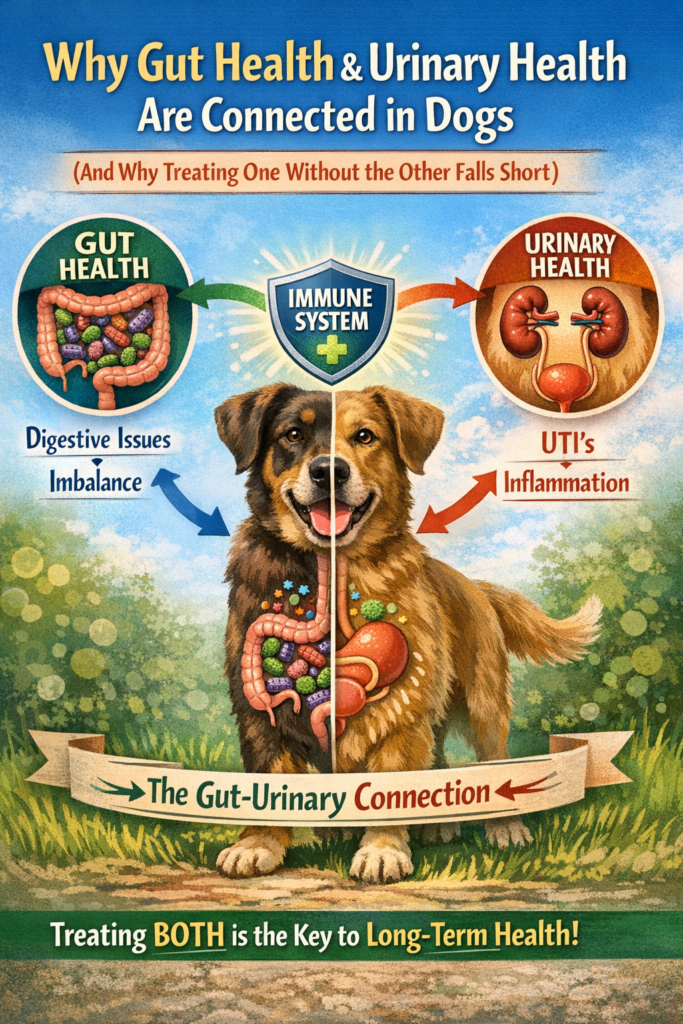
The connection between gut health and urinary health in dogs is one of the most overlooked factors in recurring UTI prevention. Most dog owners treat these as separate systems — one affects the bladder, the other affects digestion. But the biology tells a different story. The gut microbiome and urinary tract are connected through the immune system in ways that directly influence how vulnerable a dog is to recurring infections. Understanding this connection is what separates short-term symptom management from genuine long-term prevention.
The Science Behind Gut Health and Urinary Health in Dogs
Bacteria that come from the large intestine and skin are the major culprits responsible for UTIs in dogs, both male and female. This is the first and most important link between gut health and urinary health in dogs — the bacteria causing most canine UTIs originate in the digestive system before migrating to the urinary tract.
The bacteria in a dog’s gut are connected to the urinary tract. By improving gut flora, probiotics can indirectly influence urinary health by competing with pathogens for space and resources, releasing compounds that naturally inhibit bad bacteria, and strengthening local immune defenses.
This means the health of the gut microbiome is not just about digestion. It is a frontline factor in whether the bacteria most likely to cause UTIs are kept in check before they ever reach the bladder.
The Immune System Is the Bridge
The connection between gut health and urinary health in dogs runs through the immune system. Approximately 70% of the immune system is housed in the gut. When gut health is compromised — through antibiotic disruption, poor nutrition, stress, or microbiome imbalance — immune function across the entire body is affected.
The body has several defenses against unwanted bacterial intruders in the urinary tract. One is that the force of voiding can expel unwanted bacteria. A second line of defense is immune cells that line the walls of the urinary tract and help prevent infections from taking hold.
When immune function is compromised, both of these defense mechanisms are weakened. Bacteria that would normally be cleared or resisted gain a foothold. This is why dogs who have been on repeated antibiotic courses are often more vulnerable to subsequent infections — not just because of antibiotic resistance, but because each course disrupts the gut microbiome that supports the immune environment protecting the urinary tract.
For a deeper look at how bacterial persistence contributes to recurring infections: Biofilms in Canine UTIs: Why Some Infections Keep Coming Back
What Happens to Gut Health After Antibiotics
This is one of the most overlooked factors in recurring UTIs. Antibiotics are necessary for treating active infections. But they do not discriminate — they disrupt beneficial gut bacteria alongside the pathogens they are targeting.
For a dog cycling through multiple UTIs and multiple antibiotic courses, this creates a compounding problem: each treatment weakens the very system that should be preventing the next infection. Probiotics are helpful especially after antibiotic therapy, with specific strains like Lactobacillus known to support both gut and urinary tract health.
Restoring and maintaining gut microbiome balance after antibiotic treatment is not optional for dogs prone to recurrence — it is a core part of breaking the cycle.
The Nutritional Layer — Why Vitamins and Minerals Matter
Beyond probiotics, foundational nutrition plays a direct role in urinary health that most supplement strategies ignore entirely. Several key nutrients influence the urinary environment and immune function in ways that complement targeted urinary ingredients.
Vitamin C contributes to natural urine acidification, creating conditions less hospitable to bacterial persistence, while also supporting immune function systemically.
Zinc plays a critical role in immune cell function and wound healing — including the repair of bladder tissue that has been irritated or inflamed by recurring infections.
B Vitamins (B1, B2, B3, B5, B6, B12) support cellular energy production and immune health. A dog deficient in B vitamins is operating with a compromised immune system — which directly affects resistance to infection.
Vitamin A supports the integrity of mucous membranes throughout the body, including the urinary tract lining. Adequate Vitamin A is essential for maintaining the surface-level defenses that prevent bacterial adhesion.
Vitamin D3 modulates immune function and supports the body’s natural antimicrobial responses.
Selenium is a trace mineral with powerful antioxidant properties that supports immune function and reduces oxidative stress — including the inflammation that follows repeated urinary tract infections.
MSM (Methylsulfonylmethane) supports joint and tissue health and has anti-inflammatory properties that contribute to overall systemic comfort — relevant for dogs dealing with chronic bladder inflammation.
The pattern is consistent: gut health and urinary health in dogs are both dependent on a broader nutritional foundation that most urinary-specific supplements do not address at all.
Why Most Dogs Only Get Half the Support They Need
A typical approach to recurring UTIs looks like this: antibiotic treatment for the active infection, followed by a urinary supplement — usually cranberry and D-Mannose — to try to prevent the next one.
This approach addresses bacterial adhesion. It does not address the gut microbiome disrupted by antibiotics, the immune function that determines whether bacteria find a foothold, the foundational nutrition that supports tissue integrity, or the cellular environment that allows the bladder to repair and maintain its protective lining.
The result is a partial solution that works sometimes — and fails other times. The link between gut health and urinary health in dogs explains why this partial approach produces inconsistent results.
The Case for a Complete Daily Foundation
The most effective long-term approach to urinary health treats it as a whole-body issue — not a bladder-specific one. Addressing gut health and urinary health in dogs together is what the Ranch Science Total Defense System is built around. That means daily support across two complementary layers.
Layer 1 — Targeted Urinary Defense: Ingredients that work directly at the bladder wall — cranberry PACs to reduce bacterial adhesion, D-Mannose to help clear bacteria through urination, marshmallow root to soothe and protect the bladder lining, NAG to support the protective GAG layer, pumpkin seed for bladder muscle tone, Vitamin C for pH support, and probiotics for immune reinforcement. This is what Bladder Guard Soft Chews from Natural Ranch Products delivers — cold-pressed to preserve the molecular integrity of every active compound.For a full ingredient-by-ingredient breakdown and evaluation checklist:https://naturalranchproducts.com/gut-health-urinary-health-dogs/
Layer 2 — Foundational Nutritional Support: The vitamins, minerals, and micronutrients that support the immune system, tissue integrity, and cellular health that urinary-specific ingredients depend on — Zinc, B vitamins, Vitamins A, D3, and E, Selenium, MSM, and Glucosamine — delivered through cold-pressed manufacturing that preserves bioavailability. This is what the Natural Ranch Daily Multivitamin provides.
Together these two layers address gut health and urinary health in dogs the way it actually works biologically. This is exactly why we created the Total Defense System — Bladder Guard and the Daily Multivitamin together at a combined discount, because the science supports using both consistently rather than either one alone.
What This Means Practically
For a dog with recurring UTIs, the question is not just “what urinary supplement should I use?” It is “is my dog’s entire health foundation — gut, immune, nutritional — strong enough to support a urinary tract that resists infection?”
If the answer is no, then targeted urinary ingredients are working against a headwind. They may help, but they will never fully break the cycle. Daily support for both layers — targeted urinary defense and foundational nutrition — is what creates the conditions where recurring infections become less frequent, less severe, and eventually less likely to return at all.
Understanding the connection between gut health and urinary health in dogs changes how you approach prevention entirely. For a deeper look at how cold-pressed processing affects supplement effectiveness: Why Cold-Processed Pet Supplements Preserve Nutrients Better
Are gut health and urinary health connected in dogs?
Yes. The gut microbiome influences systemic immune function, and immune cells lining the urinary tract are a primary defense against infection. Gut bacteria can also migrate to the urinary tract, making microbiome health a direct factor in UTI susceptibility.
Do probiotics help prevent UTIs in dogs?
Probiotics support the gut microbiome which influences immune function and helps keep pathogenic bacteria in check. They are particularly valuable after antibiotic courses which disrupt beneficial gut flora alongside the bacteria they target.
Why does my dog keep getting UTIs after antibiotics?
Repeated antibiotic courses can disrupt the gut microbiome, weakening the immune environment that protects the urinary tract. Without restoring microbiome balance, dogs may be more vulnerable to subsequent infections despite successful treatment of individual ones.
What vitamins support urinary health in dogs?
Vitamin C supports urine pH balance and immune function. Vitamin A maintains mucous membrane integrity including the urinary tract lining. Zinc and B vitamins support immune cell function. These foundational nutrients complement targeted urinary ingredients like cranberry and D-Mannose.
What is the Total Defense System for dogs?
The Total Defense System combines Bladder Guard Soft Chews — targeted urinary defense — with the Natural Ranch Daily Multivitamin — foundational nutritional support — in a single discounted bundle. Together they address urinary health at both the bladder level and the immune and nutritional foundation level.
Should I give my dog both a urinary supplement and a multivitamin?
For dogs prone to recurring UTIs, combining targeted urinary support with foundational nutritional support addresses more of the biological factors involved in recurrence than either product alone.
References
Morris Animal Foundation. “Using Probiotics to Treat UTI in Dogs.” morrisanimalfoundation.org
Melgarejo T, et al. “Assessment of Bacterial and Fungal Populations in Urine from Clinically Healthy Dogs.” Journal of Veterinary Internal Medicine. 2021.
Reiter CP, et al. “Dietary Features Are Associated with Differences in the Urinary Microbiome in Clinically Healthy Adult Dogs.” MDPI Veterinary Sciences. 2024.
Howell AB. “Bioactive Compounds in Cranberry and Their Role in Urinary Tract Health.” Advances in Nutrition.
Kranjčec B, et al. “D-Mannose in Recurrent Urinary Tract Infections.” World Journal of Urology.
Written by [Natural Ranch Products Team ], Pet Wellness Advocate at Natural Ranch. Passionate about holistic dog care and high-quality nutrition.”