Dog Dry Skin: Causes, Signs, and How to Treat It,
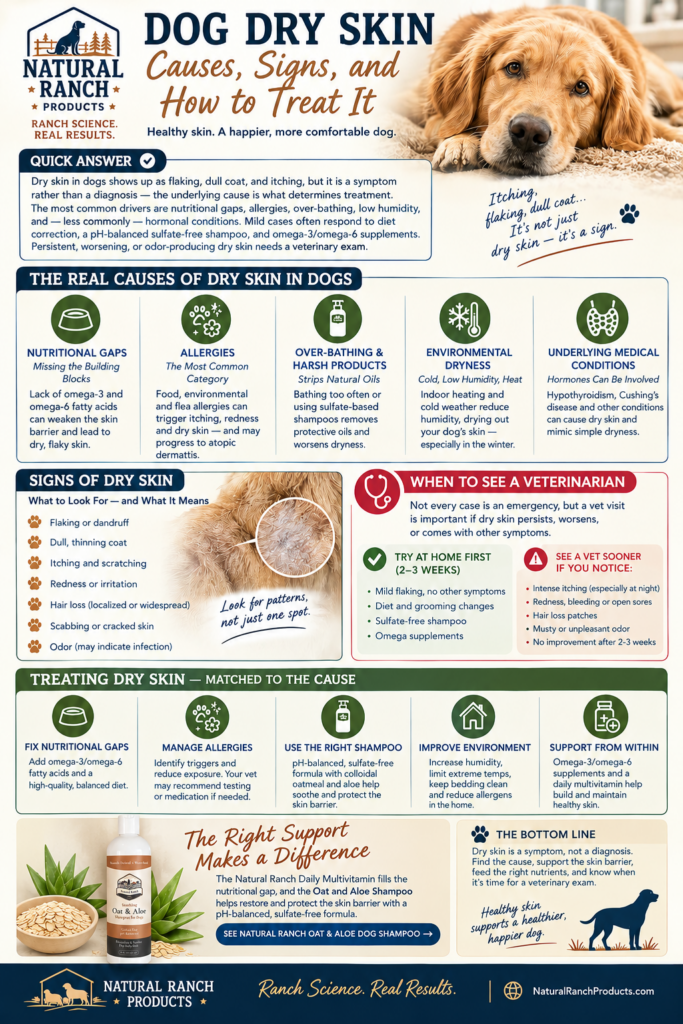
Quick Answer: Dry skin in dogs shows up as flaking, dull coat, and itching, but it is a symptom rather than a diagnosis — the underlying cause is what determines treatment. The most common drivers are nutritional gaps in omega fatty acids, allergies (environmental, food, or flea), over-bathing with harsh detergents, low-humidity air, and — less commonly — hormonal conditions like hypothyroidism or Cushing’s disease. Mild, uncomplicated dry skin usually responds to diet correction, a pH-balanced sulfate-free shampoo on a proper schedule, and omega-3/omega-6 supplementation. Persistent, worsening, or odor-producing dry skin needs a veterinary exam, because several serious conditions mimic simple dryness.
“My dog has dry skin” is one of the most common phrases typed into a search bar by dog owners — and one of the least specific. Dog dry skin isn’t a single condition with a single fix. It’s a visible sign that something underneath — diet, allergy load, grooming routine, hormone levels, or environment — has shifted enough to compromise the skin barrier.
Treating dry skin effectively means identifying which of these categories your dog falls into before reaching for a product. This guide walks through the real causes, the signs that separate simple dryness from something that needs veterinary attention, and what actually helps once you know which one you’re dealing with.
The Real Causes of Dog Dry Skin
Nutritional Gaps — Missing the Building Blocks
A dog’s diet plays a significant role in skin health, and when food lacks essential fatty acids like omega-3 and omega-6, the skin can become dry and flaky, since those nutrients help maintain a healthy skin barrier and keep the coat shiny. The skin barrier is a lipid structure — it is quite literally built from fat. When the diet doesn’t supply enough of the right fats, or the ratio between them is off, the barrier itself becomes weaker, and moisture escapes faster than the skin can replace it.
This is a slower-developing cause than allergies or bathing habits, which is part of why it gets overlooked. A dog on a nutritionally incomplete diet doesn’t develop dry skin overnight — it builds over weeks as the lipid matrix gradually depletes.
Allergies — The Most Common Category
Food allergies, environmental allergies, and seasonal allergies — including pollen, dust, feathers, grass, animal dander, grains, and flea saliva — can cause a range of symptoms in dogs, dry skin among the most common. When allergic reactions go unmanaged, they don’t stay contained to occasional itching. Left untreated, these allergies can progress into atopic dermatitis — a condition marked by dry skin, itching, redness, and inflammation, with secondary skin infections a real risk.
Flea allergy dermatitis deserves specific mention here because it’s frequently missed. It’s an allergic reaction to flea saliva and is the most common skin disorder diagnosed in dogs across the United States — meaning a dog can have a genuine flea allergy driving chronic dry, itchy skin even without an owner ever spotting a flea on the coat.
Over-Bathing and Harsh Products
Bathing frequency and product choice work together, and getting either one wrong produces the same result. Dogs with dry skin generally do best bathed every four to six weeks with mild, moisturizing shampoo formulated for sensitive skin — more frequent bathing strips the natural protective oils and worsens dryness, while too little bathing allows oil and debris buildup that can trap bacteria.
The product matters as much as the frequency. A sulfate-based shampoo used even once every six weeks can strip the acid mantle faster than a pH-balanced sulfate-free formula used weekly. This is why bathing frequency guidelines are only half the picture — the formula being used has to match the goal.
Environmental Dryness
Cold weather brings lower humidity and more indoor heating, both of which can dry out a dog’s skin — a pattern that shows up especially in dogs that spend most of their time indoors during harsh winters. This cause is often the easiest to confirm — dry skin that appears or worsens seasonally, tracks with heating system use, and improves in humid months, points toward environment rather than diet or allergy as the primary driver.
Underlying Medical Conditions
This is the category that gets missed most often because it looks identical to simple dry skin in the early stages. Hormonal conditions such as hypothyroidism and Cushing’s disease can contribute directly to dry skin in dogs — hypothyroidism occurs when the thyroid doesn’t produce enough hormone, leading to hair loss, weight gain, and dry, flaky skin, while Cushing’s disease affects hormone levels in ways that can cause thinning skin and related issues.
A veterinary dermatology perspective on this is worth taking seriously: what an owner perceives as simple “dry skin” may actually be a patient with an endocrine disorder, a resolving bacterial infection, a rare skin disease, external parasites, or even a form of skin lymphoma — dermatology is one of the specialty areas where a hands-on veterinary exam is genuinely necessary to sort out. That’s not a reason to panic over ordinary flaking — it’s a reason not to assume every case of dry skin is nutritional or cosmetic.
Signs of Dry Skin — and What They’re Telling You
Common signs of dry skin in dogs include itchiness, hair loss, scabbing, and cracked skin, and these symptoms may be present in only one area — such as the paws or base of the tail — or spread across multiple areas. Where the symptoms show up and how they behave over time carries diagnostic information:
- Localized flaking with no odor — often environmental or mild nutritional; lowest urgency
- Generalized dryness with intense itching — points toward allergy; worth an elimination approach or vet visit if persistent
- Flaking with hair loss and lethargy or weight change — raises suspicion for a hormonal cause; needs bloodwork to confirm
- Dry, itchy skin with an odor or greasy texture — reddened, itchy skin with an odor can indicate a secondary yeast or bacterial infection that may need oral medication to treat, not just topical care
- Dry, flaky patches alongside visible scratching at a specific body region — parasitic infections such as mites, fleas, or ringworm can all present as flaky, dry skin and require targeted treatment, not moisturizer
The single most useful diagnostic habit is tracking pattern over time rather than reacting to a single bath or a single flaky patch. Dry skin that resolves with a diet or product change confirms a simple cause. Dry skin that persists or worsens despite the right changes is the signal to stop guessing and get a professional exam.
When to See a Veterinarian
Because there are several possible causes of dry skin in dogs and some are more serious than others, any noticeable change in coat or skin condition is worth a call to your veterinarian. That said, not every case is urgent. These causes are typically not medical emergencies on their own — but if a dog is particularly uncomfortable, or is experiencing significant itching, redness, or bleeding, that changes the timeline for how soon they need to be seen, and may warrant an emergency visit.
A reasonable framework: mild flaking with no other symptoms — try a diet and grooming correction for two to three weeks first. Itching that’s disrupting sleep, skin that’s broken or bleeding from scratching, odor, or any hair loss pattern — schedule a vet visit rather than waiting to see if a shampoo change helps.
Treating Dry Skin — Matched to the Cause
Once the likely cause is identified, treatment follows a fairly direct path:
- Nutritional cause — correct the diet’s fatty acid profile; an omega-3/omega-6 supplement with the right ratio supports the skin barrier from the inside while topical care manages symptoms in the meantime
- Allergy cause — identify and reduce exposure where possible (food trial, flea prevention, seasonal management), paired with a soothing sulfate-free shampoo to manage symptoms and remove allergens from the coat
- Bathing/product cause — switch to a pH-balanced sulfate-free formula and adjust frequency to the four-to-six-week range unless a specific condition requires more frequent bathing
- Environmental cause — a humidifier during dry months, along with the same gentle grooming approach, is usually sufficient
- Medical cause — treatment is directed by the veterinarian once bloodwork or diagnostics confirm the underlying condition; topical care supports comfort but doesn’t replace the medical treatment
Across nearly every non-medical category, a colloidal oatmeal and aloe vera shampoo used on the right schedule addresses the topical side of the equation — soothing irritation, supporting the moisture barrier, and cleansing without stripping — while diet and supplementation address the internal side. Neither one substitutes for the other.
The Natural Ranch Daily Multivitamin fills the nutritional gap directly, and the Oat and Aloe Shampoo handles the topical side with a pH-balanced, sulfate-free formula built around the same ingredients dermatology research points to for barrier support. → See Natural Ranch Oat and Aloe Dog Shampoo
For the full mechanism behind why colloidal oatmeal specifically helps and how to use it for maximum effect: What Is Colloidal Oatmeal, and Why Your Dog’s Shampoo Needs It
Why does my dog have dry, flaky skin all of a sudden?
A sudden onset usually points to something environmental or a recent change — a new shampoo, a seasonal humidity drop, a diet switch, or a new flea/tick exposure. Gradual onset over weeks is more often nutritional or allergy-related, building slowly as the skin barrier depletes. If the change was truly sudden and severe, or came with other symptoms like lethargy or appetite change, a vet visit is the right next step rather than waiting it out.
What home remedy helps dry skin on dogs?
For mild, uncomplicated dry skin, a colloidal oatmeal bath with five to ten minutes of contact time, combined with an omega-3/omega-6 supplement and a switch to a pH-balanced sulfate-free shampoo, addresses both the topical symptom and a common underlying cause. Reducing bathing frequency to every four to six weeks with the right formula also helps. Home remedies are appropriate for mild cases without odor, bleeding, or hair loss — anything beyond that warrants veterinary evaluation.
Can dry skin in dogs be a sign of something serious?
Yes, in a subset of cases. Hormonal conditions like hypothyroidism and Cushing’s disease, secondary bacterial or yeast infections, and parasitic conditions like mange can all present initially as simple-looking dry skin. The signs that separate these from ordinary dryness include hair loss, odor, lethargy, weight change, or skin that doesn’t improve despite diet and grooming correction. These signs warrant a veterinary exam rather than continued home treatment.
How often should I bathe my dog if they have dry skin?
Every four to six weeks with a mild, moisturizing, sulfate-free shampoo is the general guideline for dogs with dry skin. Bathing more often than that with the wrong formula strips protective oils and worsens dryness, while too little bathing allows debris and oil buildup. The right frequency depends on the formula being used — a pH-balanced sulfate-free shampoo can be used more frequently than that range if allergen removal during high-pollen season is the goal.
Does diet really affect a dog’s skin?
Yes, directly. The skin barrier is built largely from lipids, and a diet lacking sufficient omega-3 and omega-6 fatty acids in the right ratio weakens that barrier over time, leading to moisture loss and flaking. This is a slower-developing cause than allergies or bathing habits, which is why it’s often overlooked until the dry skin has been present for weeks.
References
PetMD Editorial. “Dog Dry Skin: Causes, Treatments, and Prevention.”
American Kennel Club. “Common Causes & Remedies for Your Dog’s Dry, Itchy Skin.” Updated October 2025.
Pure Paws Veterinary Care. “Dry Skin in Dogs: Symptoms, Causes, and Treatment Guide.” May 2026.
dvm360. “‘Why does my dog have dry skin?'” February 2026.
Tri-County Veterinary Medical Foundation. “Dry Skin in Pets: Canine and Feline Skin Disorders.”
Broad Ripple Animal Clinic. “Why Do Dogs Get Dry Skin?” April 2025.
Arlo Pet Supplies. “Dry Skin in Dogs: Complete Guide to Causes, Symptoms, and Treatment.” August 2025.