Best Dog UTI Supplement: What to Actually Look For (And Why Most Fall Short)
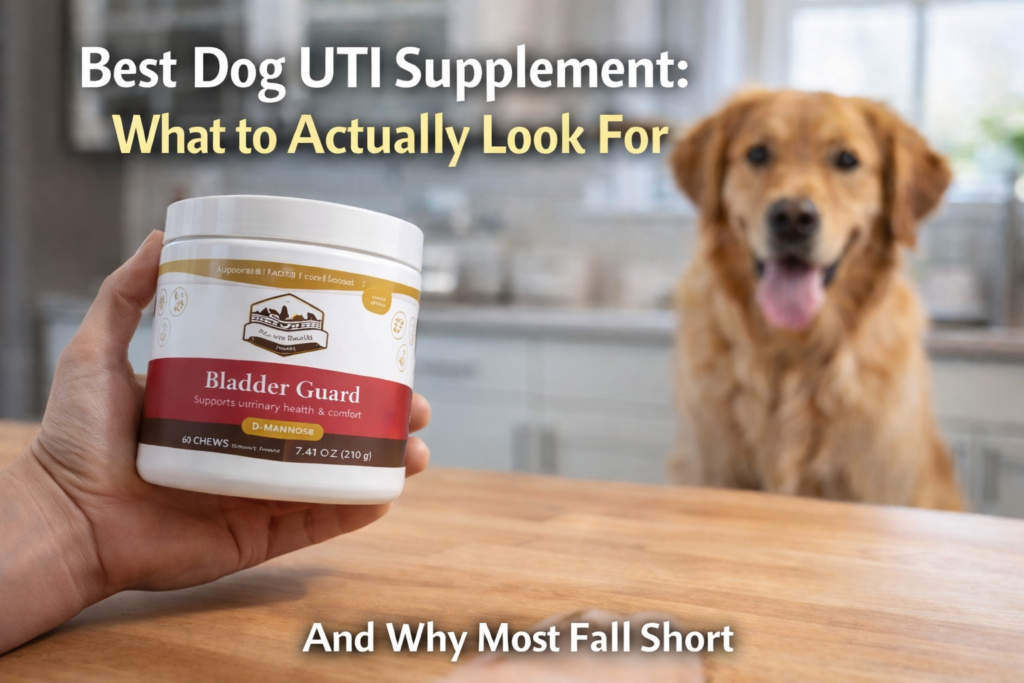
If you’ve searched for the best dog UTI supplement, you’ve already noticed the problem — every product claims to be the top choice, most look identical on the label, and none of them explain why one formula would outperform another.
This post cuts through that. Not a product ranking, not a sponsored comparison — a practical framework for evaluating any urinary supplement based on how it actually works biologically. Use it to compare any product, including ours.
Why Most Dog UTI Supplements Produce Inconsistent Results
The most effective dog urinary health supplements contain specific ingredients with research-backed benefits — and quality indicators include third-party testing, transparent sourcing, and manufacturing in facilities that follow Good Manufacturing Practices.
But ingredient lists alone don’t tell the full story. Two products can list the same ingredients and produce completely different results based on three factors most buyers never think to check.
Whether the dose is meaningful. Dosages matter significantly — some products offer only 23mg of Marshmallow Root per chew while competitors offer up to 100mg. Lower doses of key ingredients may not deliver the full range of benefits.
Whether the manufacturing method preserves active compounds. Heat-based manufacturing can degrade sensitive antioxidants — particularly the proanthocyanidins in cranberry — by up to 40% before the product leaves the factory. An ingredient at full dose on paper may be a fraction of that biologically.
Whether the formula addresses multiple mechanisms or just one. Single-ingredient products may help with one aspect of urinary health while leaving other contributing factors unaddressed.
The 6 Best Dog UTI Supplement Ingredients — And What to Look For in Each
1. Cranberry (PACs — Not Juice Powder)
This is the most commonly misunderstood ingredient in urinary supplements. Cranberries contain compounds called proanthocyanidins (PACs) which prevent bacteria, particularly E. coli, from adhering to the walls of the bladder and urinary tract — reducing the likelihood of infection as bacteria are flushed out through urination.
The critical distinction: A-Type PACs are the specific compounds responsible for anti-adhesion activity. Most mass-market supplements use spray-dried cranberry juice powder — a cheap, heat-processed form that degrades PAC integrity significantly.
What to look for: Cold-pressed or cold-extracted cranberry that specifically preserves A-Type PACs. If the label just says “cranberry extract” or “cranberry powder” without specifying the processing method, assume heat degradation has occurred.
2. D-Mannose
D-Mannose is a natural sugar that binds to E. coli bacteria, allowing them to be flushed from the urinary tract during urination rather than attaching to the bladder lining.
D-Mannose works alongside cranberry PACs through a complementary mechanism — cranberry reduces adhesion while D-Mannose gives bacteria an alternative binding target. Products containing both address bacterial behavior from two angles simultaneously.
What to look for: D-Mannose listed as a named active ingredient with a disclosed milligram amount. Products that don’t disclose the dose likely include it at levels too low to function.
3. Marshmallow Root
Marshmallow root contains mucilage, a gelatinous substance that forms a protective layer on the mucous membranes of the urinary tract, reducing inflammation and irritation.
This is the ingredient most single-focus urinary supplements skip entirely — and it’s the reason many dogs improve with cranberry and D-Mannose but plateau. Bacterial adhesion inhibition doesn’t address the tissue-level inflammation that makes the bladder lining vulnerable in the first place.
What to look for: Marshmallow root listed as a named active ingredient at a meaningful dose — 100mg or above per serving is where research-supported benefit typically begins.
4. NAG (N-Acetyl Glucosamine)
N-Acetyl Glucosamine helps rebuild the glycosaminoglycan layer that protects the bladder lining. The GAG layer is the bladder’s primary physical defense against bacterial adhesion and irritation. Chronic infections degrade it over time — which is why dogs who have had repeated UTIs are more vulnerable to subsequent ones.
For a deep dive into how this layer works: The Bladder’s Protective Barrier: Understanding the GAG Layer in Dogs
What to look for: NAG listed separately from joint-support glucosamine. Many products include glucosamine for joint health without the specific bladder-lining support function that NAG provides.
5. Probiotics
The gut microbiome directly influences systemic immune function — including the immune cells lining the urinary tract that resist infection. Probiotics support healthy bacterial balance throughout the body including the urogenital tract.
This becomes especially important for dogs on repeated antibiotic courses, which disrupt the gut microbiome alongside the bacteria they target. A formula without probiotics is leaving one of the most important long-term prevention mechanisms unaddressed.
For the full explanation of why gut health and urinary health are connected: Why Gut Health and Urinary Health Are Connected in Dogs
What to look for: Named probiotic strains with a disclosed CFU count. “Proprietary blend” without disclosure means you can’t evaluate whether the dose is functional.
6. Vitamin C
Urinary supplements that promote an acidic urinary tract pH and contain functional ingredients like Vitamin C may help lessen the frequency of recurring UTIs in dogs.
Vitamin C contributes to natural urine acidification — creating an environment less hospitable to bacterial persistence — while also supporting immune function systemically.
What to look for: Vitamin C listed as an active ingredient. Its dual role in pH support and immune function makes it a meaningful addition to a complete urinary formula.
The Manufacturing Question Nobody Asks About the Best Dog UTI Supplement
Most buyers compare ingredient lists. Almost nobody compares manufacturing methods — and this is where many supplements fail even when the ingredient list looks strong.
High-heat extrusion is the dominant manufacturing method for pet supplement chews. It’s fast and inexpensive. It also degrades heat-sensitive compounds — particularly cranberry PACs, probiotics, and certain vitamins — before the product is ever sealed.
Cold-pressed or cold-form manufacturing preserves the molecular integrity of these active compounds. The result is that what’s listed on the label is what’s actually biologically available to your dog.
This is the Ranch Science standard behind Bladder Guard Soft Chews — every ingredient cold-pressed to preserve the A-Type PACs in cranberry, the probiotic viability, and the full vitamin and antioxidant profile. Not because it’s a marketing claim but because it’s the only manufacturing method that doesn’t compromise the ingredients before they reach your dog.
For a deeper look at why manufacturing temperature matters: Why Cold-Processed Pet Supplements Preserve Nutrients Better
A Practical Checklist for Evaluating the Best Dog UTI Supplement
Use this when comparing any dog UTI supplement:
Ingredients
- Does it contain cranberry PACs specifically — not just “cranberry extract”?
- Is D-Mannose listed with a disclosed dose?
- Does it include marshmallow root at 100mg or above?
- Is NAG included for bladder lining support?
- Are probiotics included with named strains?
- Does it include Vitamin C for pH and immune support?
Dosing
- Are milligram amounts disclosed for each active ingredient?
- Does the serving size match the dog’s weight appropriately?
- How many days does one container last at full dose?
Manufacturing
- Is the processing method disclosed?
- Does the label specify cold-pressed, cold-extracted, or cold-form?
- Are there heat-sensitive ingredients that high-heat processing would degrade?
Guarantee
- Does the company offer a money-back guarantee?
- Does it cover opened containers — or only unopened returns?
Consistency
- Is the product designed for daily ongoing use?
- Does the company explain the mechanism behind each ingredient?
How Bladder Guard Measures Against This Checklist
Bladder Guard Soft Chews from Natural Ranch Products was built around exactly this framework:
- Cranberry PACs preserved through cold-pressing ✓
- D-Mannose at a disclosed functional dose ✓
- Marshmallow Root for bladder lining support ✓
- NAG for GAG layer maintenance ✓
- Probiotics for gut-immune support ✓
- Vitamin C for pH balance and immune function ✓
- Pumpkin Seed Powder for bladder muscle tone ✓
- Cold-pressed manufacturing throughout ✓
- 30-day money-back guarantee on opened containers ✓
- Designed for daily consistent use ✓
→ See Bladder Guard Soft Chews
For dogs prone to recurring UTIs, the Total Defense System pairs Bladder Guard with the Natural Ranch Daily Multivitamin for complete bladder and immune foundation support.
→ See the Total Defense System
What should I look for in the best dog UTI supplement?
The most effective formulas combine cranberry PACs for bacterial adhesion inhibition, D-Mannose for bacterial clearance, marshmallow root for bladder lining support, NAG for GAG layer maintenance, probiotics for immune support, and Vitamin C for pH balance. Manufacturing method matters as much as ingredient selection — cold-pressed processing preserves active compound integrity that heat-based manufacturing degrades.
Does cranberry actually work for dog UTIs?
Cranberry’s active compounds — proanthocyanidins — reduce bacterial adhesion to the bladder wall rather than killing bacteria directly. The key is the type and processing of cranberry used. Cold-pressed A-Type PACs are more biologically active than heat-processed juice powder or extract.
What is the difference between D-Mannose and cranberry in dog UTI supplements?
They work through complementary mechanisms. Cranberry PACs reduce bacterial adhesion to the bladder wall. D-Mannose gives certain bacteria an alternative binding target so they clear through urination rather than attaching. Together they address bacterial behavior from two angles simultaneously.
Are dog UTI supplements safe to use long-term?
Supplements containing cranberry, D-Mannose, marshmallow root, and probiotics are generally considered safe for daily long-term use. They are not a replacement for veterinary treatment of active infections but work best as a consistent daily prevention strategy.
How long does it take for the best dog UTI supplement to work?
For prevention and reduction of recurrence, consistent use over 30 to 90 days typically produces the most meaningful results. Supplements that show immediate dramatic results are more likely masking symptoms than addressing underlying mechanisms.
Should I give my dog a UTI supplement and a multivitamin?
For dogs prone to recurring UTIs, combining targeted urinary support with foundational nutritional support — including immune-supporting vitamins and minerals — addresses more of the biological factors involved in recurrence. The Total Defense System is designed around this approach.
References
Howell AB. “Bioactive Compounds in Cranberry and Their Role in Urinary Tract Health.” Advances in Nutrition.
Kranjčec B, et al. “D-Mannose in Recurrent Urinary Tract Infections.” World Journal of Urology.
Flores-Mireles AL, et al. “Urinary Tract Infections: Epidemiology, Mechanisms, and Treatment Options.” Nature Reviews Microbiology.
Byron JK. “Urinary Tract Infection.” Veterinary Clinics of North America: Small Animal Practice. 2019.
Chewy Editorial Team. “Best Urinary & Kidney Supplements for Dogs.” Chewy.com