
How Long Does a Dog UTI Supplement Take to Work? (What to Expect)
It’s one of the first questions dog owners ask after starting a urinary supplement: how long before I see results? The honest answer is that it depends — and understanding why will help you know what to watch for, when to give it more time, and when something might need to change.
There is no single timeline for how long a dog UTI supplement takes to work because different ingredients address different mechanisms — and those mechanisms operate on different timeframes. Some effects are visible within days. Others take weeks or months of consistent use to produce meaningful results. Expecting the wrong thing at the wrong time is one of the most common reasons dog owners give up on supplements that are actually working.
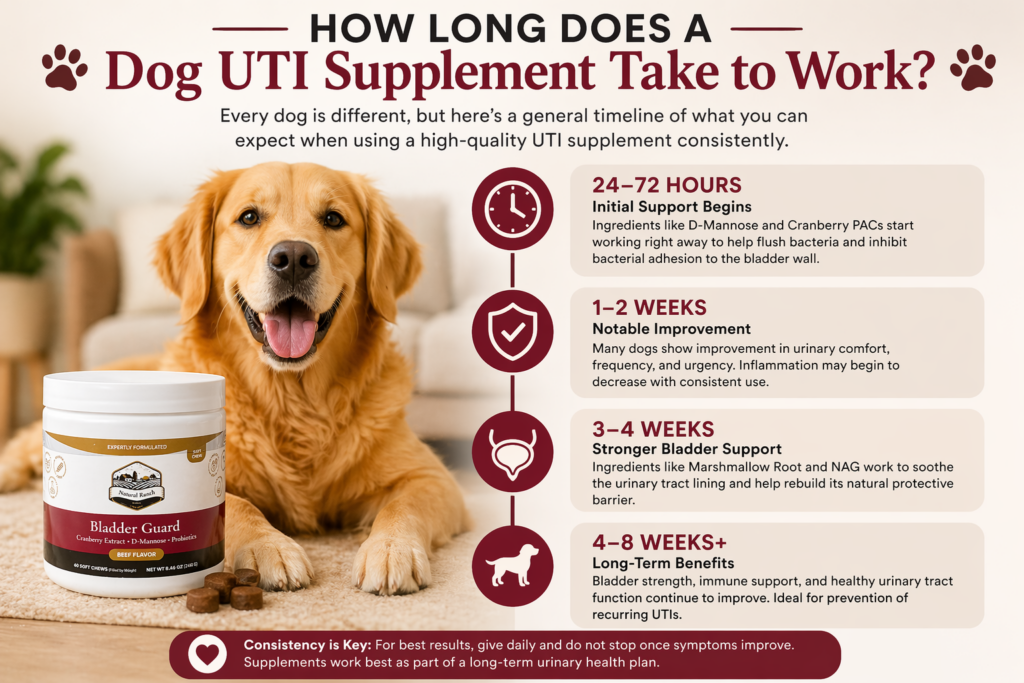
Why There Is No Single Answer to How Long a Dog UTI Supplement Takes to Work
A complete urinary supplement formula addresses multiple biological mechanisms simultaneously — each operating on its own timeline. Understanding what each ingredient is doing helps set realistic expectations for when you should see what.
Anti-adhesion ingredients like cranberry PACs and D-Mannose work at the surface level — influencing bacterial behavior in the urinary environment on a daily basis. Their effect is cumulative and ongoing rather than a single dramatic change. Bladder lining support ingredients like NAG and marshmallow root support tissue repair and maintenance — processes that take weeks not days. Probiotics influence gut microbiome balance and systemic immune function — changes that develop gradually over 30 days or more of consistent use.
This is why consistency matters more than speed. A supplement used daily for 90 days will produce fundamentally different results than the same supplement used reactively for two weeks when symptoms appear.
The 3 Timelines to Understand
Days 3–7: Early Comfort Changes
The earliest observable changes after starting a quality urinary supplement are typically comfort-related rather than infection-related. Marshmallow root begins soothing the bladder lining within the first few days of use. Dogs may show reduced urgency, less frequent attempts to urinate with no output, and overall behavioral improvement — less restlessness, less licking of the genital area.
If your dog isn’t improving after 3–5 days, it’s worth contacting your vet — particularly if an active infection is suspected. Supplements support the urinary environment but are not a treatment for established bacterial infections. Active infections require veterinary diagnosis and appropriate antibiotic treatment.
What you may notice in days 3–7: reduced straining or urgency, less frequent licking, more settled behavior, and improved comfort during urination. What you should not expect yet: significant changes in infection frequency or recurrence patterns — those operate on a longer timeline.
Weeks 2–4: Environmental Stabilization
By the end of the first month of consistent daily use, the urinary environment begins to stabilize in measurable ways. Cranberry PACs have been maintaining a consistent anti-adhesion presence. D-Mannose has been influencing bacterial behavior in the bladder daily. The bladder lining has had time to begin recovering with NAG and marshmallow root support. Probiotic colonization in the gut is establishing itself.
This is the window where dogs recovering from a recent UTI — who are also using daily supplement support alongside antibiotic treatment — tend to show the most noticeable improvement in overall urinary comfort. The supplement isn’t fighting the infection. It’s supporting the tissue recovery and environmental stability that determines how vulnerable the bladder is once antibiotics have cleared the bacteria.
What you may notice in weeks 2–4: more consistent urination patterns, reduced post-bath or post-activity urgency, improved coat and energy if using a multivitamin alongside urinary support, and generally more settled behavior around bathroom time.
Months 2–3: Recurrence Reduction
This is the timeline that matters most for dogs with recurring UTIs — and the one most owners don’t give supplements enough time to reach. Meaningful reduction in recurrence frequency typically becomes apparent between 60 and 90 days of consistent daily use.
The reason is biological. The GAG layer — the bladder’s protective surface coating — takes time to stabilize and recover after repeated infection cycles. Every animal experiences UTI differently and will respond on their own timeline. Probiotic support rebuilds gut microbiome balance over months not weeks. Anti-adhesion compounds need to be consistently present in the urinary environment to influence bacterial behavior reliably.
For dogs who have had three or more UTIs in the past year, the most meaningful measure of supplement effectiveness isn’t how they feel in week one — it’s how often infections occur over the following six months compared to the six months before starting. That comparison is what reveals whether the supplement is actually changing the pattern.
For the full science on what the bladder lining needs to recover: The Bladder’s Protective Barrier: Understanding the GAG Layer in Dogs
What Signals That a Dog UTI Supplement Is Working
Because urinary supplement results develop gradually, it helps to know what to look for rather than waiting for a dramatic single change.
Behavioral signs worth tracking: reduced urgency to go outside, fewer accidents in a house-trained dog, less straining during urination, reduced licking of the genital area, improved energy and comfort overall.
Pattern signs worth tracking over time: longer intervals between UTI episodes, milder symptoms when episodes do occur, faster recovery after antibiotic treatment, and reduced need for repeated antibiotic courses.
The most important tracking habit: keep a simple log of dates, symptoms, and what preceded each episode. This information helps your vet identify whether recurrence frequency is actually changing — and gives you objective evidence of whether the supplement is working rather than relying on impression alone.
For a full guide on what early warning signs to watch between episodes: Signs Your Dog’s UTI Is Coming Back (And What to Do Before It Gets Worse)
Why Manufacturing Method Affects How Quickly Supplements Work
The timeline above assumes the supplement is delivering biologically active ingredients at meaningful doses. That assumption isn’t always valid.
High-heat manufacturing — the dominant method for pet supplement chews — can degrade heat-sensitive compounds by up to 40% before the product leaves the factory. Cranberry PACs, probiotics, and certain vitamins are particularly vulnerable to heat degradation. A supplement whose active compounds have been significantly degraded during manufacturing will produce results on a much longer timeline — or no results at all — regardless of what the label says.
Cold-pressed manufacturing preserves the molecular integrity of these active compounds so the biologically active dose matches the labeled dose. This is why Bladder Guard Soft Chews from Natural Ranch Products uses cold-pressed manufacturing — not as a marketing distinction but because it directly affects how quickly and consistently the ingredients can influence the urinary environment.
For the full science on why manufacturing temperature matters: Why Cold-Processed Pet Supplements Preserve Nutrients Better
When to Reassess If Nothing Is Changing
If your dog has been on a quality urinary supplement consistently for 60 days and you’re seeing no improvement in comfort or recurrence frequency, there are a few things worth considering before concluding the supplement isn’t working.
Is the supplement being given consistently? Missing doses regularly — even a few per week — significantly reduces the cumulative anti-adhesion effect that daily consistency builds. Cranberry PACs and D-Mannose need to maintain a consistent presence in the urinary environment to be effective.
Is hydration adequate? Supplements work within the urinary environment. If urine is chronically concentrated due to low water intake, that environment limits how effectively anti-adhesion and tissue-support ingredients can function. Hydration is the foundation everything else depends on.
Is there an underlying condition that hasn’t been identified? Recurring UTIs that don’t respond to consistent prevention efforts often indicate an underlying factor — anatomical, systemic, or related to bacterial persistence — that requires veterinary investigation. For dogs showing active symptoms of urinary tract disease, veterinary care should always be your first step before beginning any supplement regimen.
Is the formula complete enough? Single-ingredient products that contain only cranberry or only D-Mannose address one mechanism while leaving others unaddressed. A formula that covers bacterial adhesion, bladder lining support, pH balance, and immune function produces more consistent results than one focused on a single pathway.
For a practical checklist to evaluate whether your current supplement covers all the necessary mechanisms: Best Dog UTI Supplement: What to Actually Look For
The Role of the Total Foundation: Why Bladder Guard Works Best as Part of a Complete System
For dogs with recurring UTIs, the fastest path to meaningful results combines targeted urinary defense with foundational nutritional support — not just one layer alone.
Bladder Guard Soft Chews addresses the urinary environment directly — cranberry PACs and D-Mannose for bacterial adhesion, marshmallow root and NAG for bladder lining integrity, pumpkin seed powder for bladder muscle tone, Vitamin C for pH support, and probiotics for immune reinforcement. All cold-pressed to preserve bioavailability.
The Natural Ranch Daily Multivitamin adds the foundational nutritional layer — Vitamins A, D3, E, full B-Complex, zinc, selenium, and Canine Royal Oil Omega 3-6-9 — that supports the immune environment and cellular health that urinary-specific ingredients depend on.
Together they form the Total Defense System — designed for dogs where urinary health is an ongoing management priority rather than a reactive problem.
→ See Bladder Guard Soft Chews
→ See the Total Defense System
How long does it take for a dog UTI supplement to work?
Results depend on what the supplement is addressing. Comfort improvements from ingredients like marshmallow root may appear within 3–7 days. Environmental stabilization from consistent anti-adhesion support typically develops over 2–4 weeks. Meaningful reduction in recurrence frequency for dogs with recurring UTIs generally becomes apparent after 60–90 days of consistent daily use.
How do I know if my dog’s UTI supplement is working?
Early signs include reduced urgency, less straining, fewer accidents, and improved behavioral comfort. Long-term effectiveness is best measured by tracking recurrence frequency over time — how often infections occur in the months after starting the supplement compared to before. Keeping a simple log of dates and symptoms makes this comparison objective rather than impression-based.
Should I give my dog a UTI supplement every day?
Yes — consistency is essential for urinary supplements to work. Anti-adhesion ingredients like cranberry PACs and D-Mannose need to maintain a consistent daily presence in the urinary environment to influence bacterial behavior reliably. Using them only when symptoms appear misses the prevention benefit entirely.
Can a dog UTI supplement replace antibiotics?
No. Supplements are not a treatment for active bacterial infections. They work best as daily prevention support and as part of recovery between antibiotic courses. Active infections showing symptoms like straining, blood in urine, or significant discomfort require veterinary diagnosis and appropriate antibiotic treatment.
Why isn’t my dog’s UTI supplement working?
The most common reasons are inconsistent use, inadequate hydration limiting the supplement’s effectiveness, an underlying condition that hasn’t been identified, or a formula that doesn’t cover all the necessary mechanisms. Manufacturing method also matters — heat-processed supplements may have significantly degraded active compounds despite what the label shows.
How long should I give a dog UTI supplement before deciding if it works?
Give a quality supplement at least 60–90 days of consistent daily use before evaluating recurrence impact. Comfort changes may appear within the first week. But the most meaningful measure — whether infection frequency is actually changing — requires a longer observation window, particularly for dogs with established recurring UTI patterns.
References
Howell AB. “Bioactive Compounds in Cranberry and Their Role in Urinary Tract Health.” Advances in Nutrition.
Kranjčec B, et al. “D-Mannose in Recurrent Urinary Tract Infections.” World Journal of Urology.
Flores-Mireles AL, et al. “Urinary Tract Infections: Epidemiology, Mechanisms, and Treatment Options.” Nature Reviews Microbiology.
Byron JK. “Urinary Tract Infection.” Veterinary Clinics of North America: Small Animal Practice. 2019.
Parsons CL. “The role of the glycosaminoglycan layer in bladder defense.” Urology.
VCA Animal Hospitals. “Urinary Tract Infections (UTIs) in Dogs.” vcahospitals.com
Written by [Natural Ranch Products Team ], Pet Wellness Advocate at Natural Ranch. Passionate about holistic dog care and high-quality nutrition.”