How to Read a Dog UTI Supplement Label (What the Ingredients Actually Mean)”
Dog urinary supplement labels are designed to look impressive.Bold claims, recognizable ingredient names, veterinarian endorsements, and “clinically proven” language are everywhere. But the information that actually tells you whether a supplement will work — or whether you’re paying for expensive filler — is buried in the small print most buyers skip entirely. So how to read a dog UTI supplement label!!
How to Read a Dog UTI Supplement Label: Key Features to Identify
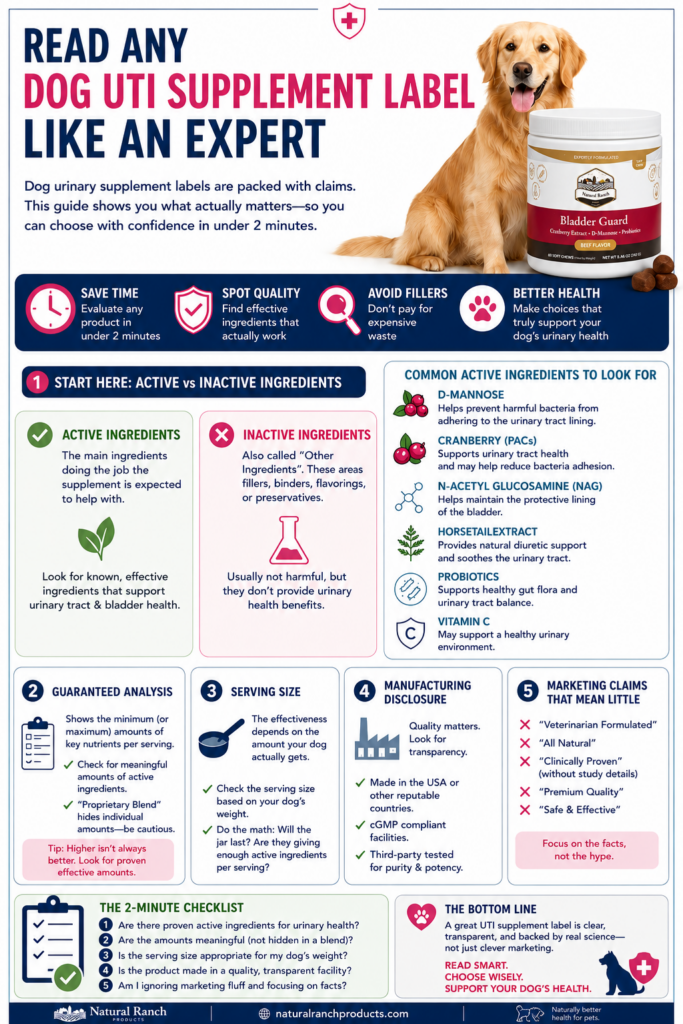
This guide walks through exactly what to look for and how read your dogs UTI supplement label — the active ingredient list, the guaranteed analysis, the serving size, the manufacturing disclosure, and the marketing claims that mean nothing. By the end you’ll be able to evaluate any product in under two minutes and know whether it’s worth buying.
Start Here: Active Ingredients vs Inactive Ingredients
Every supplement label divides ingredients into two categories. Active ingredients are the main ingredients doing the job the supplement is expected to help with. Inactive ingredients — sometimes called “other ingredients” — make the supplement chewable, add flavor, or preserve the formula. Understanding this distinction is the first step to reading any supplement label accurately.
For urinary supplements specifically, the active ingredient list is where almost all the meaningful evaluation happens. The inactive ingredients matter too — but for different reasons, covered below.
The Active Ingredients — What to Look For and What Each Means
1. Cranberry — Look for PACs, Not Just “Cranberry Extract”
Cranberry is the most common active ingredient in urinary supplements — and the most misrepresented. Cranberry extract contains proanthocyanidins that prevent bacteria from adhering to the bladder wall. Research shows cranberry can reduce UTI recurrence rates. But the form cranberry takes on the label matters enormously.
“Cranberry extract” or “cranberry powder” without specification is the lowest quality form — typically spray-dried cranberry juice that has been heat-processed, significantly degrading the PAC content that makes cranberry effective. “A-Type PACs” or “Type A proanthocyanidins” specified on the label indicates the specific compounds with documented anti-adhesion activity. Cold-pressed or cold-extracted cranberry means the manufacturing process preserved PAC integrity rather than degrading it through heat.
If the label just says “cranberry” or “cranberry fruit” without specifying the form or PAC content — assume degraded bioavailability.
2. D-Mannose — Check That the Dose Is Disclosed
D-Mannose is a natural sugar that binds to E. coli bacteria, allowing them to be flushed from the urinary tract during urination rather than attaching to the bladder lining. It works alongside cranberry through a complementary anti-adhesion mechanism.
The critical label check: is the milligram amount disclosed? Active ingredients are doing the job the supplement is expected to help with — which means their dose needs to be meaningful to produce that effect. Products that list D-Mannose without a milligram amount, or that bury it deep in a proprietary blend without individual disclosure, likely include it at doses too low to function. Always look for the specific mg amount per serving.
3. Marshmallow Root — Look for 100mg or Above Per Serving
Marshmallow root contains mucilage that soothes irritated urinary tissues and may help reduce inflammation. It addresses tissue-level bladder lining support that cranberry and D-Mannose alone don’t target — which is why its absence from a formula is a meaningful gap.
Meaningful dose starts at approximately 100mg per serving. Products that list marshmallow root without a disclosed amount — or that include it at trace levels — are using it for label appeal rather than functional benefit. If the milligram amount isn’t on the label, ask the manufacturer directly or assume it’s underdosed.
4. NAG (N-Acetyl Glucosamine) — Distinguish From Joint Glucosamine
N-Acetyl Glucosamine helps rebuild the glycosaminoglycan layer that protects the bladder lining. This is the bladder’s primary protective surface coating — the GAG layer that each infection progressively degrades. NAG supports its maintenance and repair.
The label distinction matters: NAG (N-Acetyl Glucosamine) is specifically relevant for bladder lining support. Standard glucosamine sulfate or glucosamine HCl — the forms used in joint supplements — serve a different purpose. Many products list “glucosamine” without specifying which form. Look specifically for “N-Acetyl Glucosamine” or “NAG” to confirm bladder-relevant glucosamine is present.
5. Probiotics — Named Strains and CFU Count Are Non-Negotiable
Probiotics support healthy bacterial balance throughout the body, including the urogenital tract. The gut microbiome directly influences systemic immune function — including the immune cells lining the urinary tract that resist infection between episodes.
What to look for on the label: named probiotic strains (e.g., Lactobacillus acidophilus, Bacillus coagulans) rather than generic “probiotic blend,” and a disclosed CFU count — the colony-forming unit measurement that tells you how many live organisms are present. “Proprietary blend” without disclosure means you cannot evaluate whether the dose is functional. If neither the strain nor the CFU count is disclosed, the probiotic inclusion is effectively unverifiable.
6. Vitamin C — Active Role or Preservation Role?
Vitamin C may help acidify urine in appropriate doses. It also supports immune function systemically — making it a dual-purpose active ingredient in quality urinary formulas.
The label distinction: Vitamin C as a named active ingredient at a meaningful dose versus Vitamin C (ascorbic acid) listed among inactive ingredients as a natural preservative. Both forms appear on labels but serve different purposes. Check which section of the label Vitamin C appears in — active or inactive — to understand whether it’s functioning as a urinary health ingredient or just keeping the chew fresh.
7. Pumpkin Seed Powder — Relevant for Senior and Spayed Female Dogs
Pumpkin seed powder supports bladder muscle tone and urethral sphincter function — particularly relevant for senior dogs and spayed females experiencing any incontinence. Most urinary supplements focus exclusively on anti-infection mechanisms without addressing the mechanical bladder control issues that become prevalent in older dogs.
Its presence on the label signals a formula designed for complete urinary support — not just acute infection prevention. Its absence is a meaningful gap for any dog with age-related bladder changes.
The Guaranteed Analysis — What the Numbers Actually Tell You
The Guaranteed Analysis (GA) appears on every supplement label and lists minimum or maximum percentages of key nutrients. The GA provides product information to help find the levels of at least four nutrients: protein, fat, fiber, and moisture. For urinary supplements the GA is less critical than the active ingredient list — but it tells you one important thing: whether the caloric and macronutrient profile is appropriate for your dog’s size and diet.
More importantly for supplement evaluation: if a product makes specific claims about ingredient quantities — “500mg of cranberry per chew” — those claims should be verifiable against the serving size and overall formula. A product claiming 500mg of cranberry per 4-gram chew that also lists eight other active ingredients is mathematically suspicious. The numbers have to add up.
Serving Size — The Most Commonly Manipulated Label Element
Serving size is where label manipulation most commonly occurs. A product may list impressive-sounding ingredient amounts per serving — but if the serving size is four chews per day for a medium dog, the per-chew dose of each ingredient may be minimal.
Always calculate the daily dose at the recommended serving size for your dog’s weight — not just the per-chew amount. Then ask: how many days does one package last at that dose? A 60-count product with a 3-chew daily serving lasts only 20 days for a larger dog. The actual cost per day of use — not the sticker price — is the relevant comparison metric.
The Inactive Ingredients — What to Look For and What to Avoid
Inactive ingredients hold the supplement together, provide flavor, and preserve the formula. Natural preservatives like vitamin E, vitamin C, and citric acid are preferred over synthetic ones such as BHA or BHT. Try to avoid artificial coloring ingredients. Natural palatability ingredients like molasses or honey are acceptable, but cane sugars and sugar alcohols like sorbitol are not good for dogs, nor are they necessary.
For urinary supplements specifically, sugar content in inactive ingredients is worth scrutinizing. Some brands use molasses, cane sugar, or sugar alcohols to improve palatability. For dogs with recurring UTIs — particularly those with underlying diabetes or at risk of yeast overgrowth — sugar in the supplement formula is counterproductive. A supplement designed to reduce the conditions favorable to bacterial growth should not simultaneously be introducing a substrate that fuels bacterial activity.
Natural flavors from beef liver powder, powdered beef stock, or coconut glycerin provide palatability without the metabolic downsides of sugar-based sweeteners. These are the inactive ingredient markers of a formula designed for dogs with genuine health concerns rather than just treat appeal.
Manufacturing Disclosure — The Question Most Labels Don’t Answer
The single most important quality question that most supplement labels fail to answer is: how were these ingredients processed?
High-heat extrusion is the dominant manufacturing method for supplement chews. It degrades heat-sensitive active compounds — particularly cranberry PACs, probiotics, and certain vitamins — by up to 40% before the product leaves the facility. A supplement label can accurately list every ingredient at meaningful doses and still deliver a fraction of those doses biologically if high-heat manufacturing destroyed them during production.
What to look for: “cold-pressed,” “cold-extruded,” or “cold-form” manufacturing disclosed somewhere on the label or product page. If the manufacturing method isn’t disclosed at all — assume standard high-heat processing. The burden of proof is on the manufacturer to demonstrate they’ve taken steps to preserve bioavailability. Quality indicators for supplements include third-party testing, transparent sourcing of ingredients, and manufacturing in facilities that follow Good Manufacturing Practices.
For the full science on why manufacturing temperature affects bioavailability: Why Cold-Processed Pet Supplements Preserve Nutrients Better
Marketing Claims — What They Mean and What They Don’t
Several terms appear on supplement labels that sound meaningful but carry no regulatory definition or verifiable standard:
- “All-natural” or “holistic” — these feel good to see but are more for marketing purposes than to provide clear information. Treat them as a starting point, not a guarantee of quality.
- “Veterinarian approved” — this can be a helpful vote of confidence but often just means one vet gave their opinion, not that the product has been widely studied or independently validated.
- “Clinically proven” or “backed by science” — sometimes this refers to specific ingredients, not always the full formula. It is a strong starting point but worth checking how the science connects to the specific product.
- “Premium” or “advanced formula” — no regulatory definition. Used freely regardless of actual ingredient quality or dose.
- “No fillers” — not standardly regulated. Check the inactive ingredient list directly rather than relying on this claim.
The inverse is also true: the absence of marketing language doesn’t indicate lower quality. The most credible supplements tend to let the ingredient list and manufacturing transparency do the work rather than relying on label claims.
How Bladder Guard Reads Against This Checklist
Bladder Guard Soft Chews from Natural Ranch Products is built to meet every standard in this guide:
- Cranberry PACs preserved through cold-pressed manufacturing ✓
- D-Mannose at a disclosed milligram dose ✓
- Marshmallow Root for bladder lining support ✓
- NAG (N-Acetyl Glucosamine) specifically for GAG layer maintenance ✓
- Pumpkin Seed Powder for bladder muscle tone ✓
- Vitamin C as an active ingredient for pH and immune support ✓
- Probiotics for gut-immune reinforcement ✓
- Cold-pressed manufacturing throughout ✓
- Zero sugar — grain-free and sugar-free formula ✓
- Natural beef flavor from powdered beef stock ✓
- 30-day money-back guarantee ✓
→ See Bladder Guard Soft Chews
For dogs where urinary health is an ongoing management priority, the Total Defense System pairs Bladder Guard with the Natural Ranch Daily Multivitamin — addressing both the targeted urinary defense layer and the foundational nutritional layer that immune function depends on.
→ See the Total Defense System
What should I look for on a dog UTI supplement label?
The most important elements are the active ingredient list with disclosed milligram amounts for each ingredient, the manufacturing method (cold-pressed vs heat-extruded), the serving size and daily dose at your dog’s weight, and the inactive ingredient list for sugar content and preservative type. Specifically look for cranberry PACs not just cranberry extract, D-Mannose with a disclosed dose, marshmallow root at 100mg or above, NAG specifically for bladder lining support, named probiotic strains with CFU count, and Vitamin C as an active ingredient rather than just a preservative.
What does a proprietary blend mean on a dog supplement label?
A proprietary blend lists a group of ingredients with a combined total weight but without disclosing individual ingredient amounts. This makes it impossible to evaluate whether any specific ingredient is present at a meaningful dose. Manufacturers use proprietary blends to protect formulations from competitors — but it also prevents consumers from verifying whether active ingredients are functionally dosed. For urinary supplements where ingredient doses directly determine effectiveness, individual milligram disclosure is strongly preferable to proprietary blend listing.
Does the order of ingredients on a supplement label matter?
Yes — ingredients must be listed in descending order by weight. The first ingredient is present in the highest amount. For urinary supplements this means the active ingredients you’re paying for should appear near the top of the active ingredient list, not buried at the bottom in trace amounts. If cranberry or D-Mannose appear last in a long active ingredient list, their dose relative to the other ingredients is likely minimal.
What is cold-pressed manufacturing and why does it matter for dog supplements?
Cold-pressed manufacturing keeps temperatures low throughout the production process, preserving the molecular integrity of heat-sensitive active compounds. High-heat extrusion — the standard manufacturing method for most supplement chews — can degrade cranberry PACs, probiotics, and certain vitamins by up to 40% before the product is sealed. A supplement label can accurately list every ingredient at meaningful doses and still deliver a fraction of those doses biologically if heat processing destroyed them during production. Look for cold-pressed, cold-extruded, or cold-form disclosed on the label or product page.
Are there ingredients to avoid in dog UTI supplements?
Yes. Cane sugar, molasses used as a primary sweetener, and sugar alcohols like sorbitol are counterproductive in urinary supplements — they provide palatability but introduce a substrate that can fuel bacterial activity. Artificial preservatives like BHA and BHT are preferable to avoid. Artificial colors like Red 40 or Blue 2 serve no therapeutic purpose. Also be cautious of supplements that list only a proprietary blend without individual ingredient doses — this makes it impossible to verify whether active ingredients are functionally dosed.
What does ‘veterinarian approved’ mean on a dog supplement label?
Veterinarian approved carries no standardized regulatory definition. It typically means one or more veterinarians reviewed the product and provided an endorsement — not that the product was independently tested, peer-reviewed, or validated in clinical studies. It can be a useful starting point but should not substitute for evaluating the actual ingredient list, doses, and manufacturing method. The most credible supplements let their ingredient transparency and manufacturing quality speak for themselves rather than relying primarily on endorsement claims.
References
Bernie’s Dog Health Blog. “How to Read a Dog Supplement Label (And What to Ignore).” December 2025.
The Pet Vet. “Dog Urinary Health Supplements: 7 Best Picks.” September 2025.
AAFCO. “Reading Labels.” Association of American Feed Control Officials.
American Kennel Club. “How to Read a Dog Food Label.” March 2026.
Howell AB. “Bioactive Compounds in Cranberry and Their Role in Urinary Tract Health.” Advances in Nutrition.
Kranjčec B, et al. “D-Mannose in Recurrent Urinary Tract Infections.” World Journal of Urology.