
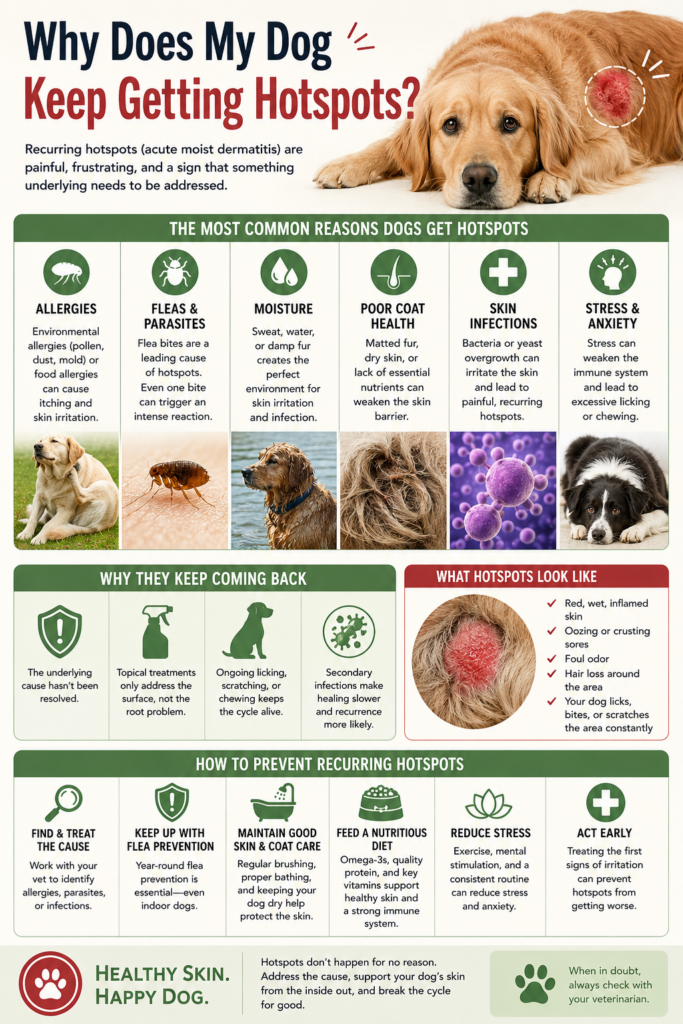
Why Does My Dog Keep Getting Hotspots?
A hotspot appears overnight. You treat it — shave the area, clean it, put your dog in a cone, finish the antibiotics. It heals. Three weeks later another one appears in almost the same spot. Sound familiar?
Recurring hotspots are one of the most frustrating skin conditions dog owners face — not because they’re hard to treat in the moment, but because treating each episode without identifying the underlying cause guarantees the next one. Understanding why your dog keeps getting hotspots is the only way to actually break the cycle.
What a Hotspot Actually Is — And Why It Matters for Preventing Recurrence
Hotspots — medically called acute moist dermatitis or pyotraumatic dermatitis — are not actually caused by bacteria on the skin. They are caused by the dog’s own scratching, licking, or chewing in response to an underlying irritant. The self-trauma creates a break in the skin barrier. Bacteria that are normally present on the skin surface then colonize the moist, broken tissue — producing the classic inflamed, oozing, painful lesion.
In most instances, hot spots start because of a minor irritant to the skin, like an insect bite or an area of fur that stayed moist after swimming. This area feels uncomfortable to the dog, so they scratch or bite at it, causing an open, irritated hot spot.
This distinction is critical for prevention: the bacteria aren’t the root cause — they’re the consequence of the skin barrier being breached by self-trauma. Treating the bacterial infection clears the current episode. But unless the underlying trigger that caused the scratching or licking is identified and addressed, the next episode is only a matter of time.
The 7 Most Common Reasons Dogs Keep Getting Hotspots
1. Unmanaged Environmental Allergies
Seasonal allergies are a common culprit for hot spots. Environmental allergens like pollen, mold, dust mites, and even food sensitivities can make a dog’s skin itchy. Scratching or licking that irritation can quickly lead to a hot spot.
Environmental allergies — atopic dermatitis — are the most common underlying cause of recurring hotspots. The dog isn’t reacting to a one-time trigger. They’re reacting to ongoing allergen exposure that keeps the skin in a state of chronic low-grade inflammation. This chronic inflammation both drives the itching that causes self-trauma and compromises the skin barrier that would otherwise prevent bacteria from establishing.
If your dog’s hotspots follow a seasonal pattern — worse in spring and summer, better in winter — environmental allergies are the most likely driver. The key is managing the allergen load, not just treating each hotspot as it appears.
2. Compromised Skin Barrier
A dog with an intact, healthy skin barrier is significantly more resistant to hotspot development than a dog whose barrier has been chronically compromised. The barrier prevents allergens from penetrating, moisture from escaping, and bacteria from colonizing the skin surface. When it’s degraded — through over-bathing with harsh shampoos, nutritional deficiencies, chronic inflammation, or underlying skin disease — minor irritants that would otherwise resolve on their own become triggers for self-trauma and secondary infection.
Dogs who develop hotspots repeatedly in the same locations often have focal areas of persistent barrier weakness at those sites — previous hotspots leave the barrier more vulnerable at the site of healing, which is why the same spots keep recurring.
For the full science on the canine skin barrier: Why the Canine Skin Barrier Matters More Than Most Dog Owners Realize
3. Moisture Trapped in the Coat
Dogs that are frequently wet from swimming, bathing, or inclement weather are more prone to developing hot spots due to the excess moisture held against the skin by their coats. Moisture creates the ideal environment for bacterial proliferation on the skin surface. When moisture is trapped against the skin — particularly in thick double-coated breeds, in skin folds, or in areas like the ears, armpits, and groin where air circulation is limited — bacterial populations can reach levels where even minor skin irritation gives them an entry point.
Dogs with long coats may benefit from having the area clipped so the hairs don’t get trapped in the ooze that comes from the sore. More broadly, ensuring the coat dries fully after swimming or bathing — particularly in thick-coated breeds — is one of the most actionable moisture management steps for hotspot-prone dogs.
4. Flea Allergy Dermatitis
Allergies and external parasites, such as fleas, are primary causes of hotspots. Flea allergy dermatitis — an allergic reaction to flea saliva rather than the flea bite itself — is one of the most intense triggers for the scratching and self-trauma that initiates hotspot development. A single flea bite can trigger a prolonged allergic reaction in sensitized dogs, causing intense itching that continues well after the flea is gone.
If your dog develops hotspots primarily around the tail base, hips, or lower back, flea allergy dermatitis is high on the differential — these are the sites where flea feeding concentrates. Consistent year-round flea prevention rather than seasonal treatment is essential for dogs with this pattern.
5. Ear Infections and Anal Gland Problems
The underlying conditions for hot spots include allergies, ear infections, poor grooming, dermatitis, excessive moisture from swimming or bathing, excessive licking from stress or boredom, or anal gland inflammation. Ear infections commonly drive hotspot development on the face, head, and neck as dogs scratch at their ears. Anal gland inflammation or impaction drives licking and chewing around the tail base and hips. In both cases, the hotspot is a secondary consequence of a primary problem elsewhere — treating the hotspot without addressing the ear infection or anal gland issue guarantees recurrence.
If your dog’s hotspots are consistently in one of these location patterns — head and neck near the ear, or tail base and hip — ask your vet specifically about ear health and anal gland function at the next appointment.
6. Nutritional Deficiencies Affecting Skin Health
The skin barrier depends on adequate dietary supply of specific nutrients — omega fatty acids for lipid layer production, zinc for skin cell repair and immune function, biotin for keratin synthesis, and vitamin E for antioxidant protection against skin cell oxidative damage. Dogs on poor quality diets — high in carbohydrate fillers, low in quality animal protein, and deficient in these key micronutrients — have structurally weaker skin barriers that are more vulnerable to breakdown and slower to recover after trauma.
Omega-3 fatty acids in particular have documented anti-inflammatory effects that reduce the chronic low-grade skin inflammation driving the itch-scratch cycle. Dogs with recurring hotspots who are on exclusively dry kibble diets high in carbohydrate fillers are worth evaluating from a nutritional standpoint — dietary improvements and targeted nutritional supplementation can meaningfully reduce hotspot frequency over time.
7. Stress, Boredom, and Behavioral Licking
The underlying cause is typically either an undiagnosed allergy (food, flea, or environmental) or a behavioral issue. Consider whether your dog is experiencing anxiety related to a recent household change, such as a new member of the family or a relocation. Compulsive licking driven by anxiety or boredom can initiate hotspot development in the absence of any physical skin condition. These dogs lick the same spot repeatedly — often a paw, leg, or flank — creating the moist, traumatized skin surface that allows bacterial colonization.
Behavioral hotspots are distinguished from allergy-driven ones by their location — typically on accessible limbs or the flank rather than the face, neck, or tail base — and by their pattern in relation to environmental stressors.
Why Treating Hotspots Without Investigating the Cause Guarantees Recurrence
Many of these conditions are chronic problems in dogs that can lead to recurring hot spots if they are not appropriately managed. Identifying and addressing the underlying cause of your dog’s hot spot is one of the most important factors in preventing future skin problems.
This is the central frustration of recurring hotspots. Each episode responds to treatment — shaving, cleaning, antibiotics, a cone. The hotspot heals. But if the environmental allergy, the ear infection, the flea exposure, the nutritional deficiency, or the behavioral trigger hasn’t been addressed, the next scratching or licking episode creates the next hotspot. The treatment addresses the secondary bacterial infection. The underlying driver remains unchanged.
If your dog experiences chronic hot spots, we suggest talking with your veterinarian about getting your dog tested for hypothyroidism, skin and food allergies, and joint problems. Dogs with three or more hotspots in twelve months warrant investigation beyond symptomatic treatment — identifying the specific underlying driver changes the management approach entirely.
Breeds Most Prone to Recurring Hotspots
Some breeds such as Golden Retrievers, St. Bernards, German Shepherd Dogs, Labrador Retrievers, and Rottweilers are predisposed to developing hot spots due to their thicker coats. Thick double coats trap moisture against the skin and reduce air circulation — creating the warm, moist environment where hotspot-causing bacteria thrive. Dogs with drop ears — Cocker Spaniels, Basset Hounds, Golden Retrievers — are at higher risk from ear infection-driven hotspots specifically.
Breed predisposition means these dogs need more proactive skin management — more consistent grooming to reduce moisture trapping, more frequent monitoring during high-allergen seasons, and more attention to skin barrier nutritional support.
A Complete Prevention Strategy for Recurring Hotspots
Identify and Address the Underlying Trigger
This is non-negotiable for dogs with recurring hotspots. Work with your vet to identify whether environmental allergies, food allergies, flea allergy dermatitis, ear infections, anal gland problems, or behavioral factors are driving the itch-scratch cycle. The treatment plan follows from the diagnosis — not from the hotspot itself.
Support the Skin Barrier From the Outside
Regular bathing with a pH-balanced, sulfate-free, colloidal oatmeal and aloe formula removes accumulated environmental allergens before they can penetrate the barrier and trigger immune responses — reducing the allergen load that drives the itch-scratch cycle. The 5-10 minute contact time rule is essential: colloidal oatmeal needs this time to form its protective film and aloe needs this time to deliver its anti-inflammatory compounds to already-irritated skin.
For dogs with environmental allergies, weekly bathing during high pollen seasons with a barrier-preserving formula can meaningfully reduce hotspot frequency — removing the allergen trigger before the itch cycle starts.
→ See Natural Ranch Oat and Aloe Dog Shampoo
Support the Skin Barrier From the Inside
The skin barrier’s structural integrity depends on adequate dietary supply of omega fatty acids, zinc, biotin, and vitamin E. Dogs with recurring hotspots benefit significantly from daily nutritional support that addresses these foundations — not just topical treatment of individual episodes.
The Natural Ranch Daily Multivitamin delivers Biotin for keratin production and coat strength, Zinc for skin cell repair and immune function, Vitamins A and E for mucous membrane and tissue integrity, and cold-pressed Canine Royal Oil — a proprietary cranberry seed oil providing a stable 1:1:1 ratio of Omega 3, 6, and 9 — for skin barrier lipid support and systemic inflammation management.
For dogs where recurring hotspots are the primary concern, the Skin and Coat Defense Duo pairs the Oat and Aloe Shampoo with the Daily Multivitamin — addressing the itch cycle from both the external allergen removal and internal barrier support directions simultaneously.
→ See the Skin and Coat Defense Duo
Moisture Management
Ensure the coat dries fully after swimming or bathing — particularly in thick-coated breeds. Use a dog dryer or towel-dry thoroughly rather than allowing air drying in dogs whose dense coats trap moisture against the skin. Check skin folds, ear canals, and axillary areas regularly for moisture accumulation. Keep coat trimmed in hotspot-prone areas to improve air circulation and reduce moisture trapping.
Consistent Flea Prevention
Year-round flea prevention — not seasonal — is essential for dogs with flea allergy dermatitis. A single flea exposure can trigger a prolonged allergic reaction in sensitized dogs. The hotspot that develops weeks after a flea exposure may not be obviously connected to fleas by the time it appears.
Grooming and Coat Management
Regular professional grooming that keeps the coat appropriately trimmed — particularly around ears, paws, and skin folds — reduces moisture trapping and allergen accumulation. Matted areas hold moisture against the skin and are significantly more prone to hotspot development. For thick-coated breeds, summer coat management is not just cosmetic — it’s a meaningful prevention measure.
Why does my dog keep getting hotspots in the same place?
Recurring hotspots in the same location usually indicate a persistent underlying trigger at that site — a chronic allergy focus, a moisture trap in a skin fold or coat area, a nearby ear infection driving scratching, or a site of previous barrier damage that healed with reduced resilience. Previous hotspots leave the barrier more vulnerable at the healing site, which is why the same spots tend to recur. Identifying the specific local trigger — rather than just treating each episode — is the key to breaking the pattern.
What causes recurring hotspots in dogs?
The most common underlying causes of recurring hotspots are unmanaged environmental allergies, compromised skin barrier integrity, moisture trapped in the coat, flea allergy dermatitis, ear infections or anal gland problems driving scratching at secondary sites, nutritional deficiencies affecting skin health, and behavioral licking driven by anxiety or boredom. Hotspots themselves are secondary bacterial infections — the bacteria colonize skin that has already been traumatized by the dog’s own scratching or licking in response to one of these underlying triggers.
What breeds are most prone to hotspots?
Golden Retrievers, Labrador Retrievers, German Shepherd Dogs, St. Bernards, and Rottweilers are among the most predisposed breeds due to their thick double coats that trap moisture against the skin. Dogs with drop ears — Cocker Spaniels, Basset Hounds, Golden Retrievers — are at higher risk from ear infection-driven hotspots. Any dog with a dense coat that doesn’t dry quickly is at elevated risk, particularly during warm humid weather or after swimming.
Can diet affect hotspots in dogs?
Yes — the skin barrier’s structural integrity depends on adequate dietary supply of omega fatty acids for lipid layer production, zinc for skin cell repair, biotin for keratin synthesis, and vitamin E for antioxidant protection. Dogs on poor quality high-carbohydrate diets deficient in these nutrients have structurally weaker skin barriers that are more vulnerable to breakdown and slower to recover. Omega-3 fatty acid supplementation has documented anti-inflammatory effects that reduce the chronic skin inflammation driving the itch-scratch cycle that initiates hotspots.
Does bathing help or hurt dogs with hotspots?
It depends entirely on the shampoo used and the frequency. Bathing with a pH-balanced, sulfate-free, colloidal oatmeal and aloe formula removes environmental allergens that trigger itching and supports the skin barrier — meaningfully reducing hotspot frequency in allergy-prone dogs when done consistently. Bathing with detergent-based shampoos that strip the skin barrier’s lipid layer worsens hotspot susceptibility over time even at moderate frequency. For dogs with environmental allergies, weekly bathing with the right formula during high-allergen seasons is often one of the most impactful prevention measures available.
When should I see a vet for my dog’s hotspots?
Any hotspot that is increasing in size rapidly, consistently bleeding, has discolored or foul-smelling discharge, or covers a large area warrants same-day veterinary attention. Dogs with three or more hotspots in twelve months should be evaluated for underlying causes — including allergy testing, ear health assessment, anal gland evaluation, and screening for hypothyroidism or other systemic conditions that affect skin health. Recurrence without investigation of the underlying cause guarantees the pattern will continue.
References
Cornell University College of Veterinary Medicine. “Hot Spots.”
PetMD Editorial. “Hot Spots on Dogs: Causes, Treatment, and Home Remedies.” Updated June 2024.
American Kennel Club. “Hot Spots on Dogs: Signs, Treatment, and Prevention.” Updated October 2025.
Small Door Veterinary. “Hot Spots on Dogs.”
Bulger Veterinary Hospital. “What To Do If Your Dog Has A Hot Spot: Causes and Treatments.”
Maple Grove Pet Hospital. “Hot Spots on Dogs: Causes and Treatments.” January 2026.