
Dog Bladder Stones vs UTI: What’s the Difference and Why It Matters
Your dog is straining to urinate, having accidents in the house, and showing blood in their urine. You search the symptoms and get two possible answers: UTI or bladder stones. Both produce nearly identical symptoms. Both require veterinary attention. But they are fundamentally different conditions with different causes, different diagnostic processes, different treatments — and a critically important relationship with each other that most dog owners don’t know about.
Understanding the difference between dog bladder stones and UTI helps you ask better questions at the vet, understand why imaging is sometimes necessary even when a UTI seems obvious, and make sense of why some dogs cycle through repeated infections that never fully resolve.
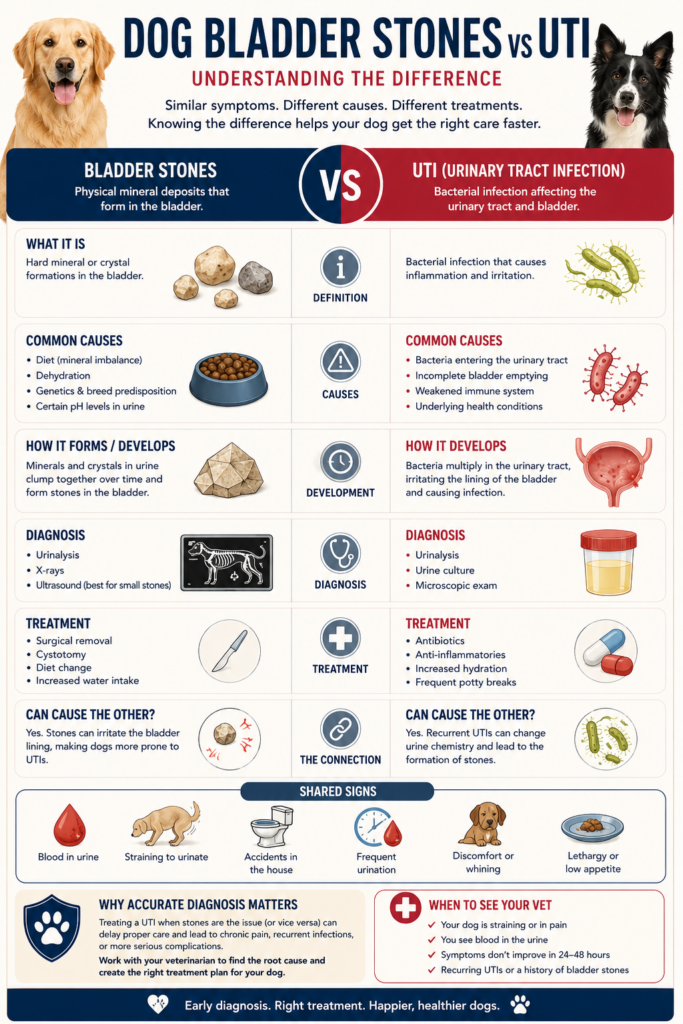
Dog Bladder Stones vs UTI: The Core Difference
A urinary tract infection is a bacterial condition — bacteria have entered the urinary tract, established in the bladder, and triggered the immune response that produces symptoms. The problem is biological and microbial. Treatment is antibiotic-based, targeting the bacteria directly.
Bladder stones — medically called uroliths or urolithiasis — are hard mineral deposits that form within the bladder itself. They are not bacteria. They are physical objects made of crystallized minerals that have accumulated and hardened over time. The signs of bladder stones are like those of an uncomplicated bladder infection or cystitis — which is exactly why the two conditions are so commonly confused by owners and why veterinary diagnosis with imaging is often necessary to distinguish them.
Most dogs with a bladder infection do not have bladder stones, so veterinarians do not assume a dog has bladder stones based only on clinical signs. But the reverse relationship is important: dogs with bladder stones are significantly more prone to getting frequent UTIs. The two conditions are closely linked — and when both are present simultaneously, treating only the UTI while missing the stones is one of the most common reasons recurring infections fail to resolve.
What Causes Bladder Stones in Dogs?
Bladder stones begin as microscopic crystals that form when certain minerals in urine reach concentrations high enough to precipitate out of solution. These crystals gradually accumulate and harden into stones that can range from sand-grain sized to golf ball sized — sometimes dozens present simultaneously, sometimes a single large stone.
The most common contributing factors are the same ones that affect overall urinary health:
Bacterial infections — the most common reason a dog develops bladder stones is due to bladder infections. These alter the urine pH and make the formation of stones more likely. This creates a reinforcing cycle: UTIs cause pH changes that promote crystal formation, and the resulting stones create surfaces where bacteria can persist between antibiotic courses — making the next UTI easier to establish.
Dietary imbalance — dogs fed diets high in magnesium, phosphorus, and protein from poor-quality sources are more likely to develop bladder stones. High-carbohydrate, grain-heavy diets that promote alkaline urine create conditions particularly favorable to struvite crystal formation.
Low water intake — when dogs do not drink enough water, their urine becomes highly concentrated. Crystals form more easily in concentrated urine where mineral levels reach saturation more quickly. Chronically low hydration is one of the most modifiable bladder stone risk factors.
Genetics and breed predisposition — certain breeds are genetically predisposed to specific stone types. Dalmatians, English Bulldogs, and Black Russian Terriers are prone to urate stones. Miniature Schnauzers, Shih Tzus, and Bichon Frises are prone to calcium oxalate stones. Understanding your breed’s predisposition helps guide both prevention and diagnosis.
Underlying metabolic conditions — liver shunts, Cushing’s disease, and certain kidney disorders alter urine composition in ways that promote stone formation regardless of diet or hydration.
The Types of Bladder Stones in Dogs
Not all bladder stones are the same — and the type determines the treatment approach entirely. This is why stone analysis after removal or dissolution is important, not just stone removal.
Struvite stones — the most common type in dogs. Composed of magnesium ammonium phosphate. Almost always associated with bacterial UTIs that create the alkaline urine conditions struvite requires to form. Struvite stones can often be dissolved with prescription urinary diets that acidify urine, alongside antibiotic treatment of the underlying infection.
Calcium oxalate stones — the second most common type. These cannot be dissolved with diet — they require physical removal through surgery or non-surgical techniques. More common in older male dogs and certain smaller breeds. Recurrence rates after removal are high without addressing dietary and metabolic contributing factors.
Urate stones — associated with liver disease or genetic metabolic disorders affecting purine metabolism. Common in Dalmatians due to a breed-specific metabolic characteristic. Require management of the underlying metabolic condition alongside stone treatment.
Cystine stones — rare, caused by a genetic defect affecting amino acid transport. Breed-specific in Newfoundlands, Mastiffs, and several other breeds.
Symptoms: Dog Bladder Stones vs UTI — What Looks the Same and What Differs
Symptoms That Appear in Both Conditions
- Frequent urination with small amounts of urine
- Straining or pain during urination
- Blood in the urine
- Accidents in a house-trained dog
- Cloudy or strong-smelling urine
- Excessive licking of the genital area
Symptoms More Specific to Bladder Stones
- Symptoms with no response to antibiotics — if a dog’s urinary symptoms don’t improve after a full appropriate antibiotic course, bladder stones should be investigated. Stones create surfaces where bacteria persist between treatments, making recurrence rapid even when the antibiotic was correct.
- Intermittent symptoms over a long period — UTIs typically produce consistent acute symptoms. Bladder stones can cause intermittent irritation over months as stones shift position in the bladder.
- Visible discomfort without active infection confirmed — some dogs with stones show discomfort and straining without bacteria detected on urinalysis, because the stones themselves are causing mechanical irritation independent of infection.
- Straining without producing any urine — this is an emergency that may indicate a stone has lodged in the urethra, creating a blockage. Particularly dangerous in male dogs whose narrower urethra makes obstruction more likely. Requires immediate veterinary attention.
Bladder stones may also affect a dog’s energy and appetite levels due to pain or discomfort. Some dogs exhibit only minor symptoms or no symptoms at all — bladder stones are sometimes found incidentally when imaging is performed for an unrelated reason. This is why imaging rather than urinalysis alone is often needed for a complete picture.
How Vets Diagnose Bladder Stones vs UTI
The diagnostic process is the key difference between the two conditions — urinalysis alone cannot reliably distinguish a UTI from bladder stones, which is why imaging is often necessary when stones are suspected.
Urinalysis
The first step for both conditions. Urinalysis checks urine pH, specific gravity, the presence of bacteria, white blood cells, red blood cells, and — critically for stone evaluation — crystals. Crystals in urine don’t confirm stones are present, but their absence doesn’t rule them out either, since stones and crystals don’t always appear together.
Urine Culture and Sensitivity
Essential for UTI diagnosis — identifies the specific bacteria and which antibiotic will treat it. Also important when stones are present alongside infection, since the bacteria present can indicate the stone type (struvite stones are almost always associated with urease-producing bacteria).
Imaging — X-Ray and Ultrasound
Most bladder stones are visible on X-rays or by ultrasound exam of the bladder. X-rays are particularly effective for mineral-dense stones like struvite and calcium oxalate. Ultrasound provides better visualization of stone size, number, and location — and can identify stones that don’t show well on X-ray, like some urate and cystine stones.
Some bladder stones can be palpated through the abdominal wall during physical examination — but failure to feel stones doesn’t rule them out, since many are too small or the bladder too inflamed to allow reliable palpation. Imaging is the definitive diagnostic tool.
Stone Analysis
When stones are removed — either surgically or through non-surgical techniques — laboratory analysis identifies their mineral composition. This is critical for prevention: knowing the stone type allows dietary and management changes that target the specific metabolic pathway responsible, rather than generic urinary health recommendations that may not address the actual cause.
Treatment: Dog Bladder Stones vs UTI
UTI Treatment
Bacterial UTIs require antibiotic treatment selected based on urine culture and sensitivity results. Uncomplicated UTIs typically respond to 7 days or fewer of appropriate antibiotics. Follow-up urinalysis 7-14 days after completing the course confirms full clearance. Without culture-guided treatment, empirical antibiotic prescribing risks selecting the wrong antibiotic — suppressing symptoms without fully clearing the infection.
Bladder Stone Treatment
Dissolution diet — struvite stones can often be dissolved non-surgically using prescription urinary diets that acidify urine and reduce the mineral concentrations that sustain stone structure. This process typically takes 4-12 weeks and requires concurrent antibiotic treatment of any underlying infection. Regular imaging monitors stone dissolution progress.
Surgical removal (cystotomy) — calcium oxalate, urate, and cystine stones cannot be dissolved with diet and require surgical removal. Cystotomy — opening the bladder surgically to remove stones — is a routine procedure with high success rates. Stone analysis after removal guides prevention.
Non-surgical removal techniques — urohydropropulsion (flushing small stones out through the urethra under anesthesia) and laser lithotripsy (breaking stones with laser energy) are available at some specialty centers as alternatives to surgery for appropriate stone types and sizes.
If the UTI is complicated by the presence of bladder stones or crystals, treatment may include surgery or a dissolution diet alongside antibiotic therapy. Treating the UTI alone when stones are present will produce temporary symptom improvement followed by rapid recurrence — because the stones provide bacterial hiding places that antibiotics don’t reach effectively.
The Critical Link: How Bladder Stones and UTIs Fuel Each Other
This is the relationship most owners don’t know about — and it explains one of the most common recurring UTI patterns in dogs.
Bladder stones create rough, porous surfaces inside the bladder where bacteria can embed and persist between antibiotic courses. When antibiotics clear the planktonic (free-floating) bacteria in the urine, bacteria sheltered within stone surfaces survive in populations too small to produce symptoms — but large enough to reestablish infection once antibiotic pressure ends.
At the same time, the infection itself promotes stone formation by altering urine pH toward the alkaline range where struvite crystals form. The bacteria and stones create a reinforcing cycle: infection promotes stone formation, stones protect bacteria from antibiotics, bacteria reestablish infection when treatment ends.
This cycle is one of the primary reasons dogs with recurring UTIs that don’t respond as expected to appropriate antibiotics should have imaging to rule out stones — not just repeated antibiotic courses.
For the full science on why some UTIs keep coming back: Why Some Dogs Keep Getting UTIs (And What Actually Helps Long-Term)
For the science on bacterial biofilms that persist on stone surfaces: Biofilms in Canine UTIs: Why Some Infections Keep Coming Back
Prevention: Reducing Risk of Both Bladder Stones and UTIs
Because bladder stones and UTIs share several risk factors, many prevention strategies address both simultaneously.
Consistent hydration — the single most impactful prevention measure for bladder stones. Dilute urine keeps mineral concentrations below the threshold where crystals form, and flushes the bladder regularly to reduce bacterial accumulation. Adding warm water or low-sodium broth to meals, using a pet water fountain, and ensuring fresh water is always available are the most practical daily interventions.
Diet quality — high-carbohydrate, grain-heavy diets that promote alkaline urine create conditions favorable for struvite stone formation. Higher-quality diets with adequate animal protein support a more acidic urine pH less favorable to bacterial persistence and crystal formation.
Regular veterinary monitoring — dogs with a history of bladder stones should have periodic urinalysis to monitor urine pH and check for crystal recurrence, even when asymptomatic. Stone recurrence rates are high without ongoing management — early crystal detection allows intervention before stones reform.
Daily urinary supplement support — cranberry PACs and D-Mannose reduce bacterial adhesion that initiates the UTI-stone formation cycle. Vitamin C supports urine acidification that reduces the alkaline conditions favorable for struvite formation. Consistent hydration combined with daily supplement support addresses both the infectious and mineral components of urinary health.
→ See Bladder Guard Soft Chews
For the complete daily prevention guide: Dog UTI Prevention: Daily Habits That Actually Matter
For the full explanation of how diet affects urinary health: Can Dogs Get UTIs From Diet? What Your Dog Eats and Bladder Health
When to See the Vet — And What to Ask
Any urinary symptom warrants veterinary evaluation — not watchful waiting. Both UTIs and bladder stones can progress to serious complications if left untreated, including kidney infection, bladder rupture from obstruction, and in the case of long-standing stones, bladder wall damage.
Contact your vet same-day if your dog is straining without producing any urine — this may indicate a urethral obstruction from a stone, which is a medical emergency particularly in male dogs.
For dogs with recurring UTIs — particularly those whose infections return quickly after appropriate antibiotic treatment — ask your vet specifically about imaging to rule out bladder stones, urine culture rather than empirical antibiotic prescribing, and stone analysis if stones are found to guide prevention of recurrence.
What is the difference between bladder stones and a UTI in dogs?
A UTI is a bacterial infection in the urinary tract that responds to antibiotic treatment. Bladder stones are hard mineral deposits that form inside the bladder — they are physical objects, not bacteria. Both produce nearly identical symptoms including straining, frequent urination, and blood in the urine, which is why imaging is often needed to distinguish them. The two conditions are closely linked — UTIs promote stone formation by altering urine pH, and stones protect bacteria from antibiotics, creating a reinforcing cycle.
Can bladder stones cause UTIs in dogs?
Yes — dogs with bladder stones are significantly more prone to frequent UTIs. Stones create rough, porous surfaces inside the bladder where bacteria can embed and persist between antibiotic courses. When antibiotics clear the bacteria in the urine, bacteria sheltered within stone surfaces survive in small populations that reestablish infection once treatment ends. This is one of the primary reasons recurring UTIs that don’t respond to appropriate antibiotics should be investigated with imaging.
How do vets tell the difference between bladder stones and a UTI?
Urinalysis is the first step for both conditions — checking for bacteria, crystals, white blood cells, and urine pH. However urinalysis alone cannot reliably distinguish the two. Most bladder stones are visible on X-rays or ultrasound, making imaging the definitive diagnostic tool when stones are suspected. Urine culture and sensitivity testing identifies the specific bacteria causing any concurrent infection and guides antibiotic selection.
What are the symptoms of bladder stones in dogs?
Bladder stone symptoms closely resemble UTI symptoms — frequent urination with small output, straining, blood in the urine, accidents in a house-trained dog, and genital licking. Symptoms more specific to stones include symptoms that don’t improve with antibiotics, intermittent symptoms over a long period, and straining without producing any urine which may indicate urethral obstruction and requires immediate veterinary attention. Some dogs with stones show no symptoms at all — stones are sometimes found incidentally on imaging performed for another reason.
How are bladder stones in dogs treated?
Treatment depends on the stone type. Struvite stones — the most common type, almost always associated with bacterial infection — can often be dissolved with prescription urinary diets that acidify urine alongside antibiotic treatment, typically over 4-12 weeks. Calcium oxalate, urate, and cystine stones cannot be dissolved and require surgical removal (cystotomy) or non-surgical techniques like urohydropropulsion or laser lithotripsy available at specialty centers. Stone analysis after removal is essential to guide prevention of recurrence.
Can dog bladder stones be prevented?
Risk can be significantly reduced through consistent hydration — the most impactful prevention measure — which keeps mineral concentrations below crystallization thresholds and regularly flushes the bladder. Diet quality matters: high-carbohydrate, grain-heavy diets promote alkaline urine favorable to struvite formation. Dogs with a history of bladder stones benefit from periodic urinalysis monitoring for crystal recurrence even when asymptomatic. Daily urinary supplement support with cranberry PACs, D-Mannose, and Vitamin C reduces bacterial adhesion and supports urine pH balance simultaneously.
References
VCA Animal Hospitals. “Bladder Stones in Dogs.” vcahospitals.com
PetMD Editorial. “Bladder Stones in Dogs: Symptoms, Prevention, and More.” Updated March 2025.
PetMD Editorial. “UTI in Dogs: Signs, Causes, and Treatment.” Updated December 2025.
Orchard Road Animal Hospital. “Bladder Stones in Dogs: Symptoms, Treatment, Removal, and Prevention.” January 2026.
CareCredit. “UTI and Bladder Stones in Dogs Explained with Dr. Ayeley Okine.”
Byron JK. “Urinary Tract Infection.” Veterinary Clinics of North America: Small Animal Practice. 2019.
Cornell University College of Veterinary Medicine. “Urinary Tract Infections.”