
Why Hydration Determines Whether Urinary Health Strategies Work in Dogs
Hydration isn’t just about water intake — it determines urine concentration, bladder irritation, bacterial adhesion, and whether urinary supplements can work at all.
Introduction
When dogs struggle with recurring urinary issues, the conversation usually centers around bacteria, urine pH, or supplements.
But there is a more fundamental variable that quietly determines whether any urinary strategy succeeds or fails:
Hydration.
Hydration affects:
- How concentrated urine becomes
- How irritated the bladder lining stays
- How easily bacteria adhere to bladder tissue
- Whether supplements ever reach a functional environment
Without adequate hydration, even well-designed urinary supplements and diets are working against physics.
Hydration Controls the Physical Environment of the Bladder
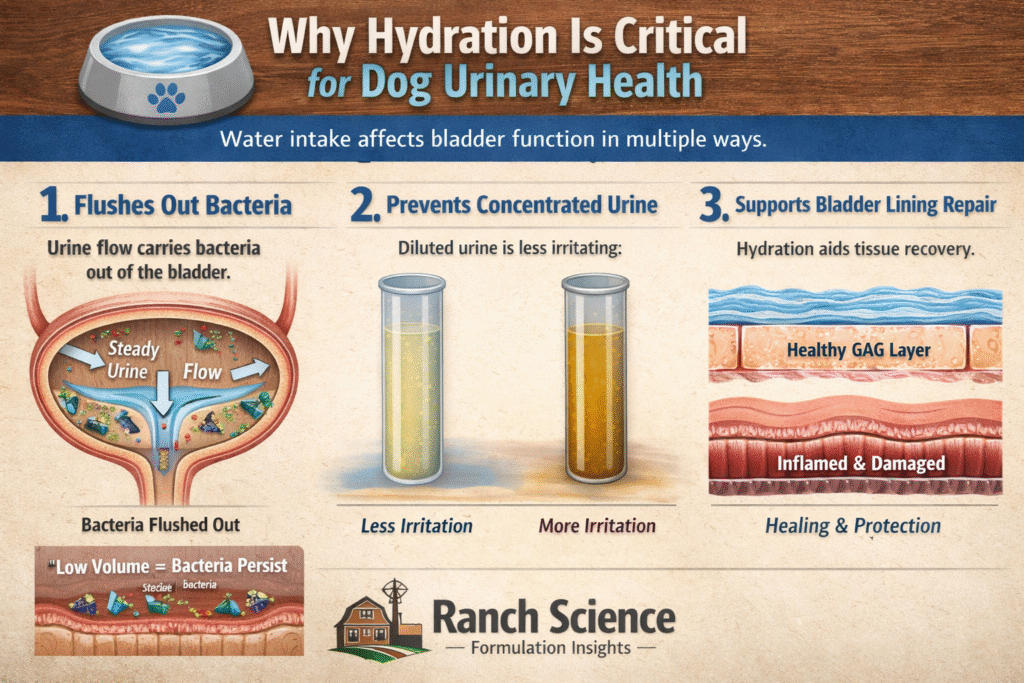
Urine is not just a waste product — it is a mechanical flushing system.
When hydration is adequate:
- Urine is dilute
- Bacteria are flushed before they can attach
- The bladder lining experiences less chemical irritation
When hydration is inadequate:
- Urine becomes concentrated
- Contact time between bacteria and bladder tissue increases
- Inflammatory stress on the bladder wall rises
This physical environment determines whether the bladder becomes hostile to bacteria — or hospitable.
Concentrated Urine Drives Bladder Irritation
Concentrated urine contains higher levels of:
- Urea
- Minerals
- Metabolic waste products
These compounds increase irritation of the bladder lining, especially when exposure is prolonged.
Over time, this irritation damages the bladder’s protective glycosaminoglycan (GAG) layer, weakening the natural barrier that prevents bacterial attachment.
This mechanism is explored in detail here:
👉 How Bacteria Adhere to the Bladder Wall in Dogs (and Why Recurring UTIs Keep Coming Back)
Why Hydration Comes Before Supplements
Many owners conclude that cranberry or urinary supplements “didn’t work.”
In reality, supplements cannot overcome a hostile tissue environment.
When the bladder lining is inflamed and urine is concentrated:
- Bacterial adhesion increases
- Tissue permeability increases
- Supplements have limited functional impact
This is why urinary supplements often fail during active inflammation, as explained here:
👉 Why Urinary Supplements Fail When the Bladder Lining Is Inflamed in Dogs
Hydration is what lowers the inflammatory baseline so other strategies can function.
Urine pH Is Influenced by Hydration, Not the Other Way Around
Urine pH often fluctuates in dogs with urinary issues, but pH is largely a downstream effect.
Hydration influences:
- Urine concentration
- Waste product density
- Metabolic byproduct accumulation
Which in turn influences pH.
This misconception is addressed in:
👉 Why Urine pH Isn’t the Real Problem in Most Dog UTIs
Adjusting pH without addressing hydration treats numbers — not biology.
Where Cranberry PACs Fit — After Hydration Is Addressed
Cranberry proanthocyanidins (PACs) do not kill bacteria.
They work by interfering with bacterial adhesion, reducing the ability of bacteria to attach to bladder tissue.
This mechanism is detailed here:
👉 Cranberry Proanthocyanidins and Urinary Tract Defense in Dogs
However, PACs are most effective when:
- Urine is dilute
- Bladder irritation is reduced
- Tissue surfaces are healing
Hydration creates the conditions that allow PACs to do their job.
Hydration Is a Daily, Mechanical Defense
Unlike supplements or medications, hydration:
- Works continuously
- Requires no metabolic conversion
- Reduces risk mechanically, not chemically
Effective hydration strategies include:
- Encouraging frequent water intake
- Feeding moisture-rich foods when appropriate
- Monitoring urine color and frequency
- Adjusting intake for activity level, age, and climate
Hydration is not a “supportive” strategy — it is foundational.
Prevention Works From the Ground Up
Long-term urinary resilience depends on:
- Dilute urine
- Intact bladder lining
- Reduced inflammation
- Limited bacterial attachment opportunities
Hydration influences every one of these variables.
Without it, no supplement, diet, or protocol can reliably succeed.
Frequently Asked Questions
Why is hydration so important for urinary health in dogs?
Hydration dilutes urine, reduces bladder irritation, and physically flushes bacteria before they can adhere to the bladder wall.
Can dehydration cause urinary tract infections in dogs?
Dehydration increases urine concentration and contact time with bladder tissue, creating conditions that favor bacterial adhesion and inflammation.
Does drinking more water reduce bladder inflammation?
Adequate hydration reduces chemical irritation from concentrated urine, which helps lower inflammatory stress on the bladder lining.
Will urinary supplements work if my dog is dehydrated?
Supplements are less effective when urine is concentrated and bladder tissue is inflamed. Hydration improves the environment supplements rely on.
Scientific References
- Flores-Mireles AL et al. Urinary tract infections: epidemiology, mechanisms. Nature Reviews Microbiology.
- Hooton TM et al. Pathogenesis of urinary tract infections. New England Journal of Medicine.
- Veterinary Clinics of North America — Canine Lower Urinary Tract Disease.
- Howell AB et al. Anti-adhesion activity of cranberry PACs. Journal of Nutrition.
Written by [Natural Ranch Products Team ], Pet Wellness Advocate at Natural Ranch. Passionate about holistic dog care and high-quality nutrition.”