Why Multivitamins Fail in Dogs — And What Actually Works
Most dog multivitamins promise everything. Ranch Science explains why many fail biologically — and what truly supports canine health long-term.
Introduction: More Isn’t Better — It’s Often Worse
Walk down the pet supplement aisle and you’ll see multivitamins promising complete nutrition, immune support, joint health, skin health, and more — all in one chew.
Yet many dogs on multivitamins still struggle with:
• Recurrent inflammation
• Digestive upset
• Poor coat quality
• Low energy despite “daily supplementation”
The issue isn’t that dogs don’t need nutrients.
The issue is how nutrients are delivered, absorbed, and utilized.
Ranch Science looks past label claims and focuses on biology.
⸻
The Core Problem With Most Dog Multivitamins
Most multivitamins fail for three scientific reasons:
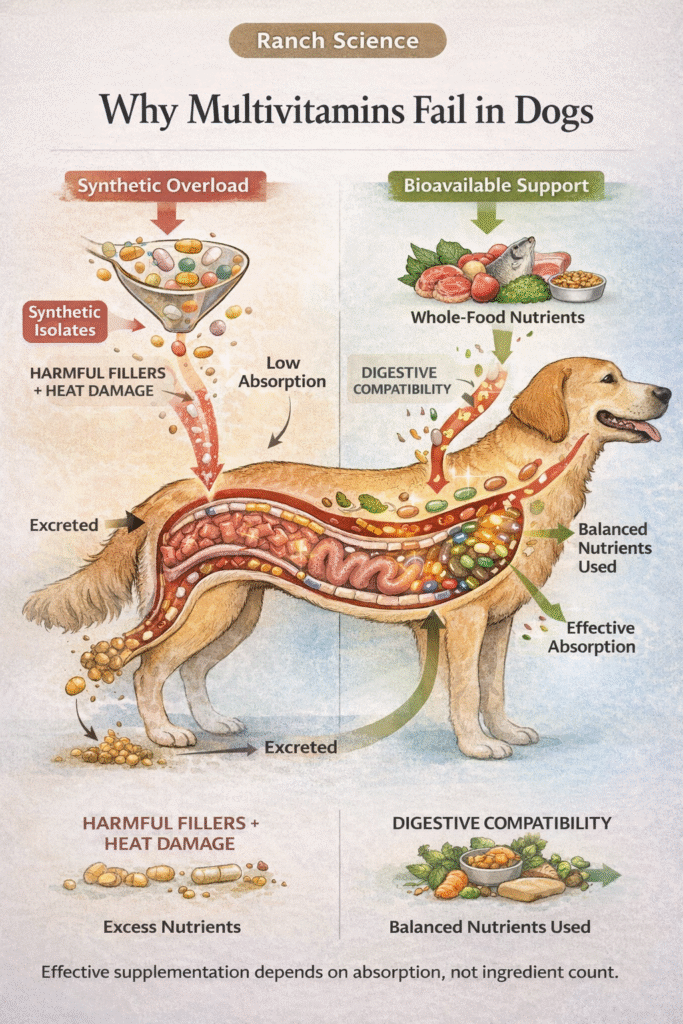
1. Synthetic Nutrients Don’t Behave Like Food
Many multivitamins rely heavily on synthetic isolates:
• Synthetic vitamin A
• Synthetic B-complexes
• Inorganic mineral salts
These nutrients:
• Compete for absorption
• Can overload metabolic pathways
• Are often excreted rather than utilized
More isn’t better — bioavailability is everything.
⸻
2. Absorption Happens in the Gut, Not the Label
A vitamin only helps if it’s absorbed.
Factors that reduce absorption:
• Inflammation in the gut
• Poor fat digestion
• Competing nutrients dosed together
• High-heat processing
This is why delivery method matters.
(See related Ranch Science concept:
👉 Why cold-extruded supplements preserve nutrients better than high-heat processing
⸻
3. Vitamins Can’t Fix Structural Problems Alone
Multivitamins don’t:
• Repair inflamed tissue
• Restore gut barrier integrity
• Prevent bacterial adhesion
• Correct hydration deficits
This mirrors what we see in urinary health, where chemistry alone doesn’t solve mechanical problems.
(Referenced here:
👉 Why urine pH isn’t the real problem in most dog UTIs
https://naturalranchproducts.com/why-urine-ph-isnt-the-real-problem-in-most-dog-utis/)
⸻
What Does Work: Targeted, Bioavailable Support
Effective supplementation follows three rules:
✔ Real Forms
Nutrients should come from food-based or biologically active sources whenever possible.
✔ Intelligent Dosing
Stacking dozens of nutrients at max dose creates competition — not synergy.
✔ Gentle Processing
Heat destroys delicate compounds before your dog ever consumes them.
This is where soft chew delivery, cold processing, and targeted formulation matter.
⸻
Where Multivitamin Soft Chews Fit (Correctly)
When done right, multivitamins can support foundational health — not override biology.
The Ranch Science approach focuses on:
• Supporting nutrient gaps
• Working with digestion
• Complementing targeted supplements (like bladder or inflammation support)
👉 Multivitamin Soft Chews for Dogs
These are designed to support, not replace, systems already doing their job.
⸻
Why Multivitamins Should Never Be the Only Tool
Foundational health requires:
• Hydration
• Inflammation control
• Organ-specific support
• Structural protection (gut, bladder, joints)
This is why we don’t treat multivitamins as a “fix-all” — just like cranberry PACs aren’t antibiotics.
(See Ranch Science explanation:
👉 Cranberry proanthocyanidins and urinary tract defense in dogs
https://naturalranchproducts.com/cranberry-proanthocyanidins-and-urinary-tract-defense-in-dogs/)
⸻
Ranch Science Perspective
Multivitamins work best when:
• The gut can absorb them
• The body actually needs them
• They aren’t fighting inflammation or overload
They are foundational, not corrective.
FAQ SET (FINAL)
1. What is the biggest problem with dog multivitamins?
Most dog multivitamins rely on synthetic nutrients and high-dose formulations that compete for absorption. When multiple vitamins and minerals are delivered in excess or poor ratios, the body cannot efficiently absorb or use them, which limits real nutritional benefit.
2. Are multivitamins bad for dogs?
Answer:
Multivitamins are not inherently bad for dogs. Problems arise when formulas use low-quality synthetic ingredients, excessive dosing, or high-heat processing that reduces nutrient integrity. Well-designed multivitamins can support baseline nutritional needs when used appropriately.
3. Do multivitamins replace targeted supplements?
Answer:
No. Multivitamins provide general nutritional support but do not replace targeted supplements designed for specific systems such as urinary health, joint integrity, inflammation control, or gut function. Targeted formulas address mechanisms that multivitamins cannot.
4. Why does processing matter in dog supplements?
Answer:
High-heat processing can degrade sensitive vitamins, fats, and antioxidants before a dog ever consumes them. Gentle processing methods help preserve nutrient structure, improving stability, bioavailability, and real-world effectiveness.
Conclusion: Support Biology — Don’t Override It
Health doesn’t come from stacking ingredients.
It comes from working with the body’s systems, not overwhelming them.
Ranch Science isn’t anti-vitamin.
It’s anti-ineffective nutrition.
Written by Natural Rach Products Team , Pet Wellness Advocate at Natural Ranch. Passionate about holistic dog care and high-quality nutrition.”