Why Whole-Food Multinutrient Support Matters in Dogs (and Why Processing Changes Everything)
When dog owners think about supplements they usually think in silos — joint support for the hips, urinary support for the bladder, skin support for the coat. It makes intuitive sense to match a supplement to a symptom. But biology doesn’t work in silos, and this approach consistently misses the foundational layer that determines how well every targeted intervention actually performs.
A dog’s immune system, bladder lining, gut microbiome, inflammatory response, and tissue repair capacity are all interconnected — and all of them depend on adequate micronutrient availability to function at their potential. When that nutritional foundation is compromised — through heat-damaged nutrients, synthetic isolates with poor bioavailability, or age-related absorption decline — targeted supplements are forced to compensate for deeper weaknesses rather than working on a prepared biological foundation for canine multinutrient support.
Nutrition Is the Infrastructure That All Defense Systems Run On
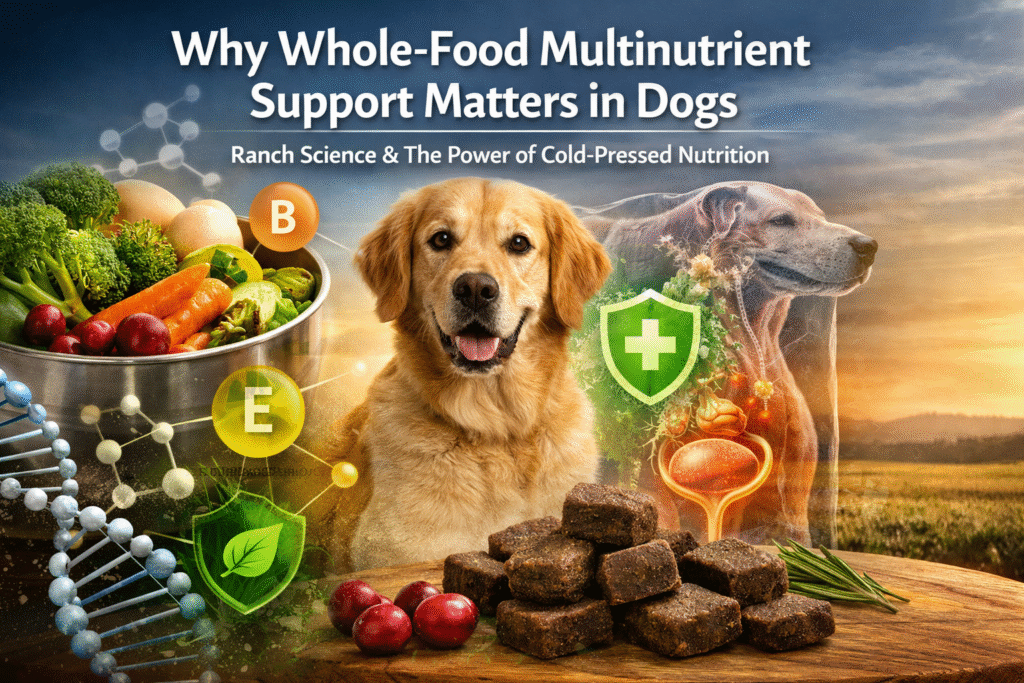
Every protective system in a dog’s body depends on nutrients to function. Immune cells require vitamins, minerals, and enzymatic cofactors to identify and respond to pathogens appropriately. Tissue repair relies on antioxidants, amino acids, and zinc for cell regeneration. Inflammatory signaling is regulated by micronutrient balance — particularly omega fatty acid ratios, Vitamin E, and selenium. Barrier tissues — gut lining, bladder lining, skin — depend on nutritional integrity to maintain their protective function.
When dogs are deficient in these micronutrients — or when they are consuming heat-damaged nutrients that the body cannot effectively absorb and use — these systems weaken quietly over time. The dog may appear healthy by gross observation while the biological foundations of their immune resilience, tissue integrity, and inflammatory regulation erode. This is why dogs can experience recurring infections, chronic inflammation, slow recovery after illness, and increasing sensitivity with age even when calories are sufficient and the diet appears complete on paper.
Whole-food multinutrient support addresses this foundation directly — not as a targeted intervention for a specific symptom, but as the nutritional infrastructure that allows every other system, and every other supplement, to function at its potential.
Why Processing Temperature Determines Whether Nutrients Actually Work
The most important and most overlooked factor in supplement evaluation isn’t the ingredient list — it’s what happened to those ingredients during manufacturing. High-heat steam extrusion — the dominant manufacturing method for commercial pet supplement chews — processes ingredients at temperatures exceeding 150-180°C. At these temperatures probiotics lose viability, enzymes are denatured, fragile fatty acids oxidize, and heat-sensitive vitamins including B1, B6, B12, C, and E degrade.
A supplement label can accurately list every nutrient at its stated amount — because the label reflects what went in. But what the dog’s body receives is determined by what survived the manufacturing process. When nutrients are heat-damaged, the body often fails to recognize them as usable compounds, routes them through the liver and kidneys for elimination rather than absorbing them, or — in the case of oxidized fatty acids — receives compounds that promote the inflammation they were intended to reduce.
Cold-pressed manufacturing keeps temperatures low throughout production, preserving biological activity from ingredient to finished chew. Enzymes remain active. Probiotics survive processing at viable counts. Antioxidants retain their molecular structure. Fat-soluble nutrients remain stable rather than oxidizing. This is the manufacturing standard that makes a whole-food multinutrient formula actually function as labeled.
For the full science on how manufacturing temperature affects nutrient integrity: Why Cold-Processed Pet Supplements Preserve Nutrients Better
How Whole-Food Multinutrient Status Influences Urinary Health
Urinary health is not just about bacteria — it is about environment. The bladder lining’s ability to maintain its protective GAG layer, the immune system’s capacity to resist bacterial establishment between antibiotic courses, the inflammatory response that determines how quickly the bladder recovers after infection — all of these are micronutrient-dependent functions.
Cranberry PACs reduce bacterial adhesion to the bladder wall — a well-documented anti-adhesion mechanism. But preventing recurring UTIs also requires controlled inflammation that allows the bladder lining to repair between episodes, functional immune response that resists bacterial establishment during the vulnerable post-antibiotic window, and healthy tissue turnover that maintains the GAG layer integrity that each infection progressively degrades.
These are multinutrient-dependent functions. Zinc for tissue repair. Vitamin E and selenium for antioxidant protection during inflammatory recovery. B vitamins for cellular energy that drives immune cell function. Probiotics for gut microbiome balance that directly influences the immune cells lining the urinary tract. A dog whose foundational nutritional status is strong responds to targeted urinary support more effectively than one whose nutritional foundation is compromised.
For the full science on how bacteria establish in the bladder and what determines resistance: How Bacteria Adhere to the Bladder Wall in Dogs (And Why Recurring UTIs Keep Coming Back)
For the full science on why gut health directly affects urinary health: Why Gut Health and Urinary Health Are Connected in Dogs
Whole-Food Multinutrients vs Synthetic Isolates — Why the Form Determines the Outcome
Not all multinutrient formulas are equivalent, even at identical labeled doses. Synthetic isolated vitamins lack the cofactors — complementary enzymes, minerals, and phytonutrients — that naturally accompany nutrients in whole food sources and that influence their absorption and cellular utilization. A synthetic vitamin C supplement contains ascorbic acid without the flavonoids that enhance its cellular uptake. A synthetic Vitamin E supplement typically contains only dl-alpha-tocopherol — a racemic mixture of bioactive and inactive forms — rather than the complete tocopherol family that works synergistically in natural sources.
Whole-food-based multinutrient formulas maintain natural nutrient ratios, support synergistic absorption, and act more like food than isolated chemicals. For dogs with chronic inflammation, digestive sensitivity, recurring infections, or age-related metabolic decline — the distinction between synthetic isolates and naturally derived nutrients in bioavailable forms produces meaningfully different outcomes at equivalent label doses.
For the full breakdown of synthetic versus natural vitamin forms and what to look for on a label: The Multivitamin Myth: Why Synthetic Nutrients Aren’t Real Food
Why Aging Dogs Need Whole-Food Canine Multinutrient Support More, Not Less
Every factor that makes whole-food multinutrient support valuable is amplified as dogs age. Stomach acid production declines — reducing the acid environment needed to release B12 from food proteins and to ionize minerals for absorption. Pancreatic enzyme output decreases — reducing the efficiency of protein, fat, and carbohydrate digestion that nutrient extraction depends on. Gut microbiome diversity progressively narrows — weakening the microbial nutritional production and immune support functions it provides. Intestinal cell renewal slows — reducing the absorption surface area that nutrient uptake requires.
A senior dog on the same commercial diet they’ve eaten for years may be running nutritional deficits that didn’t exist at age three — not because the diet changed but because their capacity to extract nutrition from it has. Senior dogs often show meaningful improvement from multinutrient support not because the supplement is “extra” — but because their bodies are receiving usable nutrition in bioavailable forms that their declining digestive systems can actually absorb.
For the specific signs that indicate nutritional gaps may be driving recurring health issues: 7 Signs Your Dog Needs a Multivitamin
The Ranch Science Approach — Multinutrient Support as Infrastructure
This is where the Natural Ranch Daily Multivitamin fits into the Ranch Science framework — not as a general supplement or a quick fix, but as nutritional infrastructure. Active vitamin forms that don’t require conversion steps. Chelated minerals that absorb efficiently rather than passing through. Named probiotic strains with CFU counts that support the gut microbiome rather than just listing “probiotics” on the label. Digestive enzymes that restore what processing removed. Cold-pressed Canine Royal Oil™ — a proprietary cranberry seed oil providing a balanced 1:1:1 ratio of Omega-3, Omega-6, and Omega-9 — turning the carrier into a functional nutritional contribution rather than an inert filler.
Cold-pressed manufacturing throughout. Grain-free and sugar-free. Made in the USA. 30-day money-back guarantee.
When the nutritional foundation is genuinely intact — not labeled, but biologically active — targeted supplements like Bladder Guard work on a prepared system rather than compensating for deeper gaps. That’s the difference between supplementing and actually supporting.
→ See the Natural Ranch Daily Multivitamin
→ See the Total Defense System — Bladder Guard + Daily Multivitamin
Why would my dog need a multivitamin if they eat a complete commercial diet?
Commercial diets meet AAFCO minimum requirements — but minimums are not optimal levels. High-heat kibble processing degrades heat-sensitive vitamins during manufacturing. Senior dogs absorb nutrients less efficiently from the same food they’ve eaten for years. Dogs with digestive conditions may not extract adequate nutrients even from quality food. And homemade diet dogs almost always have nutritional gaps. A daily multivitamin fills the gap between minimum standards and what a dog with individual needs actually requires for optimal biological function.
Are multivitamins safe for long-term daily use in dogs?
When formulated with appropriate nutrients at appropriate doses and manufactured with cold-pressed methods that preserve biological activity, daily multinutrient support is generally considered safe for long-term use. The primary safety consideration is fat-soluble vitamins — A, D, E, and K — which accumulate in tissue rather than being excreted. A balanced formula at appropriate doses is significantly safer than stacking multiple individual supplements. Always follow label dosing guidelines for your dog’s weight.
Do multivitamins replace targeted supplements like bladder or joint support?
No — they serve different functions and work best together. Whole-food multinutrient support provides the foundational nutritional infrastructure that all biological systems depend on — immune function, tissue repair, inflammatory regulation, gut microbiome balance. Targeted supplements address specific mechanisms within those systems — cranberry PACs for bacterial anti-adhesion, glucosamine for cartilage support. Multinutrient support strengthens the environment in which targeted supplements work, allowing them to perform more effectively than they would on a nutritionally depleted foundation.
Why does cold-pressed manufacturing matter for a multinutrient supplement?
High-heat steam extrusion — used for most commercial supplement chews — processes at temperatures that destroy probiotics, denature enzymes, oxidize fatty acids, and degrade heat-sensitive vitamins. A supplement can accurately list all ingredients at stated amounts while delivering minimal biological benefit because manufacturing destroyed them. Cold-pressed manufacturing preserves biological activity from production to bowl — enzymes remain active, probiotics survive at viable counts, vitamins retain their functional forms. The label reflects what the dog’s body actually receives rather than what went in before heat processing.
How does multinutrient status affect urinary health in dogs?
Urinary health depends on more than bacterial anti-adhesion. The bladder lining’s ability to maintain its protective GAG layer requires zinc and amino acids for tissue repair. The immune system’s capacity to resist bacterial establishment between antibiotic courses requires vitamins C, E, and selenium. Inflammatory recovery after infection requires antioxidant support. Gut microbiome balance — supported by probiotics — directly influences the immune cells lining the urinary tract. A dog with a strong nutritional foundation responds to targeted urinary support more effectively than one whose foundational nutritional status is compromised.
Why do senior dogs benefit most from whole-food multinutrient support?
Every absorption mechanism declines with age — stomach acid production decreases reducing B12 and mineral absorption, pancreatic enzyme output falls reducing digestive efficiency, gut microbiome diversity narrows weakening nutritional production and immune function, and intestinal absorption surface area reduces. A senior dog on the same diet they’ve eaten for years may be running deficits that didn’t exist at age three — not because the diet changed but because their capacity to extract nutrition from it has declined. Whole-food multinutrient support in bioavailable forms addresses these declining absorption mechanisms directly.
References
National Research Council. Nutrient Requirements of Dogs and Cats. National Academies Press. 2006.
Hand MS, et al. Small Animal Clinical Nutrition, 5th Edition. Mark Morris Institute. 2010.
Larsen J., Fascetti A. “Evaluation of recipes for home-prepared diets for dogs and cats.” Journal of the American Veterinary Medical Association. 2019.
Song H., et al. “Probiotics ameliorate atopic dermatitis in dogs by modulating gut microbiota.” BMC Microbiology. 2025.
Association of American Feed Control Officials. “Nutritional Adequacy Statements and Pet Food Labeling.” aafco.org.
VCA Animal Hospitals. “Vitamins and Minerals for Dogs.” vcahospitals.com.