Why Oat and Aloe Help Calm Irritated Dog Skin
When a dog scratches persistently after a bath, develops dry flaky skin despite regular grooming, or shows recurring hotspots that never fully resolve, the answer is often found in the ingredients used during bathing — not in the bathing frequency itself. Oatmeal and aloe are the two most well-researched topical ingredients for calming irritated dog skin, and understanding exactly how they work explains why they appear so consistently in formulas designed for sensitive dogs.
This isn’t marketing language. Both ingredients have documented mechanisms that directly address the biological causes of skin irritation — and knowing those mechanisms helps you evaluate any grooming product more critically.
The Canine Skin Barrier — Why It’s the Starting Point
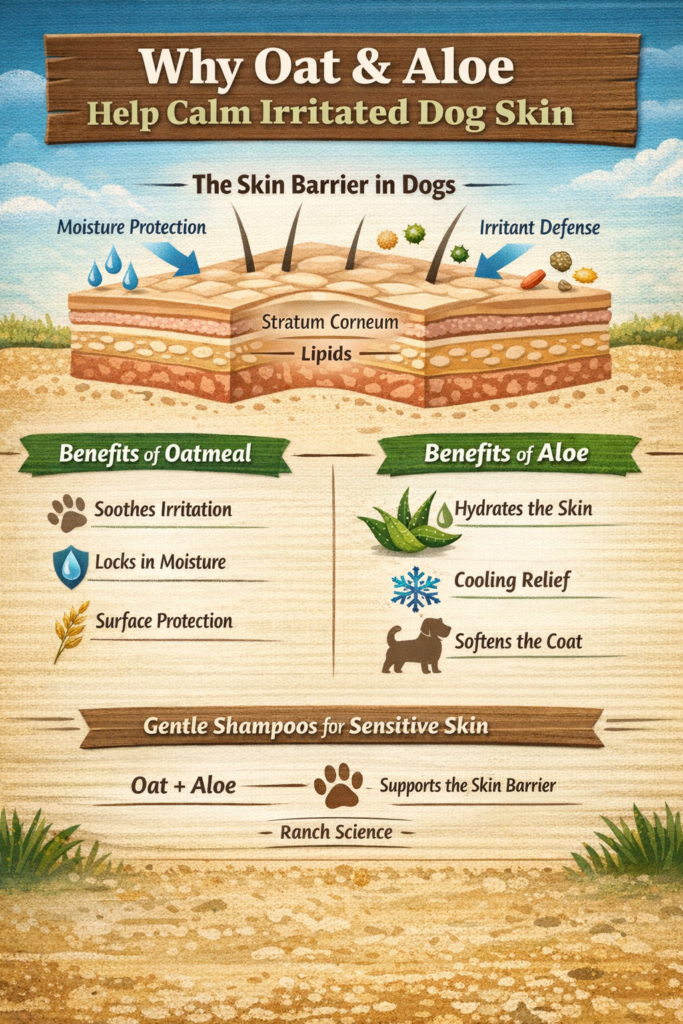
The skin’s outermost layer — the stratum corneum — is not just a passive surface. It is an active biological structure made of tightly packed cells surrounded by a lipid matrix that regulates moisture, limits allergen penetration, and protects the deeper tissue layers from chemical and microbial irritants.
When this barrier is intact the skin maintains its own moisture, repels environmental triggers, and supports healthy coat growth. When it is disrupted — through harsh detergents, environmental allergens, dry climates, or underlying skin conditions — moisture escapes, allergens penetrate more easily, and the skin becomes progressively more reactive and difficult to manage.
Most skin irritation in dogs is either caused by barrier disruption or significantly worsened by it. This is why the most effective approach to irritated dog skin focuses on supporting and restoring the barrier rather than just suppressing symptoms.
For the full science on why the canine skin barrier matters: Why the Canine Skin Barrier Matters More Than Most Dog Owners Realize
How Colloidal Oatmeal Works on Dog Skin
Not all oatmeal in dog shampoos is created equal. The key distinction is between colloidal oatmeal — whole-grain oats ground into a micro-fine powder — and oat protein, a cheaper processed derivative that behaves very differently on the skin surface.
The FDA recognized colloidal oatmeal as a skin protectant in 2003 based on its demonstrated efficacy. Oat protein carries no such recognition — and for good reason. The active compounds that make colloidal oatmeal effective are found in whole-grain oats, not in the protein fraction.
Avenanthramides — The Anti-Itch Compounds
Avenanthramides are polyphenolic antioxidants found exclusively in oats. Clinical research has shown that avenanthramides significantly reduce the release of pro-inflammatory cytokines — the signaling molecules that drive the itch-scratch cycle in irritated skin. This is why the anti-itch effect of colloidal oatmeal is not just a mechanical or physical effect — it works at the cellular inflammation level.
Studies published in PubMed have shown that colloidal oatmeal extracts diminished pro-inflammatory cytokines in vitro with significant clinical improvements in skin dryness, scaling, and itch intensity. This is the science behind why dogs scratch less after bathing with colloidal oatmeal shampoos compared to standard detergent formulas.
The Mucilaginous Film — Physical Barrier Protection
When colloidal oatmeal is applied to the skin and given adequate contact time — the critical 5-10 minutes before rinsing — it forms a mucilaginous film on the skin surface. This film is physically protective: it locks in hydration, reduces transepidermal water loss, and creates a temporary barrier against environmental allergens like pollen, dust, and dander.
This film persists after rinsing and continues to protect the skin for days after the bath. This is why dogs bathed with proper colloidal oatmeal formulas show reduced irritation not just during the bath but for days afterward — the protection outlasts the washing.
Saponins — Nature’s Cleanser
Oats naturally contain saponins — compounds that act as mild cleansers, lifting dirt, dander, and environmental debris from the coat and skin without the need for synthetic detergents. This allows colloidal oatmeal shampoos to clean effectively while using gentler surfactant systems — or none at all — compared to detergent-based formulas.
Beta-Glucans — Immune Modulation
Beta-glucans in oats support immune modulation at the skin surface — helping regulate the inflammatory response that causes redness and reactive skin. For dogs with chronic skin conditions driven by immune overresponse, beta-glucans contribute to a calmer, more stable skin environment over repeated bathing cycles.
How Aloe Vera Supports Irritated Dog Skin
Aloe vera barbadensis leaf juice — the whole-leaf gel of the aloe plant — has been used in skin care for centuries and is now well-documented in peer-reviewed literature for its mechanisms on inflamed and irritated skin.
Anti-Inflammatory Pathways
Aloe vera contains compounds including acemannan, aloesin, and bradykininase that inhibit inflammatory pathways including prostaglandin production. Research published in NIH literature shows that aloe vera can inhibit inflammatory pathways, improve the wound healing process, and reduce skin redness — mechanisms that directly address the biological drivers of irritated and reactive skin.
For dogs with inflamed skin from hotspots, seasonal allergies, or post-bath irritation, aloe addresses the inflammation at the source rather than just masking the visible symptoms.
Humectant Hydration
The polysaccharides in aloe vera — particularly the mucopolysaccharides — act as natural humectants, attracting and binding moisture to the skin surface. This hydrating mechanism is particularly effective for dogs with chronically dry skin where the lipid barrier is unable to retain adequate moisture between baths.
When used as a primary base ingredient rather than a trace addition at the end of the ingredient list, organic aloe vera delivers meaningful hydration — not just cosmetic moisture that evaporates quickly after application.
Cooling and Immediate Comfort
The evaporative cooling effect of aloe vera on application provides immediate sensory relief from hot, irritated skin — reducing the post-bath scratching that occurs when inflamed skin makes contact with air. This immediate comfort response is particularly noticeable in dogs with active hotspots or seasonal allergic reactions.
Wound Healing Support
Aloe vera supports the wound healing process in skin experiencing barrier disruption — stimulating fibroblast activity, improving collagen synthesis, and reducing the time needed for compromised skin to recover its protective function. For dogs whose skin barrier has been degraded by repeated inflammation or harsh shampoo use, this healing support accelerates recovery between bathing cycles.
Why the 5-10 Minute Contact Time Changes Everything
The most common reason oatmeal and aloe shampoos underperform is insufficient contact time. Most owners apply shampoo and rinse within a minute or two — cleaning the coat but missing the therapeutic window entirely.
Both colloidal oatmeal and aloe vera need time to work. Colloidal oatmeal requires contact time to form its mucilaginous protective film. Aloe vera requires contact time to penetrate and hydrate deeper skin layers and to deliver its anti-inflammatory compounds to the inflamed tissue.
The difference in outcome between a 1-minute application and a 10-minute application is significant — particularly for dogs with active skin irritation. The 5-10 minute rule isn’t a grooming preference, it’s the difference between surface cleaning and actual therapeutic benefit.
Why Oat and Aloe Work Better Together Than Either Alone
Colloidal oatmeal and aloe vera address complementary mechanisms simultaneously — which is why formulas containing both consistently outperform single-ingredient alternatives.
- Oatmeal provides the physical protective film that locks in moisture after rinsing. Aloe provides the humectant action that draws moisture into the skin during contact time.
- Oatmeal’s avenanthramides reduce cytokine-driven inflammation from within the skin layers. Aloe’s acemannan and bradykininase inhibit inflammatory pathways from the surface.
- Oatmeal’s saponins provide gentle mechanical cleansing. Aloe’s polysaccharides provide conditioning that keeps the coat soft and manageable after washing.
- Oatmeal’s protective film reduces post-bath allergen penetration. Aloe’s cooling effect reduces the immediate post-bath inflammatory response that triggers scratching.
Together they address the itch-scratch-inflammation cycle at multiple points simultaneously — which is why the combination is considered the standard of care in formulas designed for dogs with sensitive, reactive, or allergy-prone skin.
The Inside-Out Approach to Skin Health
Oatmeal and aloe shampoos address skin health from the outside. For dogs with chronic skin issues, the most complete approach combines topical support with internal nutritional support that rebuilds the skin barrier from within — Omega-3 fatty acids for lipid layer production, Biotin for keratin synthesis, and Zinc for skin cell repair and immune regulation.
The Natural Ranch Skin and Coat Defense Duo combines Oat and Aloe Shampoo with the Daily Multivitamin powered by cold-pressed Canine Royal Oil for inside-out comprehensive skin and coat support.
→ See Natural Ranch Oat and Aloe Dog Shampoo
→ See the Skin and Coat Defense Duo
For the full science on over-bathing and skin barrier disruption: Are You Over-Bathing Your Dog? What It Does to Their Skin
Why is oatmeal used in dog shampoo?
Colloidal oatmeal contains avenanthramides that reduce pro-inflammatory cytokines driving the itch-scratch cycle, beta-glucans that modulate skin immune response, saponins that provide gentle cleansing, and polysaccharides that form a protective moisture-locking film on the skin surface. The FDA recognized colloidal oatmeal as a skin protectant in 2003 based on its demonstrated efficacy — a distinction that oat protein, the cheaper alternative used in many shampoos, does not share.
Is aloe vera safe for dogs in shampoo?
Organic aloe vera barbadensis leaf juice in properly formulated dog shampoos is widely considered safe and beneficial. Topical aloe vera inhibits inflammatory pathways, provides humectant hydration through its polysaccharide content, supports the wound healing process in compromised skin, and delivers immediate cooling relief for irritated skin. The form matters — whole-leaf organic aloe used as a primary base ingredient delivers meaningful benefit, while trace aloe at the end of the ingredient list provides minimal effect.
What causes dry skin in dogs?
Dry skin in dogs results from disruption of the skin barrier’s ability to retain moisture — transepidermal water loss. Common causes include frequent bathing with sulfate-based detergent shampoos that strip the lipid layer, environmental allergens that trigger inflammatory barrier disruption, low humidity, inadequate dietary fatty acids that support lipid layer production, and underlying skin conditions including atopic dermatitis. Colloidal oatmeal and aloe address the moisture retention and inflammation aspects of dry skin directly.
How often should dogs with sensitive skin be bathed?
Most dogs with sensitive skin benefit from bathing every 4-6 weeks with a barrier-preserving formula. Dogs with environmental allergies may benefit from weekly bathing to remove allergens — but only with a sulfate-free, pH-balanced formula containing colloidal oatmeal and aloe that can be used frequently without stripping the barrier. The 5-10 minute contact time rule is essential for frequent bathers — allowing therapeutic ingredients to provide their full benefit between wash cycles.
What is the difference between colloidal oatmeal and oat protein in dog shampoo?
Colloidal oatmeal is whole-grain oats ground into a micro-fine powder containing avenanthramides, beta-glucans, saponins, and polysaccharides that actively support skin health. It forms a protective film on the skin and has FDA recognition as a skin protectant. Oat protein is a cheaper processed derivative that is water-soluble, washes off during rinsing, and provides minimal physical protection or anti-inflammatory benefit. Always check the ingredient list — the label saying ‘oatmeal’ may mean either form.
How long should oatmeal shampoo be left on a dog?
5-10 minutes is the optimal contact time for colloidal oatmeal and aloe shampoos to deliver their full therapeutic benefit. Colloidal oatmeal needs this time to form its protective mucilaginous film on the skin surface. Aloe vera needs this time to penetrate and hydrate deeper skin layers and deliver its anti-inflammatory compounds. Rinsing immediately after application provides surface cleaning without the therapeutic benefit — particularly important for dogs with active irritation or seasonal allergies.
References
Marsella R., et al. “Current Evidence on the Use of Colloidal Oatmeal in Veterinary Dermatology.” Veterinary Dermatology.
Pavicic T., et al. “Colloidal Oatmeal in Dermatology.” Journal of Drugs in Dermatology.
PubMed. “Extracts of colloidal oatmeal diminished pro-inflammatory cytokines in vitro showing significant clinical improvements in skin dryness, scaling, and itch intensity.” PMID: 25607907.
NIH National Library of Medicine. “Aloe vera can inhibit inflammatory pathways, improve the wound healing process, and reduce skin redness.” PMC6330525.
Surjushe A., et al. “Aloe Vera: A Short Review.” Indian Journal of Dermatology.
Scott D., Miller W., Griffin C. Muller and Kirk’s Small Animal Dermatology.