
Why Some Dog UTIs Return: The Role of Dormant Bacteria in the Bladder
Some bacteria can enter low-activity states inside tissues, allowing them to persist quietly before becoming active again. This behavior may help explain why some canine urinary infections appear to resolve but later return.
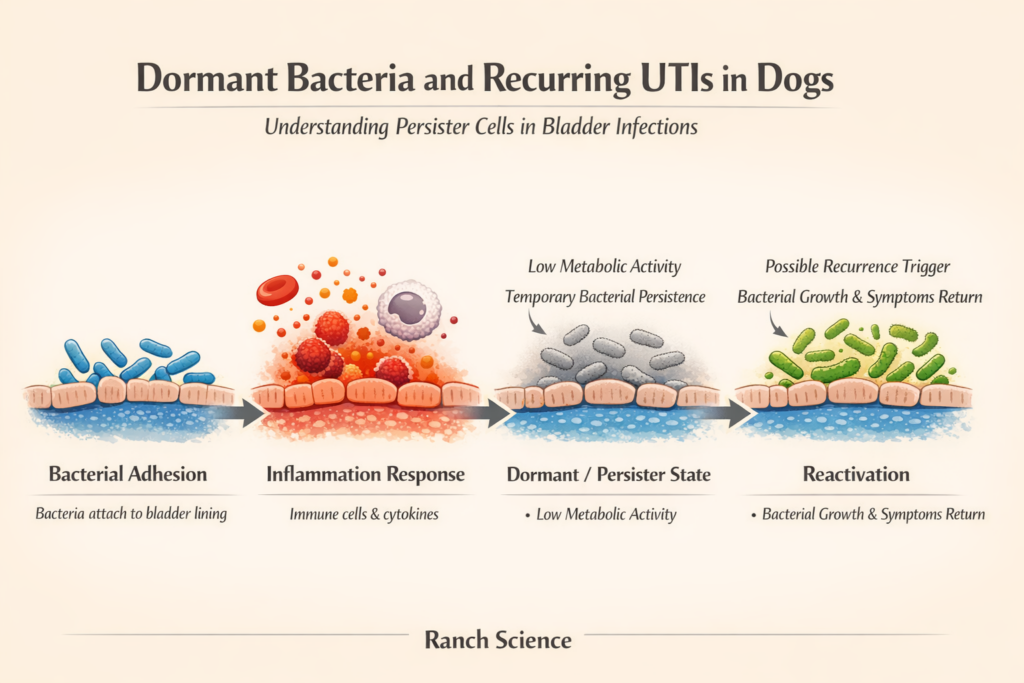
Introduction
Many dogs recover from a urinary tract infection, only to develop symptoms again weeks or months later.
From an owner’s perspective, this pattern can be confusing. The infection seemed to clear, the dog improved, and then the problem returned.
Reinfection from environmental exposure is one possible explanation. But researchers studying bacterial behavior have also identified another biological mechanism that may influence recurrence patterns: bacterial dormancy.
In certain conditions, small populations of bacteria can enter a low-activity state inside tissues. While inactive, these cells may remain undetected before becoming active again later.
Understanding how dormant bacteria behave inside the bladder helps explain why some urinary infections appear to resolve but may still return.
To see how this occurs, it helps to first understand how bacteria interact with the bladder surface.
The First Step: Bacterial Adhesion
Urinary infections typically begin when bacteria reach the bladder and attach to the bladder lining.
This process, known as adhesion, allows microbes to remain in place instead of being flushed out during urination.
We explored this process in detail in our article on bacterial adhesion and recurring UTIs:
Once bacteria attach to the bladder lining, they can trigger the body’s immune response.
This response may include the release of inflammatory signaling molecules and the recruitment of immune cells. These events are part of what scientists refer to as the inflammatory cascade.
You can read more about that process here:
While inflammation helps the body fight infection, it can also temporarily alter the surface environment of the bladder.
Those surface changes may influence how bacteria behave in the tissue.
A Survival Strategy: Dormant or Persister Bacteria
Not all bacteria behave the same way during infection.
While many actively grow and divide, some cells can shift into a dormant state.
Microbiologists often refer to these as persister cells.
Persister cells are not genetically resistant to treatment. Instead, they temporarily slow their metabolism and reduce growth activity. In this state, the bacteria become far less active than normal.
Because many treatments and immune responses target actively growing cells, dormant bacteria may sometimes survive environmental stress by simply remaining inactive.
Once conditions change, these cells can resume normal metabolic activity.
This biological behavior has been observed in many bacterial species and is an area of active research in infectious disease biology.
How Dormant Bacteria May Persist in the Bladder
Inside the bladder, several conditions may influence bacterial survival:
• attachment to bladder tissue
• local inflammation
• changes to the protective surface lining
• shifts in urine chemistry
The bladder lining itself contains a specialized protective coating known as the glycosaminoglycan (GAG) layer.
This layer helps reduce irritation and can limit bacterial attachment to bladder cells.
We discussed this protective barrier in detail in our article on the GAG layer in dogs:
When the bladder lining becomes inflamed or disrupted, parts of the underlying surface may become more exposed.
These changes may influence how bacteria interact with the tissue environment.
In some cases, small bacterial populations may persist near the bladder lining and enter dormant states while immune defenses reduce the overall infection.
During this phase, symptoms may disappear and urine tests may show improvement.
But the underlying tissue environment may still be recovering.
Why Symptoms May Disappear Before Recurrence
Many urinary infections improve rapidly once treatment begins.
Immune defenses respond, bacterial populations decrease, and inflammation begins to resolve.
However, if a small number of bacteria remain in a low-activity state, they may persist quietly for a period of time.
Later, when conditions inside the bladder change again, those bacteria may become metabolically active.
This can lead to a new cycle of bacterial growth and symptoms.
Researchers believe this type of behavior may contribute to certain recurrence patterns observed in both human and veterinary medicine.
It is one reason scientists increasingly focus not only on bacteria themselves, but also on the bladder environment where infections occur.
The Role of Surface Biology
The bladder is more than a passive container for urine.
Its lining contains specialized cells, protective surface molecules, and immune signaling systems that influence how microbes interact with the tissue.
Several factors may influence this environment, including:
• hydration levels
• urine concentration
• inflammation
• surface barrier integrity
We explored how hydration affects bladder chemistry in our article on hydration and urinary health in dogs:
Together, these factors shape the conditions that bacteria encounter inside the urinary tract.
Understanding this environment helps explain why infections may behave differently from one dog to another.
Looking Ahead: Biofilms and Bacterial Communities
Dormant bacteria represent only one survival strategy used by microbes.
Another important mechanism involves the formation of biofilms, structured bacterial communities attached to biological surfaces.
Within biofilms, bacteria cooperate to produce a protective matrix that can anchor them to tissue.
We explored this phenomenon in our article:
https://naturalranchproducts.com/biofilms-and-recurring-utis-in-dogs
Biofilms and dormant bacteria are often studied together because both influence how microbial populations behave during infection.
By examining these biological processes, researchers continue to improve our understanding of urinary health and recurrence patterns in dogs.
Conclusion
Recurring urinary infections can be influenced by several interacting factors.
While new bacterial exposure is one possibility, scientists also study how microbes survive inside tissues between infection episodes.
Dormant bacterial cells represent one potential mechanism that may help explain why symptoms sometimes disappear before returning.
Combined with factors such as bladder inflammation, surface disruption, and bacterial biofilms, these microbial survival strategies highlight the complex biology of urinary health.
As research continues, understanding these interactions may help veterinarians and scientists better explain the patterns seen in recurring infections.
Scientific References
Lewis K. (2010). Persister cells. Annual Review of Microbiology.
Hultgren SJ et al. (2004). Bacterial adhesion and persistence in urinary tract infections. Nature Reviews Microbiology.
Flores-Mireles AL et al. (2015). Urinary tract infections: epidemiology, mechanisms of infection and treatment options. Nature Reviews Microbiology.
Mulvey MA et al. (2001). Establishment of persistent infection by intracellular bacterial communities. Science.
Costerton JW et al. (1999). Bacterial biofilms: a common cause of persistent infections. Science.
Written by [Natural Ranch Products Team ], Pet Wellness Advocate at Natural Ranch. Passionate about holistic dog care and high-quality nutrition.”