
“Dog Allergies: Seasonal vs Food vs Contact — How to Tell the Difference”
Your dog is scratching constantly, their paws are red, their ears keep getting infected, and you’re not sure whether it’s something they’re eating, something in the air, or something they’re touching. The symptoms of the three main allergy types in dogs overlap significantly —Dog Allergies: Seasonal vs Food vs Contact which is why owners spend months switching foods, trying different shampoos, and treating symptoms without identifying the actual cause.
Distinguishing between seasonal allergies, food allergies, and contact allergies requires looking at specific patterns — when symptoms appear, where on the body they concentrate, whether they follow the diet or the environment, and how they respond to different interventions. This guide gives you the diagnostic framework vets use and the practical steps that follow from each allergy type.
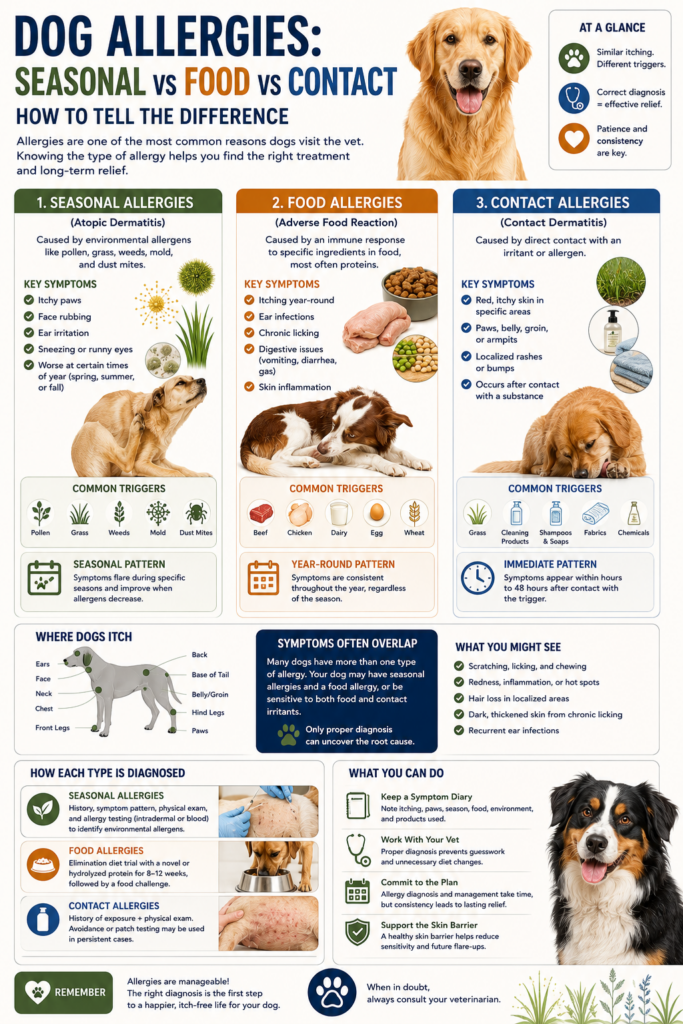
Dog Allergies Seasonal vs Food vs Contact and how they work
All three allergy types share the same underlying mechanism — the immune system overreacting to a normally harmless substance. Dogs experience allergies when their immune system overreacts to a typically harmless substance such as pollen, plants, an ingredient in their food, or insect bites. The substance is classified as a foreign invader, and the immune system sends antibodies to attack, causing distressing symptoms.
The critical difference from human allergies: allergies generally don’t affect dogs’ respiratory systems the way they do in people. Instead canine allergies cause lots of skin problems such as atopic dermatitis. It’s common for dogs with allergies to suffer from chronic ear infections and itchy skin, especially on the face, paws, armpits, and lower belly. This means the familiar human allergy picture — sneezing, runny nose, watery eyes — is not the primary presentation in dogs. Skin is the primary target, which is why all three allergy types can produce nearly identical surface symptoms while having completely different causes.
Seasonal and Environmental Allergies (Atopic Dermatitis)
Environmental allergies — medically called atopic dermatitis — are the most common allergy type in dogs and the most likely explanation for a dog with skin symptoms. The three main types of allergies in dogs are environmental allergies which can be seasonal, flea allergies, and food allergies. Environmental allergies are triggered by inhaled or skin-contact allergens including pollen, grass, dust mites, mold spores, and dander.
Key Identifying Features of Seasonal Allergies
Seasonal or cyclical pattern. Unlike food or flea allergies which can persist year-round, seasonal allergies appear during specific times of the year making diagnosis and management more predictable. A dog whose symptoms are significantly worse in spring and summer and better in winter is showing the clearest possible signal of environmental allergy to pollen or grass. However while some environmental allergies are seasonal, others like dust mites and mold can cause year-round symptoms. Year-round dust mite allergy in particular produces continuous symptoms that are easily mistaken for food allergy.
Characteristic body locations. The feet, face, ears, front legs, and abdomen are the most frequently affected areas, but scratching all over the body is common. Scratching can lead to secondary signs of wounds, scabbing, skin and ear infections, hair loss, and scaling. Other signs of atopy include licking or chewing the paws and rubbing the face and eyes. Paw licking is often the earliest and most consistent behavioral sign — the paws contact ground allergens directly, making them the first site of reaction in many atopic dogs.
Age of onset. The age of onset is generally between 6 months and 3 years. A dog who develops skin symptoms for the first time in this age range, with symptoms that worsen in spring and summer, is showing the classic atopic dermatitis presentation.
Diagnosing Environmental Allergies
Diagnosing environmental allergies in dogs can be performed using two techniques: RAST testing or intradermal skin testing. Intradermal skin testing is a highly specialized and complex process so dogs requiring such testing are almost always referred to a board-certified veterinary dermatologist. Intradermal testing is the gold standard when it comes to diagnosing environmental allergies. RAST or serologic testing requires drawing a single blood sample to test a dog’s response to environmental allergens so it is less invasive and does not require sedation.
Note that allergy testing identifies specific allergens for immunotherapy formulation — it does not diagnose atopic dermatitis. The condition is diagnosed based on clinical signs, age, breed, and exclusion of other causes. Testing is performed to determine which specific allergens to include in immunotherapy treatment.
Managing Environmental Allergies
Atopic dermatitis is a lifelong disease that requires long-term management and regular veterinary examinations. Treatment involves avoidance of the offending allergens, controlling the signs of itching, bathing and improving coat hygiene, controlling flare factors such as fleas or secondary infections, and immunotherapy.
Weekly bathing with a pH-balanced, sulfate-free, colloidal oatmeal and aloe formula during high-allergen seasons is one of the most actionable management strategies available without a prescription. Wiping your dog’s paws, skin, and coat with a wet rag or fragrance-free grooming wipes after walks and time outside reduces the allergen load between baths. Adding omega-3 fatty acid supplements to support skin and coat health reduces the systemic inflammation that amplifies allergic responses.
For the science on how colloidal oatmeal and aloe support the skin barrier during allergy season: Why Oat and Aloe Help Calm Irritated Dog Skin
For the full science on avoiding barrier damage during frequent bathing: Are You Over-Bathing Your Dog? What It Does to Their Skin
Food Allergies in Dogs
Food allergies are significantly less common than most owners assume. Of those dogs whose owners think they may have a food allergy, perhaps only 10% or less actually do. Food allergies account for about 10% of allergies in pets. Although it may be surprising, the most frequent allergy culprit is a protein, usually chicken or beef. But certain dogs can also be allergic to carbohydrates, preservatives, or food dyes.
Food allergy develops over time — a dog must be exposed to a protein repeatedly before sensitization occurs. A dog who has eaten chicken all their life and suddenly develops skin symptoms may have developed chicken sensitivity — not despite the long exposure but partly because of it.
Key Identifying Features of Food Allergies
No seasonal pattern. Signs of food allergy are similar to airborne allergies except there is little variation in the intensity of itching from one season to another. A dog with consistent year-round symptoms that don’t improve during winter — when pollen counts drop significantly — is more likely experiencing food allergy or year-round dust mite allergy than seasonal environmental allergy.
Gastrointestinal symptoms alongside skin symptoms. Unlike humans who almost always have gastrointestinal symptoms with a food allergy, dogs and cats are much more likely to develop skin problems first. Common signs of food allergies include itchy skin, skin and ear infections, and sometimes vomiting and diarrhea. The presence of digestive symptoms alongside skin symptoms — particularly chronic loose stools, gas, or inconsistent appetite — raises the probability of food sensitivity significantly.
Symptoms unrelated to season or location. If symptoms are the same indoors as outdoors, the same in winter as summer, and unaffected by reducing outdoor time during high pollen periods — diet becomes the primary investigation target.
Diagnosing Food Allergies — The Elimination Diet
Food allergies are diagnosed by feeding a limited foodstuff — elimination or hydrolyzed — diet and seeing if the itching resolves. Blood and skin tests are not reliable for diagnosis. This is an important point that surprises many owners: the blood tests and skin prick tests marketed for food allergy diagnosis in dogs are not validated for this purpose. The elimination diet is the only reliable diagnostic method.
An elimination trial is when you feed your dog a hypoallergenic diet for eight to twelve weeks to test whether their symptoms improve. The diet must not contain any ingredients that the pet has eaten in the past including treats, foods, or supplements. This eight to twelve week commitment is non-negotiable — shorter trials may not allow enough time for the immune response to fully resolve. During this period flavored supplements, chews, and treats must also be eliminated unless they are part of the novel protein trial.
If symptoms improve during the elimination trial, the offending ingredient is identified by reintroducing ingredients one at a time and monitoring for symptom return.
Contact Allergies in Dogs
Contact allergies are the least common of the three types and the most straightforward to identify once recognized. Contact allergies come from fabrics, chemicals, or even certain shampoos. If your dog comes into contact with something they’re allergic to like certain fabrics or cleaning products you might see skin irritation or hair loss.
Key Identifying Features of Contact Allergies
Location precisely maps to contact area. Unlike environmental allergies that affect the face, paws, armpits, and belly more broadly, contact allergy irritation appears specifically where the offending substance touched the skin. A dog reacting to a new collar shows irritation around the neck. A dog reacting to carpet cleaning products shows irritation on the belly and paws that contact the floor. A dog reacting to a new shampoo shows diffuse post-bath irritation over the entire bathed area.
Clear temporal relationship to contact. Symptoms appear after contact with the specific substance and improve when contact is removed. If a dog’s skin irritation consistently appears or worsens after specific exposures — new bedding, new grooming products, garden chemical application — contact allergy is the investigation priority.
Common contact allergens in dogs: Synthetic fabrics in bedding, plastic food and water bowls, rubber toys, carpet cleaning products and fabric softeners, lawn chemicals including herbicides and fertilizers, certain shampoos and grooming products — particularly those containing sulfates, synthetic fragrances, or parabens, and topical flea medications in sensitive individuals.
Diagnosing and Managing Contact Allergies
Diagnosis is through elimination and reintroduction — removing suspected contact substances systematically and monitoring for improvement. This is more straightforward than food elimination trials because contact with a substance can often be controlled completely. Switch plastic bowls to stainless steel. Replace synthetic bedding with natural fiber. Discontinue the new shampoo or grooming product. Most contact allergies resolve within days to weeks of removing the offending substance.
For dogs reacting to grooming products — one of the most common contact allergy triggers — switching to a pH-balanced, sulfate-free, fragrance-free formula eliminates the most common chemical irritants simultaneously. Natural Ranch Oat and Aloe Dog Shampoo is sulfate-free, paraben-free, and free from synthetic fragrances — formulated specifically to avoid the ingredients most commonly implicated in grooming product contact reactions.
→ See Natural Ranch Oat and Aloe Dog Shampoo
Flea Allergy Dermatitis — The Fourth Type Worth Knowing
Flea allergy dermatitis is a leading cause of dog allergies. It is technically a contact allergy to flea saliva — but it deserves separate discussion because of how commonly it is missed and how dramatically it mimics environmental allergy.
Dogs may also lick or chew their paws after exposure to these allergens. Some dogs are super sensitive to flea bites and it only takes one to cause intense itching and redness. The red bumps or rashes from the bites can be particularly noticeable at the base of the tail and around the groin. The tail base and hip location is the most reliable indicator distinguishing flea allergy from environmental allergy — environmental allergy concentrates on paws, face, and belly, while flea allergy concentrates on the tail base and hindquarters.
A single flea bite can trigger a prolonged reaction in sensitized dogs — which means the dog may be visibly flea-free when examined but still experiencing an active allergic response from an exposure days or weeks earlier. Year-round flea prevention rather than seasonal treatment is essential for dogs with this pattern.
The Quick Diagnostic Guide — How to Tell the Difference
| Feature | Seasonal/Environmental | Food Allergy | Contact Allergy | Flea Allergy |
| Seasonal pattern | Yes — worse spring/summer | No — year-round | No — follows contact | No — follows flea exposure |
| Primary body location | Paws, face, ears, belly, armpits | Variable — similar to environmental | Precisely where contact occurred | Tail base, hips, groin |
| GI symptoms | Rare | Common — loose stools, gas | Rare | Rare |
| Age of onset | 6 months to 3 years | Any age — after repeated exposure | Any age | Any age |
| Diagnosis method | Clinical signs plus allergy testing | 8-12 week elimination diet | Remove suspected substance | Year-round flea prevention trial |
| Improves away from home | Sometimes — if away from dust mites | No | Yes — if away from contact substance | Depends on flea exposure |
Supporting the Skin Barrier During Allergy Management
Regardless of allergy type, the skin barrier is the system most affected — and supporting it reduces both the severity of reactions and the frequency of secondary infections that complicate allergy management.
External barrier support — regular bathing with a pH-balanced, sulfate-free formula removes environmental allergens and supports barrier integrity rather than damaging it. Bathing your dog using hypoallergenic or moisturizing dog shampoos and avoiding over-bathing which can dry out the skin and coat is specifically recommended for allergy management. Colloidal oatmeal and aloe vera shampoos address both the allergen removal goal and the barrier support goal simultaneously.
Internal nutritional support — omega-3 fatty acids reduce the systemic inflammation that amplifies allergic skin responses. Zinc supports skin cell repair and immune regulation at the skin surface. Biotin supports keratin synthesis for stronger barrier structure. Vitamin E provides antioxidant protection for skin cells under chronic inflammatory stress. A daily multivitamin addressing these foundations supports the barrier from within regardless of which allergy type is being managed.
The Natural Ranch Skin and Coat Defense Duo combines Oat and Aloe Shampoo with the Daily Multivitamin — addressing allergen removal and barrier support from both the external and internal directions simultaneously.
→ See the Skin and Coat Defense Duo
→ See Natural Ranch Oat and Aloe Dog Shampoo
→ See the Natural Ranch Daily Multivitamin
For the complete dog skin health guide connecting all three allergy types to the broader skin health picture: Dog Skin Health: A Complete Guide to Causes, Nutrition, and Long-Term Support
For the full science on recurring hotspots as a secondary consequence of unmanaged allergies: Why Does My Dog Keep Getting Hotspots? The Real Causes and How to Stop the Cycle
How do I know if my dog has seasonal allergies or a food allergy?
The clearest distinguishing factor is seasonality. Seasonal environmental allergies follow a predictable pattern — worse in spring and summer when pollen counts peak, significantly better in winter. Food allergies produce year-round symptoms with no seasonal variation. Body location provides additional clues: environmental allergies concentrate on the paws, face, ears, belly, and armpits. GI symptoms like chronic loose stools or gas alongside skin symptoms raise the probability of food sensitivity. If your dog’s symptoms are consistent year-round and don’t improve when pollen counts drop, food allergy investigation is warranted.
What are the most common dog food allergies?
The most frequent food allergy culprits are proteins — particularly chicken and beef, which are also the most commonly fed proteins in commercial dog food. Dogs must be repeatedly exposed to a protein before sensitization develops, which is why a dog can eat chicken all their life and then develop chicken sensitivity. Other common allergens include dairy, eggs, wheat, corn, and soy. Food allergies are diagnosed through an 8-12 week elimination diet trial on a novel protein or hydrolyzed protein diet — blood tests and skin tests are not reliable for diagnosing food allergy in dogs.
What does contact allergy look like in dogs?
Contact allergy produces skin irritation precisely where the offending substance made contact — unlike environmental allergies which affect the face, paws, and belly more broadly. A dog reacting to a new collar shows irritation around the neck. A dog reacting to carpet cleaning products shows irritation on the belly and paws. Symptoms appear after contact with the specific substance and resolve when contact is removed. Common contact allergens include synthetic fabrics, plastic bowls, rubber toys, lawn chemicals, carpet cleaning products, and grooming products containing sulfates, synthetic fragrances, or parabens.
Can dogs have both environmental and food allergies?
Yes — dogs can have multiple concurrent allergy types, which is one reason allergy diagnosis can be complex and time-consuming. A dog with both environmental and food allergies may show symptoms year-round that worsen seasonally. Addressing one allergy type may reduce but not eliminate symptoms. Working systematically — usually ruling out food allergy with an elimination trial first, then investigating environmental allergens — is the standard diagnostic approach for dogs who don’t respond as expected to single-allergen management.
Does bathing help dogs with allergies?
Yes — for environmental allergies specifically, regular bathing removes accumulated pollen, grass, dust, and other environmental allergens from the coat and skin before they can penetrate the barrier and trigger immune responses. Weekly bathing during high-allergen seasons with a pH-balanced, sulfate-free, colloidal oatmeal and aloe formula is one of the most actionable non-prescription allergy management strategies available. The critical requirement is using a formula that can be used frequently without damaging the skin barrier — sulfate-based shampoos worsen skin barrier integrity even at moderate frequency.
When should I see a vet for my dog’s allergies?
Any dog with persistent scratching, recurrent ear infections, recurring hotspots, or skin symptoms that don’t resolve within a week or two warrants veterinary evaluation. Allergies are managed rather than cured — a vet can identify the most likely allergy type based on symptom pattern, recommend appropriate diagnostic testing, and prescribe medications for acute flare-up management that are not available over the counter. Dogs with severe or worsening symptoms despite management may benefit from referral to a board-certified veterinary dermatologist for comprehensive allergy testing and immunotherapy.
References
American Animal Hospital Association. “Decoding Dog Allergies: Symptoms, Testing, and Treatment.” August 2025.
PetMD Editorial. “Allergies in Dogs: Symptoms, Causes, and Treatment.” February 2026.
Merck Veterinary Manual. “Allergies in Dogs.” Updated September 2024.
Small Door Veterinary. “The Difference Between Food Allergies and Environmental Allergies in Dogs.”
Vetericyn Editorial. “Seasonal Allergies vs Food Allergies in Dogs: What’s the Difference?”
National Research Council. Nutrient Requirements of Dogs and Cats. National Academies Press. 2006.
VCA Animal Hospitals. “Atopic Dermatitis in Dogs.” vcahospitals.com