Dog Multivitamin: The Complete Guide to Benefits, Nutrients, and What to Look For
Most dog owners think about multivitamins the way they think about pet insurance — something that’s probably a good idea but easy to put off. Unlike insurance, a daily multivitamin produces visible results over weeks and months: improved coat quality, more consistent energy, better digestive function, and fewer of the recurring health issues that accumulate quietly when nutritional foundations aren’t solid.
This guide covers everything you need to make an informed decision about dog multivitamins — what they are, what they do, which dogs benefit most, what the essential nutrients are and why each matters, how to evaluate any product on the market, and what to avoid. It is designed as a complete reference you can use at any stage of your dog’s health journey.
What Is a Dog Multivitamin — And What Does It Actually Do?
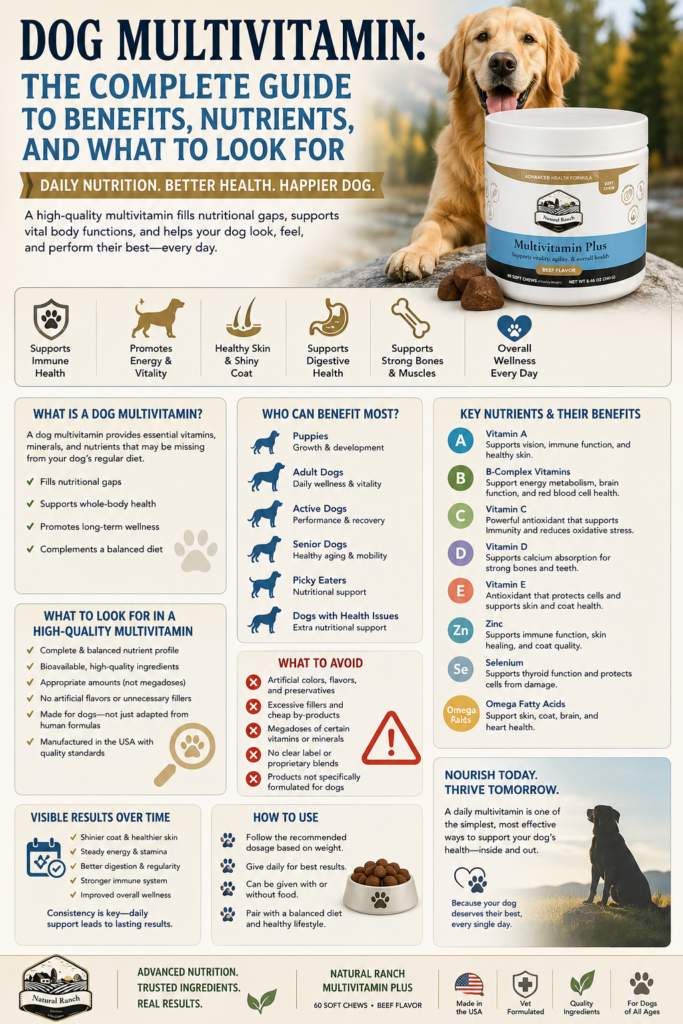
A dog multivitamin is a supplement providing a broad spectrum of essential vitamins, minerals, and supporting nutrients in a single daily formula. Unlike targeted supplements that address one specific health area — joint support, urinary health, skin and coat — a multivitamin addresses the foundational nutritional layer that every other biological system depends on.
Vitamins are organic compounds that provide essential micronutrients the body cannot produce on its own. Like humans, dogs need vitamins in small quantities to help their bodies function properly. Without adequate levels, health issues develop gradually — often in ways that are easy to normalize as aging, genetics, or “just how this dog is” rather than recognizing as addressable nutritional gaps.
A quality multivitamin doesn’t replace a balanced diet — it fills the gap between what commercial diets provide at minimum AAFCO standards and what a dog with individual needs, age-related absorption changes, or elevated health demands actually requires for optimal function.
Why Commercial Diets Alone Often Fall Short
AAFCO nutritional standards — the baseline that commercial dog foods must meet — set minimum thresholds, not optimal levels. A food meeting AAFCO requirements can still leave a dog running low on specific micronutrients when individual needs exceed average requirements.
Processing compounds this. High-heat extrusion — the dominant manufacturing method for dry kibble — degrades meaningful percentages of heat-sensitive vitamins including B1, B6, B12, C, and E during production. Manufacturers compensate by over-fortifying, but the margin isn’t always sufficient for dogs with elevated needs. Storage further degrades certain vitamins over the months between manufacturing and consumption.
The result: even dogs eating quality commercial diets can run silent nutritional deficits that accumulate over years rather than producing immediate obvious symptoms. A daily multivitamin acts as nutritional insurance — filling gaps that neither the owner nor the vet can easily identify without expensive bloodwork panels.
Which Dogs Benefit Most From a Daily Multivitamin
Senior dogs — nutrient absorption efficiency declines with age. Senior dogs produce less stomach acid needed to release B12 from food, have reduced enzyme output affecting fat-soluble vitamin absorption, and show progressive decline in gut microbiome diversity. Dogs aged 7 and above may be running nutritional deficits that didn’t exist two years earlier on the same diet.
Dogs on homemade or raw diets — research shows 95% of home-prepared dog diets are deficient in at least one essential nutrient. Unlike commercial diets which are legally required to meet AAFCO minimums, homemade diets have no regulatory floor. A daily multivitamin is strongly recommended for any dog on a home-prepared diet regardless of how carefully it was formulated.
Dogs with recurring health issues — recurring skin problems, chronic digestive irregularity, slow wound healing, and frequent illness often reflect underlying nutritional gaps rather than conditions requiring pharmaceutical management. Addressing the nutritional foundation first is both less expensive and more sustainable than symptom management alone.
Active and working dogs — dogs with high activity levels have elevated metabolic demands for B vitamins for energy production, antioxidant nutrients for oxidative stress management, and mineral cofactors for muscle function and recovery.
Dogs recovering from illness or surgery — illness and surgery increase nutritional demands simultaneously while often reducing appetite and absorption efficiency. Supplemental nutritional support during recovery directly supports the biological processes driving healing.
Picky eaters — dogs who don’t eat consistently or who eat varied amounts of their commercial diet may not reliably receive even AAFCO minimum levels of certain nutrients. A daily multivitamin provides a consistent nutritional baseline regardless of daily food consumption variability.
For the full breakdown of specific signs that indicate nutritional gaps: 7 Signs Your Dog Needs a Multivitamin
The Essential Nutrients — What Each Does and Why It Matters
Full B-Complex — Energy, Nervous System, and Cellular Health
The B vitamins — B1 (Thiamine), B2 (Riboflavin), B3 (Niacin), B5 (Pantothenic Acid), B6 (Pyridoxine), B12 (Cobalamin), Folic Acid, and Biotin — work as a system supporting cellular energy metabolism, nervous system function, red blood cell production, and DNA synthesis. Each plays a distinct role and deficiency in any one produces specific consequences.
B vitamins are water-soluble and not stored in the body — they require daily replenishment. They are also among the most heat-sensitive nutrients in pet food manufacturing, making supplemental sources particularly important for dogs on processed commercial diets. Biotin specifically is essential for keratin synthesis — the structural protein of skin, coat, and nails — making it a key nutrient for dogs with recurring skin or coat issues.
Vitamin A — Vision, Immune Function, and Skin Cell Differentiation
Vitamin A supports normal skin cell differentiation and turnover, immune function, and vision — particularly night vision. It is fat-soluble and requires dietary fat for absorption. Deficiency produces thickened scaly skin, dry brittle coat, and impaired immune response. Excess is also a risk — Vitamin A accumulates in tissue and toxicity from over-supplementation is real, which is why appropriate dose in a balanced formula rather than individual supplementation is important.
Vitamin D3 — Calcium Absorption and Immune Modulation
Vitamin D3 — the more bioavailable form for dogs versus D2 — supports calcium absorption for bone density, immune cell function, and insulin regulation. Unlike humans who can synthesize Vitamin D from sunlight, dogs have limited capacity for cutaneous Vitamin D synthesis and are largely dependent on dietary sources. D3 deficiency contributes to bone fragility, immune dysfunction, and in severe cases metabolic bone disease. Clinical research has shown Vitamin D supplementation demonstrates efficacy in canine atopic dermatitis, connecting skin immune function directly to D3 status.
Vitamin E — Antioxidant Protection and Skin Cell Integrity
Vitamin E is a fat-soluble antioxidant that protects cell membranes from oxidative damage — the cellular stress that accumulates from normal metabolic activity, UV exposure, and inflammatory processes. It works synergistically with omega fatty acids — protecting the unsaturated fatty acids that make up the skin barrier from oxidative degradation. Vitamin E also supports immune function by maintaining the integrity of immune cell membranes.
Zinc — Skin, Immune, and Wound Healing
Zinc is essential for skin cell repair, immune cell function, and wound healing. It is a cofactor for over 300 enzymatic reactions in the body. Zinc deficiency produces characteristic skin changes — scaling, crusting, and thickened skin particularly around the face and footpads — and impairs the immune response that resists infection. Chelated zinc (zinc bisglycinate) is significantly more bioavailable than zinc oxide, which is why the form matters as much as the amount.
Selenium — Antioxidant Cofactor and Thyroid Support
Selenium works alongside Vitamin E as an antioxidant cofactor and supports thyroid hormone metabolism — which influences coat quality, energy, and metabolic rate. Selenium deficiency is associated with muscle weakness and immune dysfunction. Like Vitamin E, appropriate levels from a balanced formula are important — selenium toxicity is possible from over-supplementation.
Glucosamine HCl — Joint Cartilage Support
Glucosamine HCl supports joint cartilage maintenance — the tissue that cushions bones at joint surfaces. It is a precursor to glycosaminoglycans, the compounds that maintain cartilage structure and the synovial fluid that lubricates joints. For large breeds, active dogs, and senior dogs where joint wear is a primary health concern, glucosamine in a daily multivitamin provides baseline cartilage support alongside the broader nutritional foundation.
Digestive Enzymes — Absorption Efficiency
Digestive enzymes support the breakdown and absorption of nutrients from food — a particularly important function for senior dogs whose enzyme output declines with age and for dogs on heavily processed commercial diets that have been heat-treated to eliminate naturally occurring food enzymes. Without adequate digestive enzyme activity even a well-formulated diet produces suboptimal nutrient absorption.
Probiotics — Gut Microbiome and Immune Function
The gut microbiome directly influences systemic immune function — including the immune cells lining the urinary tract that resist infection and the immune regulation at the skin surface that determines allergic reactivity. Named probiotic strains at a disclosed CFU count support the beneficial bacterial populations that drive these functions. Probiotics are particularly important for dogs who have been on antibiotic courses that disrupt the microbiome alongside the bacteria they target.
Omega Fatty Acids — The Carrier That Does Double Duty
The carrier oil in a multivitamin formula is often overlooked as a quality signal. Most manufacturers use cheap corn or soybean oil as a carrier — adding minimal nutritional contribution. Natural Ranch Products uses cold-pressed Canine Royal Oil™ — a proprietary cranberry seed oil providing a naturally balanced 1:1:1 ratio of Omega-3, Omega-6, and Omega-9 fatty acids. This balanced omega profile supports skin barrier lipid production, systemic inflammation management, and cellular health — adding meaningful functional nutrition to every chew beyond the labeled active ingredients.
How to Evaluate Any Dog Multivitamin
The quality signals that distinguish a genuinely effective multivitamin from one that looks good on the label:
- Full B-Complex — all eight B vitamins disclosed individually. Partial formulas listing only Biotin or B12 leave the energy metabolism and nervous system foundations incomplete.
- Chelated minerals — zinc bisglycinate and selenium from organic sources absorb significantly more efficiently than zinc oxide and sodium selenite. Chelated minerals are the mark of a formula prioritizing bioavailability.
- D3 not D2 — Vitamin D3 (cholecalciferol) is more bioavailable for dogs than D2 (ergocalciferol). Check which form is specified.
- Named probiotic strains with CFU count — “probiotic blend” without strain names or colony-forming unit counts cannot be evaluated. Named strains and CFU disclosure are the minimum standard for a verifiable probiotic inclusion.
- Quality carrier oil — check what the carrier oil is. Corn oil, soybean oil, and generic vegetable oil are low-cost fillers. Cold-pressed plant-based oils with balanced omega profiles add functional nutritional value.
- Cold-pressed or cold-form manufacturing — B vitamins, probiotics, and omega fatty acids are heat-sensitive. Cold-pressed manufacturing preserves their biological activity. If manufacturing method isn’t disclosed, assume standard high-heat processing.
- Transparent dosing — individual ingredient amounts in milligrams rather than hidden in a proprietary blend. Without specific amounts you cannot evaluate whether active ingredients are at functional doses.
- No added sugar or artificial ingredients — sugar serves no nutritional purpose in a supplement. Artificial colors, synthetic preservatives, and unnecessary fillers signal a formula optimized for appearance rather than function.
For the complete label-reading guide applied to urinary supplements — the same principles apply to multivitamins: How to Read a Dog UTI Supplement Label (What the Ingredients Actually Mean)
The Natural Ranch Daily Multivitamin
The Natural Ranch Daily Multivitamin was formulated around the complete nutritional picture — not just the ingredients that are easy to market. Full B-Complex including Biotin. Vitamins A, D3, and E at appropriate doses. Chelated Zinc and Selenium for immune and antioxidant support. Glucosamine HCl for joint cartilage maintenance. Digestive enzymes for absorption efficiency. Named probiotic strains for gut microbiome support. And cold-pressed Canine Royal Oil™ as the carrier — providing a balanced 1:1:1 ratio of Omega-3, Omega-6, and Omega-9 from cranberry seed oil.
Cold-pressed manufacturing throughout. Grain-free and sugar-free formula. Natural beef flavor from powdered beef stock. Made in the USA. 30-day money-back guarantee.
→ See the Natural Ranch Daily Multivitamin — $36.00
For dogs where urinary health is also a concern alongside general nutritional support, the Total Defense System pairs the Daily Multivitamin with Bladder Guard Soft Chews — addressing both the foundational nutritional layer and targeted urinary defense simultaneously.
→ See the Total Defense System
For dogs where skin and coat support is the primary concern, the Skin and Coat Defense Duo pairs the Daily Multivitamin with Oat and Aloe Shampoo for complete inside-out skin support.
→ See the Skin and Coat Defense Duo
Do dogs need a multivitamin if they eat quality commercial food?
Most healthy adult dogs eating AAFCO-approved commercial diets receive adequate minimum nutrition. However AAFCO sets minimums, not optimal levels. High-heat kibble processing degrades heat-sensitive vitamins during manufacturing. Senior dogs absorb nutrients less efficiently. Dogs with health conditions may not absorb adequate nutrients even from good food. And homemade diet dogs almost always have nutritional gaps. A daily multivitamin acts as nutritional insurance — filling gaps that are difficult to identify without expensive bloodwork and that accumulate silently over years.
What vitamins should a dog multivitamin contain?
A complete dog multivitamin should include the full B-Complex (B1, B2, B3, B5, B6, B12, Folic Acid, and Biotin), fat-soluble vitamins A, D3, and E at appropriate doses, chelated minerals including zinc and selenium, digestive enzymes for absorption support, named probiotic strains with a disclosed CFU count, and a quality omega fatty acid source. Glucosamine HCl for joint support and a cold-pressed carrier oil that contributes meaningful omega-3 fatty acids add further functional value beyond the core vitamin and mineral spectrum.
Can you give a dog too many vitamins?
Yes — particularly fat-soluble vitamins A, D, E, and K which accumulate in tissue rather than being excreted. Vitamin A toxicity, vitamin D toxicity, and zinc toxicity are real risks from over-supplementation with individual nutrients. A balanced multivitamin formulated specifically for dogs at appropriate doses is significantly safer than stacking multiple individual supplements. Always follow label dosing guidelines for your dog’s weight and consult your vet before adding any supplement to a dog already eating a fortified commercial diet.
When should dogs start taking a multivitamin?
Most veterinarians recommend considering a daily multivitamin from age 1 onward as nutritional insurance, and especially from age 6-7 when nutrient absorption efficiency begins to decline. Senior dogs have higher supplementation needs due to reduced stomach acid for B12 release, lower enzyme output affecting fat-soluble vitamin absorption, and progressive decline in gut microbiome diversity. Puppies generally receive sufficient nutrition from quality complete puppy formulas and typically don’t require additional supplementation before 12 months.
How long before seeing results from a dog multivitamin?
Coat improvements are typically visible within 6-10 weeks of consistent daily use. Energy and digestive improvements may be noticed within 2-4 weeks. Immune support benefits are cumulative and harder to observe directly — they show up over time as reduced illness frequency and faster recovery. Joint support develops gradually over 60-90 days. Consistency is essential — a multivitamin used daily for 90 days shows fundamentally different results than one given sporadically. Results compound over months of consistent use.
What is the difference between a dog multivitamin and a human one?
Significant differences make human vitamins inappropriate for dogs. Dogs have different metabolic requirements, absorption rates, and toxicity thresholds. Xylitol — commonly used as a sweetener in human vitamins — is toxic to dogs. Iron at levels safe for humans can cause toxicity in dogs. Human vitamins are not dosed for a dog’s body weight or metabolic rate. And many vitamin forms optimized for human absorption are not the most bioavailable for canine metabolism. Always use a supplement specifically formulated, dosed, and safety-tested for dogs.
What makes Canine Royal Oil different from fish oil in dog supplements?
Cold-pressed Canine Royal Oil from cranberry seed provides a naturally balanced 1:1:1 ratio of Omega-3, Omega-6, and Omega-9 fatty acids — the balance that supports skin barrier lipid production and systemic inflammation management simultaneously. Fish oil is heavily weighted toward omega-3 without this balance, prone to rancidity after opening, and carries heavy metal contamination risk from marine sources. Cranberry seed oil is naturally rich in tocopherols that protect against oxidation without refrigeration, and carries no heavy metal concerns as a plant-based source.
References
American Kennel Club. “What Are the Benefits of Using Multivitamins for Dogs?” akc.org.
National Research Council. Nutrient Requirements of Dogs and Cats. National Academies Press. 2006.
Hand MS, et al. Small Animal Clinical Nutrition, 5th Edition. Mark Morris Institute. 2010.
Larsen J., Fascetti A. “Evaluation of recipes for home-prepared diets for dogs and cats.” Journal of the American Veterinary Medical Association. 2019.
Klinger CJ, et al. “Vitamin D shows in vivo efficacy in a placebo-controlled, double-blinded, randomised clinical trial on dogs with cutaneous leishmaniosis.” Veterinary Record. 2018.
Association of American Feed Control Officials. “Nutritional Adequacy Statements and Pet Food Labeling.” aafco.org.
VCA Animal Hospitals. “Vitamins and Minerals for Dogs.” vcahospitals.com.