
Why Does My Dog Smell Like Urine?
Your dog smells like urine and you can’t figure out why — or you’ve bathed them and the smell comes back within hours. This is one of the most common and most emotionally loaded dog health questions owners search. The smell is embarrassing, concerning, and confusing all at once.
The good news is that a persistent urine smell in dogs almost always has a specific, identifiable cause — and most of those causes are treatable once identified. This guide covers every common reason a dog smells like urine, how to tell which one applies to your dog, and what to do about each one.
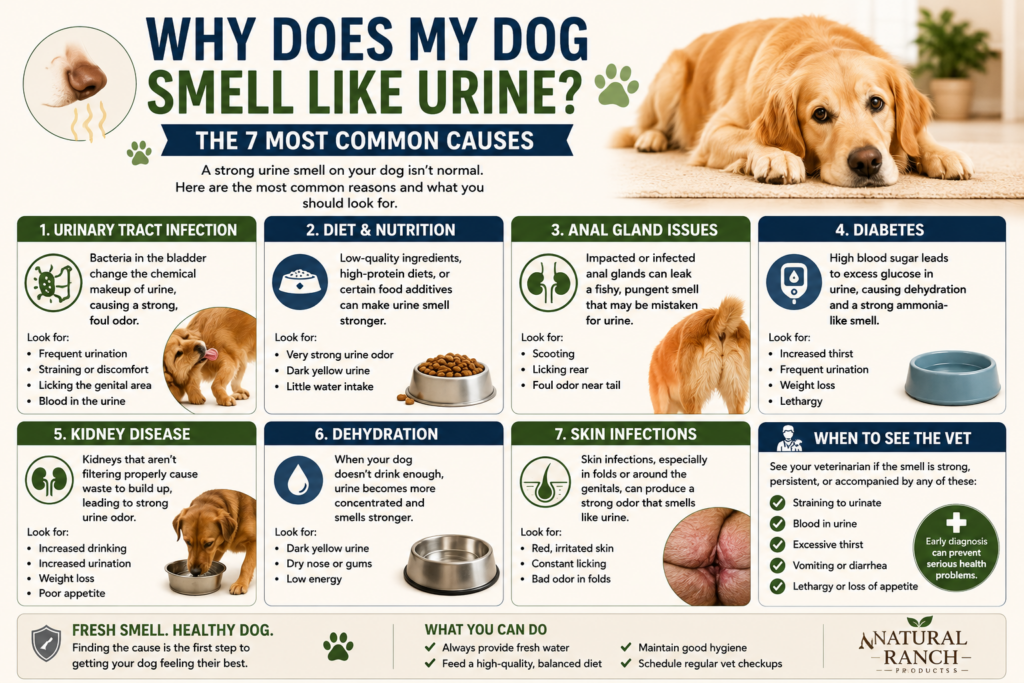
Why Does My Dog Smell Like Urine? The 7 Most Common Causes
1. Urinary Tract Infection — The Most Common Medical Cause
The most common reason a dog’s urine stinks is because of a urinary tract infection. UTIs occur when bacteria travel up the urethra and into the bladder — producing urine that smells significantly stronger and more pungent than normal. The altered chemical composition of infected urine produces a distinctively sharp, foul odor that many owners describe as ammonia-like or unusually sour.
The urine smell associated with UTI is usually accompanied by other behavioral signs — more frequent trips outside with small amounts of urine, straining or discomfort during urination, excessive licking of the genital area, and sometimes blood in the urine. If the urine smell is new, strong, and accompanied by any of these behavioral changes, a UTI is the most likely explanation and warrants a veterinary appointment rather than watchful waiting.
Female dogs are significantly more susceptible to UTIs due to their shorter urethra and the proximity of the vulvar opening to the anal area — giving bacteria a shorter path to the bladder and more constant exposure to fecal bacteria at the urethral entry point.
For the complete guide to UTI causes, symptoms, and prevention: Dog Urinary Tract Health: A Complete Guide to UTIs, Prevention, and Long-Term Support
2. Urinary Incontinence — Urine Soaking Into Fur and Skin
Incontinence is when a dog involuntarily leaks urine — often during sleep or rest, without being aware it’s happening. An incontinent dog will smell of urine — and so will their bed, their toys, and possibly your furniture. Incontinence causes a dog to unintentionally leak pee between trips outside, and that urine soaks into the fur and skin, creating a persistent smell that bathing temporarily removes but doesn’t resolve.
The key distinguishing feature of incontinence versus UTI: the dog is not straining or showing obvious discomfort during urination, and the leaking happens involuntarily rather than as a deliberate urination attempt. Wet spots on bedding after the dog has been resting or sleeping are the most common first sign.
Incontinence has several specific causes that require different treatments. The most common cause in spayed female dogs is urethral sphincter mechanism incompetence (USMI) — reduced estrogen after spaying weakens the urethral sphincter. Other causes include urinary tract infections, anatomical abnormalities, neurological conditions, and systemic diseases like diabetes and Cushing’s that cause excessive water intake and output.
Urinary incontinence can quickly develop into an infection — urine leaking onto the skin creates the warm, moist environment where bacteria thrive, increasing UTI risk significantly. Dogs with incontinence often develop secondary skin infections in the areas of chronic urine contact.
For the complete guide to why senior dogs are more vulnerable to both incontinence and UTIs: Senior Dog Urinary Health: Why Older Dogs Are More Vulnerable (And What Actually Helps)
3. Skin Folds Trapping Urine — Common in Specific Breeds
Dogs with excessive skin folds — particularly around the vulva in female dogs, or facial and body folds in brachycephalic breeds — can trap urine in the skin fold itself. In some cases anatomical defects such as excessive skin around a female’s vulva may trap urine in the skin folds which can then cause a skin infection that ascends into the bladder leading to a UTI. This is one reason UTIs are more common in breeds such as English Bulldogs, French Bulldogs, and Pugs that have excess skin folds around their vulvas that provide the warm, dark, moist environments where bacteria thrive.
The urine smell in these cases comes from the fold itself — urine is trapped against the skin and unable to evaporate. The skin inside the fold may be red, moist, and irritated. Regular cleaning of skin folds — particularly after urination — is essential management for fold-prone breeds. In severe cases veterinary assessment for surgical correction may be appropriate.
4. Concentrated Urine From Dehydration or Diet
Not all urine smell indicates infection or incontinence. Dehydration can lead to more concentrated urine, which may also contribute to a stronger odor. When a dog isn’t drinking enough water or is primarily on a dry kibble diet with low moisture content, their urine becomes highly concentrated — producing a stronger ammonia smell that can transfer to fur and skin during urination and grooming.
Certain foods can cause your dog’s urine to have a stronger smell, which can then transfer to their fur and skin. High-protein diets in particular produce more nitrogen waste that increases urine concentration and odor. If your dog’s urine smell is mild, consistent, and not accompanied by behavioral changes suggesting discomfort, dehydration and diet are worth investigating before assuming a medical cause.
The fix is straightforward — increase daily water intake by adding warm water or low-sodium broth to meals, using a pet water fountain, and placing multiple water bowls in accessible locations. More dilute urine smells significantly less and is better for urinary health overall.
For the full science on why hydration matters for urinary health: Why Hydration Determines Whether Urinary Health Strategies Work in Dogs
5. Kidney Disease — When Urine Smell Is a Systemic Signal
Kidney disease significantly affects urine composition and odor. The kidneys are responsible for filtering waste products from the blood — when they aren’t functioning efficiently, waste products accumulate in the urine at higher concentrations, producing a distinctively strong and sometimes fishy or metallic smell. Certain health issues like diabetes, kidney disease, ear infections, or urinary tract infections can make dogs smell bad.
Kidney disease also causes dogs to drink significantly more water while simultaneously producing more concentrated urine — a counterintuitive combination where increased urine volume doesn’t translate to less smell because the kidneys aren’t concentrating waste efficiently. If the urine smell is accompanied by increased water consumption, increased urination, weight loss, decreased appetite, or lethargy — veterinary evaluation including bloodwork is warranted rather than topical management.
6. Diabetes — Sweet or Fruity Urine Smell
Diabetic dogs produce urine with elevated glucose content that creates a distinctively sweet or fruity smell — different from the ammonia or sour smell of bacterial UTI. Diseases that cause excessive drinking of water, for example, diabetes, kidney disease, and Cushing’s disease are all causes of urinary incontinence and associated urine odor in dogs.
Diabetes also increases UTI susceptibility significantly — elevated glucose in urine fuels bacterial growth, making diabetic dogs much more prone to recurring urinary infections. A dog with a sweet-smelling urine odor combined with increased thirst and urination, weight loss despite normal or increased appetite, and lethargy should be evaluated for diabetes promptly. The urine smell is a symptom, not the primary problem.
7. Secondary Skin Infection From Chronic Urine Contact
Dogs with incontinence or skin folds that trap urine often develop secondary bacterial or yeast skin infections in the areas of chronic urine exposure. Smelly imbalances of the normal bacteria and yeast on the skin can occur secondary to deep skin folds, immune system problems, or mobility issues. These skin infections produce their own distinct odor — often described as musty, yeasty, or sour — that compounds with the urine smell and persists even after bathing because it’s coming from the skin itself rather than just residual urine on the fur.
Skin infections from chronic urine contact require veterinary treatment — topical or systemic antifungal or antibiotic medication depending on the organism — alongside addressing the underlying incontinence or anatomical cause that’s allowing the urine exposure to continue.
Why Does My Dog Still Smell Like Urine After a Bath?
Bathing removes urine from the coat surface — but if the underlying cause is still active, the smell returns quickly. The specific reason depends on which cause is driving it:
- Active UTI — the infected urine continues to smell strongly regardless of how recently the dog was bathed. The smell is in the urine itself, not just on the coat.
- Ongoing incontinence — the dog leaks more urine shortly after bathing, recontaminating the freshly cleaned fur. Bathing without addressing the incontinence is a temporary fix at best.
- Skin fold infection — the infection is in the skin fold itself, not on the surface fur. Bathing the outer coat doesn’t reach or treat the fold.
- Secondary skin infection — the yeast or bacteria producing the odor are embedded in the skin. Surface cleaning doesn’t eliminate them without appropriate medical treatment.
- Concentrated urine — if hydration hasn’t been addressed, the next urination after bathing recontaminates the coat with concentrated urine that smells strongly.
If your dog smells like urine within hours of a bath — the cause is active and ongoing, not residual. Veterinary evaluation is the appropriate next step rather than more frequent bathing.
How to Tell Which Cause Applies to Your Dog
| If you notice… | Most likely cause | Next step |
| Strong smell plus straining, blood in urine, or accidents | UTI | Vet appointment — urinalysis and culture |
| Wet spots on bedding after resting or sleeping | Incontinence | Vet appointment — identify underlying cause |
| Smell concentrated around skin folds near vulva | Skin fold urine trapping | Clean folds regularly — vet assessment for severe cases |
| Mild consistent smell, no behavioral changes | Concentrated urine from dehydration | Increase daily water intake significantly |
| Sweet or fruity smell plus increased thirst and weight loss | Diabetes | Vet appointment — bloodwork urgently |
| Strong fishy or metallic smell plus lethargy and increased drinking | Kidney disease | Vet appointment — bloodwork urgently |
| Musty or yeasty skin smell alongside urine smell | Secondary skin infection | Vet appointment — topical or systemic treatment |
Managing the Most Common Cause — UTI and Incontinence Prevention
For dogs where UTI or incontinence is the driver — the two most common medical causes of urine smell — daily prevention support addresses the underlying urinary environment rather than just the surface symptom.
For UTI-driven urine smell: Consistent hydration to dilute urine and flush bacteria more effectively. Daily anti-adhesion support with cranberry PACs and D-Mannose to reduce bacterial adhesion to the bladder wall. Bladder lining support with marshmallow root and NAG to maintain the protective GAG layer. Probiotics to support gut microbiome health and the immune function that resists infection between episodes.
For incontinence-driven urine smell: Pumpkin seed powder supports bladder muscle tone and urethral sphincter function — particularly relevant for spayed females experiencing USMI-related leaking. Keeping the genital area clean and trimmed reduces bacterial accumulation from urine contact. Washing bedding regularly in hot water prevents reinfection from urine residue.
Bladder Guard Soft Chews from Natural Ranch Products addresses both drivers simultaneously — cranberry PACs and D-Mannose for UTI prevention, marshmallow root and NAG for bladder lining support, pumpkin seed powder for bladder muscle tone, Vitamin C for pH support, and probiotics for immune reinforcement. Cold-pressed manufacturing preserves the bioavailability of every active compound.
→ See Bladder Guard Soft Chews
For dogs where urine smell is driven by age-related incontinence and recurring infections together — the Total Defense System pairs Bladder Guard with the Daily Multivitamin for complete foundational support.
→ See the Total Defense System
For more on why senior dogs are particularly prone to both UTIs and incontinence: Senior Dog Urinary Health: Why Older Dogs Are More Vulnerable (And What Actually Helps)
For the complete daily habits that support urinary health long-term: Dog UTI Prevention: Daily Habits That Actually Matter
Why does my dog smell like urine?
The most common causes are a urinary tract infection producing strongly scented urine, urinary incontinence causing urine to leak onto fur and skin, skin folds trapping urine near the vulva or body folds, concentrated urine from inadequate hydration, and secondary skin infections from chronic urine contact. Less common causes include kidney disease and diabetes which alter urine composition and odor. If the smell is new, strong, and accompanied by behavioral changes like straining or accidents, a veterinary evaluation is the appropriate first step.
Why does my dog still smell like urine after a bath?
If the underlying cause is still active, the smell returns quickly after bathing. An active UTI produces strongly scented urine continuously — bathing removes what’s on the coat but the next urination recontaminates it. Ongoing incontinence leaks more urine shortly after bathing. Skin fold infections are embedded in the fold itself and not reached by surface bathing. Secondary skin infections require medical treatment not just surface cleaning. If your dog smells like urine within hours of a bath, the cause is active and ongoing — veterinary evaluation is more appropriate than more frequent bathing.
Why does my female dog smell like urine?
Female dogs are more prone to both UTIs and incontinence than males — both of which cause urine smell. Female anatomy includes a shorter urethra that gives bacteria shorter access to the bladder, and the vulvar opening sits near the anal area increasing fecal bacterial exposure. Spayed females are additionally vulnerable to urethral sphincter weakness from reduced estrogen that causes involuntary leaking. Skin folds near the vulva can trap urine. Any of these factors alone or in combination can cause a persistent urine smell in female dogs.
Can a UTI cause my dog to smell like urine?
Yes — UTI is the most common medical cause of strong urine odor in dogs. Bacterial infection changes the chemical composition of urine, producing a distinctively sharp, ammonia-like, or sour smell that is noticeably stronger than normal urine. UTI-related urine smell is usually accompanied by behavioral signs including more frequent urination with small output, straining, excessive genital licking, and sometimes blood in the urine. Veterinary diagnosis and antibiotic treatment are required for active UTIs.
Is it normal for dogs to smell like urine?
No — a persistent urine smell is not a normal part of dog ownership and should be investigated rather than managed with frequent bathing. Healthy dogs with adequate hydration and no urinary conditions produce urine with a mild smell that doesn’t transfer noticeably to their fur or persist after bathing. A dog that consistently smells like urine has an identifiable underlying cause — UTI, incontinence, skin folds, dehydration, or a systemic condition — that is treatable once properly diagnosed.
What can I do if my dog smells like urine?
First identify the likely cause using the symptom pattern — is there straining or accidents suggesting UTI, wet spots on bedding suggesting incontinence, concentrated smell with no behavioral changes suggesting dehydration, or sweet smell with increased thirst suggesting diabetes. If behavioral changes are present contact your vet for diagnosis and treatment. For dehydration-related smell increase daily water intake significantly by adding warm water or broth to meals. For UTI and incontinence prevention, daily supplement support with cranberry PACs, D-Mannose, marshmallow root, pumpkin seed powder, and probiotics addresses the urinary environment that drives both conditions.
References
Rover Editorial. “Why Does My Dog Smell So Bad? Causes and Remedies.” November 2025.
WebMD Pets. “Urinary Incontinence in Dogs: Causes and Treatment.” July 2025.
PetMD Editorial. “UTI in Dogs: Signs, Causes, and Treatment.” Updated December 2025.
Great Pet Care Editorial. “8 Dog UTI Symptoms You Shouldn’t Ignore.” March 2024.
Bayside Animal Hospital. “Help! I Have a Senior Citizen Stinky Dog!” February 2024.
Byron JK. “Urinary Tract Infection.” Veterinary Clinics of North America: Small Animal Practice. 2019.
VCA Animal Hospitals. “Urinary Tract Infections (UTIs) in Dogs.” vcahospitals.com