
Dog UTI Home Remedies: What Actually Works (And What to Avoid)
When a dog shows UTI symptoms — straining, frequent urination, blood in the urine — the first instinct for many owners is to search for home remedies. That instinct isn’t wrong. Some natural approaches genuinely support urinary health. But some popular remedies do nothing, some are actively harmful, and all of them share one critical limitation: none of them treat an active bacterial infection.
This guide gives you the honest, evidence-informed breakdown of dog UTI home remedies — what the science actually supports, what’s ineffective despite widespread promotion, what’s potentially dangerous, and most importantly, when home support is appropriate versus when veterinary care is non-negotiable.
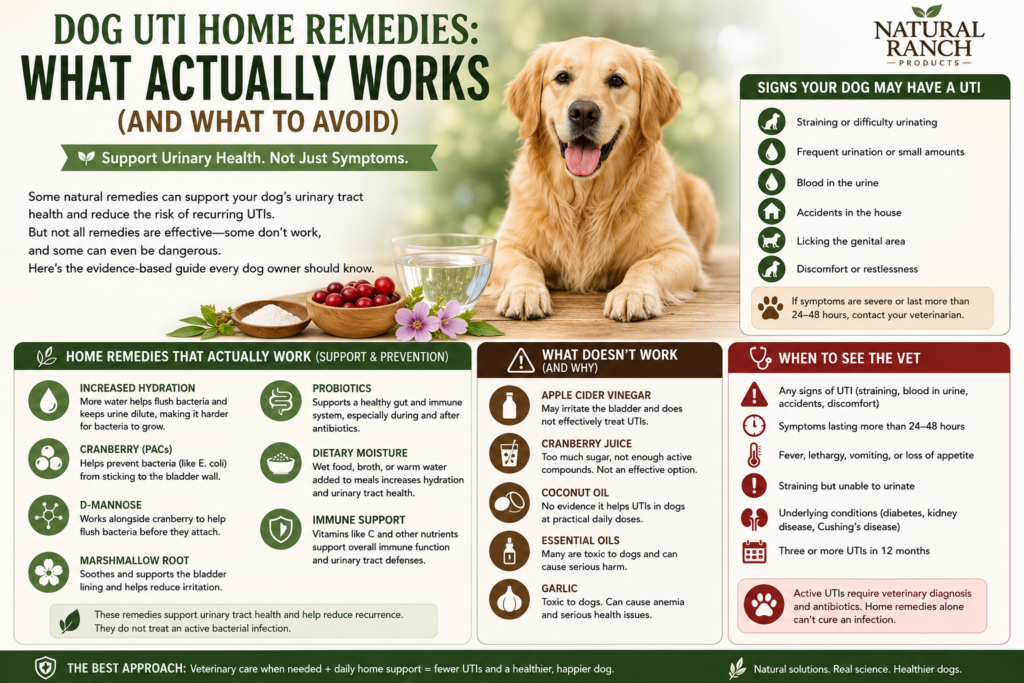
The Critical Distinction: Support vs Treatment
Before evaluating any home remedy, this distinction needs to be clear: no home remedy treats an active bacterial UTI. Active infections — where bacteria have established in the bladder and are causing clinical symptoms — require veterinary diagnosis and appropriate antibiotic treatment. There is no evidence that any natural remedy at home doses eliminates an established bacterial infection in a dog.
What home remedies can legitimately do is support the urinary environment — reducing conditions favorable to bacterial growth, supporting the bladder lining, maintaining immune function, and reducing the frequency of recurrence between properly treated episodes. This is meaningful and valuable. But it is categorically different from treating an infection that’s already established.
If your dog is showing active UTI symptoms — straining, blood in urine, accidents in the house, obvious discomfort — the first call is to your vet, not to the kitchen. Home remedies used while an active infection goes untreated allow the infection to worsen, spread to the kidneys, and potentially cause serious complications.
Home Remedies That Actually Have Evidence Behind Them
1. Increased Hydration — The Most Effective Natural Support
Hydration is the simplest and most effective natural remedy for urinary health. More water helps flush bacteria from the urinary tract before they can establish — and dilutes urine so that the bladder environment is less favorable to bacterial growth.
For dogs who are reluctant drinkers or primarily on dry kibble, practical hydration strategies make a meaningful difference. Adding warm water or low-sodium broth to meals can increase daily moisture intake by up to 30%. Using a pet water fountain — many dogs drink significantly more from moving water. Placing multiple water bowls in different locations. Adding a small amount of wet food to meals for additional moisture.
Hydration doesn’t treat an existing infection but it is the foundation that makes every other prevention strategy more effective. A dog with consistently dilute urine has fewer UTIs than an identical dog with consistently concentrated urine — the evidence for this is consistent across the veterinary literature.
For the full explanation of how hydration affects the urinary environment: Why Hydration Determines Whether Urinary Health Strategies Work in Dogs
2. Cranberry — But Not in the Form Most People Use
Cranberry is one of the most well-researched natural urinary health ingredients — and one of the most misunderstood. Cranberries contain proanthocyanidins (PACs) that may help reduce bacterial adhesion to the bladder wall. The research in dogs supports this mechanism — cranberry PACs reduce the ability of E. coli bacteria to attach to bladder epithelial cells.
The form matters enormously. Cranberry juice — even unsweetened — is not an appropriate delivery vehicle for dogs. The volume needed to deliver meaningful PAC levels is impractical, and commercial cranberry juices contain sugars that are counterproductive in a dog with urinary concerns. Human cranberry supplements may contain xylitol or other ingredients toxic to dogs.
The effective form is a canine-specific supplement containing A-Type PACs at a meaningful dose — cold-pressed to preserve the PAC integrity that heat processing degrades. This is not the same as feeding cranberries or giving human cranberry products. It requires a specifically formulated dog supplement. And critically — cranberry PACs are a prevention tool, not a treatment. They reduce bacterial adhesion in a bladder that hasn’t yet been colonized. They don’t eliminate bacteria that have already established.
3. D-Mannose — Complementary Anti-Adhesion Support
D-Mannose is a naturally occurring sugar that works alongside cranberry PACs through a complementary mechanism — giving E. coli bacteria an alternative binding target so they are more likely to be cleared through urination rather than attaching to the bladder wall. Research has shown that D-Mannose can provide effective support during UTI prevention and recovery.
Like cranberry PACs, D-Mannose works best as a daily prevention measure rather than an acute treatment for an established infection. It is most effective for UTIs caused by E. coli — which accounts for the majority of canine UTI cases. At meaningful doses in canine-specific formulations it is a genuinely useful tool for reducing recurrence frequency in dogs prone to recurring infections.
4. Marshmallow Root — Bladder Lining Soothing Support
Marshmallow root contains mucilage — a gel-like compound that soothes and coats irritated urinary tissues. Traditionally used as a demulcent, marshmallow root produces a mucilage that may help soothe irritated urinary tissues. While this doesn’t address bacterial infection directly, it provides meaningful comfort support for dogs experiencing bladder irritation — and supports the bladder lining that repeated infections progressively degrade.
At appropriate doses in canine-specific formulations, marshmallow root is one of the few natural ingredients that addresses tissue-level bladder lining health rather than just anti-adhesion mechanisms. For dogs with chronic irritation or recurring infections, this tissue support is a meaningful gap in single-ingredient cranberry or D-Mannose supplements.
5. Probiotics — Gut-Immune Support During and After Antibiotics
Probiotics help maintain a healthy gut microbiome, which plays a role in immune function including the immune cells lining the urinary tract that resist infection. This is particularly relevant during and after antibiotic treatment — antibiotics disrupt the gut microbiome alongside the bacteria they target, progressively weakening the immune environment that protects the urinary tract between infections.
Probiotic support during antibiotic courses helps maintain gut microbiome balance. Probiotic support after completing antibiotics helps restore it. Named strains with a disclosed CFU count in a canine-specific formulation are significantly more reliable than generic “probiotic blend” products without individual strain disclosure.
For the full explanation of why gut health affects urinary health: Why Gut Health and Urinary Health Are Connected in Dogs
6. Dietary Moisture Increase — Wet Food and Broth Addition
Adding wet food, low-sodium broth, or warm water to meals is one of the most practical and impactful home interventions for urinary health. Wet food contains approximately 75% moisture versus only 10% in dry kibble. The resulting increase in urine dilution reduces bacterial concentration, decreases mineral crystallization risk, and improves the natural flushing that clears bacteria before they can establish.
This is not a treatment for active infection — but as a daily habit it produces measurable changes in the urinary environment over time that meaningfully reduce recurrence frequency for dogs prone to UTIs.
Home Remedies That Don’t Work — And Why They’re Still Widely Recommended
Apple Cider Vinegar — Popular But Problematic
Apple cider vinegar is one of the most commonly recommended dog UTI home remedies online. Home remedies such as apple cider vinegar may not be effective in curing a UTI. The theory is that it acidifies urine and creates conditions less favorable for bacterial growth — but the amount needed to meaningfully alter urine pH in a dog is far more than safe to give, and the acidity can irritate an already inflamed bladder lining.
For a dog whose bladder is already inflamed from infection, adding an acidic substance that can further irritate the bladder wall is counterproductive. The mechanism doesn’t translate from human use to canine use at safe doses. Most veterinary sources do not recommend apple cider vinegar as a UTI remedy for dogs.
Cranberry Juice — Wrong Form of the Right Ingredient
Cranberry juice — including unsweetened versions — is not an appropriate way to deliver cranberry PACs to a dog. The PAC concentration in juice is low relative to what’s needed for anti-adhesion effect. The sugar content is high relative to what’s appropriate for a dog with UTI. And the volume needed is impractical. The active compounds in cranberry are real and effective — but juice is not the right delivery mechanism. This is one of the most common misunderstandings in dog UTI home remedy discussions.
Coconut Oil — No Meaningful Urinary Benefit
Coconut oil has natural antibacterial properties in certain contexts — but there is no meaningful evidence that oral coconut oil at practical doses produces urinary tract antibacterial effects in dogs. The medium-chain fatty acids in coconut oil that produce antibacterial effects in laboratory settings are metabolized before reaching the urinary tract at concentrations that would affect bacterial populations there. Coconut oil may be fine as a dietary fat source but it is not a UTI remedy.
Essential Oils — Avoid Entirely
Several essential oils are marketed as natural UTI remedies for dogs — tea tree oil, oregano oil, and others. These should be avoided. Many essential oils that have antibacterial properties in laboratory conditions are toxic to dogs at doses that would produce any meaningful systemic effect. Tea tree oil in particular is well-documented as toxic to dogs even at small topical doses. Essential oils have no established safe dose for UTI treatment in dogs and should not be used for this purpose.
Garlic — Toxic to Dogs
Garlic is sometimes promoted as a natural antibacterial remedy. In dogs garlic is toxic — it contains thiosulfate compounds that damage red blood cells and can cause hemolytic anemia. There is no safe therapeutic dose of garlic for dogs. This is one home remedy that is not just ineffective but actively dangerous.
Waiting It Out — The Most Dangerous “Remedy”
The most dangerous approach to a suspected dog UTI is watchful waiting without veterinary evaluation. UTIs that are left untreated can progress to kidney infections, bladder stones, and in serious cases sepsis. If your dog is showing active symptoms — straining, blood in urine, obvious discomfort — waiting to see if it resolves on its own while trying home remedies is not appropriate. The window between a treatable bladder infection and a serious kidney infection can be shorter than most owners expect.
When Home Support Is Appropriate vs When Veterinary Care Is Required
Home Support Is Appropriate For:
- Daily prevention between infections — cranberry PACs, D-Mannose, marshmallow root, probiotics, and consistent hydration as a daily ongoing routine for dogs prone to recurring UTIs
- Supporting recovery after antibiotic treatment — probiotic support to restore gut microbiome balance, bladder lining support with marshmallow root and NAG, and increased hydration to maintain dilute urine
- Environmental optimization — hygiene maintenance, regular bathroom breaks, moisture addition to diet — all reduce recurrence risk meaningfully without any clinical downside
Veterinary Care Is Required For:
- Any dog showing active UTI symptoms — straining, blood in urine, accidents, obvious discomfort
- Symptoms that haven’t improved within 24-48 hours of increased hydration and supportive care
- Fever, lethargy, or loss of appetite alongside urinary symptoms — may indicate kidney involvement
- Straining without producing any urine — potential obstruction requiring immediate attention
- Any dog with diabetes, Cushing’s disease, or kidney disease showing urinary symptoms
- Dogs with three or more UTIs in twelve months — requires diagnostic investigation not just repeated treatment
The Most Effective Approach: Combining Veterinary Care With Daily Prevention
The dogs with the fewest recurring UTIs are those whose owners do both — appropriate veterinary care when infections occur and consistent daily prevention support between episodes. Neither approach alone produces the same results as both together.
Bladder Guard Soft Chews from Natural Ranch Products combines the evidence-supported prevention ingredients — cranberry PACs, D-Mannose, marshmallow root, NAG, pumpkin seed powder, Vitamin C, and probiotics — in a single daily cold-pressed formula. Cold-pressed manufacturing preserves the PAC integrity and probiotic viability that heat processing degrades. Every ingredient is at a disclosed dose rather than hidden in a proprietary blend.
This is the canine-specific formulation that delivers what the research supports — not juice, not generic human supplements, not unverified folk remedies — at doses designed for dogs and manufactured to preserve bioavailability.
→ See Bladder Guard Soft Chews
For the complete daily prevention routine beyond supplements: Dog UTI Prevention: Daily Habits That Actually Matter
For a practical evaluation of what to look for in any urinary supplement: Best Dog UTI Supplement: What to Actually Look For
For the science on how antibiotics and supplements work together: Dog UTI Supplement vs Antibiotics: What’s the Difference and When You Need Each
Can I treat my dog’s UTI at home?
Home remedies cannot treat an active bacterial UTI — established infections require veterinary diagnosis and appropriate antibiotic treatment. What home support can do is support the urinary environment to reduce recurrence risk between properly treated episodes. Cranberry PACs and D-Mannose reduce bacterial adhesion, marshmallow root soothes bladder lining tissue, probiotics restore gut microbiome balance, and consistent hydration dilutes urine and flushes bacteria more effectively. These are prevention tools, not treatments for active infection.
Does apple cider vinegar help dog UTIs?
No — apple cider vinegar is not an effective dog UTI remedy and may be counterproductive. The theory is that it acidifies urine to reduce bacterial growth, but the amount needed to meaningfully alter urine pH at safe doses is insufficient to produce this effect. The acidity can also irritate an already inflamed bladder lining. Most veterinary sources do not recommend apple cider vinegar for dog UTIs. Canine-specific cranberry PAC supplements address the anti-adhesion mechanism with actual evidence behind them and without the bladder irritation risk.
Can cranberry juice treat a dog UTI?
Cranberry juice is not an appropriate way to deliver cranberry’s active compounds to dogs. The PAC concentration in juice is low relative to what’s needed for anti-adhesion effect, the sugar content is counterproductive for a dog with urinary concerns, and the volume needed is impractical. The active compounds in cranberry — A-Type proanthocyanidins — are real and well-researched. But canine-specific supplements containing cold-pressed cranberry PACs at meaningful doses are the appropriate delivery mechanism, not juice.
Is D-Mannose safe for dogs?
Yes — D-Mannose is generally considered safe for dogs at appropriate doses in canine-specific formulations. It is a naturally occurring sugar that works by giving E. coli bacteria an alternative binding target, making them more likely to be flushed through urination rather than adhering to the bladder wall. It works alongside cranberry PACs through a complementary mechanism and is most effective for UTIs caused by E. coli, which accounts for the majority of canine UTI cases. Always use canine-specific formulations at appropriate doses rather than human products.
When should I take my dog to the vet for a UTI?
Any dog showing active UTI symptoms — straining during urination, blood in urine, accidents in a house-trained dog, obvious discomfort — needs veterinary evaluation rather than home treatment. Don’t wait more than 24-48 hours after symptoms appear before contacting your vet. Urgently contact your vet if your dog shows fever or lethargy alongside urinary symptoms, is straining without producing any urine, is vomiting alongside urinary symptoms, or has underlying conditions like diabetes or kidney disease. UTIs that progress to kidney infections can do so faster than most owners expect.
What home remedies are dangerous for dogs with UTIs?
Garlic is toxic to dogs and should never be used — it causes hemolytic anemia. Essential oils including tea tree oil and oregano oil are toxic to dogs at doses that would produce any systemic effect and should be avoided entirely. Azo — the human UTI pain relief medication — is not safe for dogs and should never be given. Waiting it out without veterinary evaluation while an active infection progresses is the most dangerous approach of all. Any dog with active UTI symptoms should be evaluated by a vet rather than managed with home remedies alone.
References
Howell AB. “Bioactive Compounds in Cranberry and Their Role in Urinary Tract Health.” Advances in Nutrition.
Kranjčec B, et al. “D-Mannose in Recurrent Urinary Tract Infections.” World Journal of Urology.
Byron JK. “Urinary Tract Infection.” Veterinary Clinics of North America: Small Animal Practice. 2019.
PetMD Editorial. “UTI in Dogs: Signs, Causes, and Treatment.” Updated December 2025.
Tequesta Veterinary Clinic. “5 Natural Remedies for Dog UTI That Actually Work.” 2026.
VCA Animal Hospitals. “Urinary Tract Infections (UTIs) in Dogs.” vcahospitals.com
Cornell University College of Veterinary Medicine. “Urinary Tract Infections.” vet.cornell.edu