
Dog UTI Supplement vs Antibiotics: What’s the Difference and When You Need Each
If your dog has been diagnosed with a UTI you’ve probably wondered whether antibiotics are strictly necessary, whether supplements could help alongside them, or whether supplements alone are ever enough. These are the right questions to ask — and the answers depend on understanding what each approach actually does biologically and when each one applies. If you ever thought about dog UTI supplement vs antibiotics, then read on.
The short answer: antibiotics and urinary supplements are not competing options. They serve fundamentally different purposes and work best when used strategically together rather than as alternatives to each other. Understanding the distinction helps you have a more productive conversation with your vet and make better decisions about your dog’s long-term urinary health.
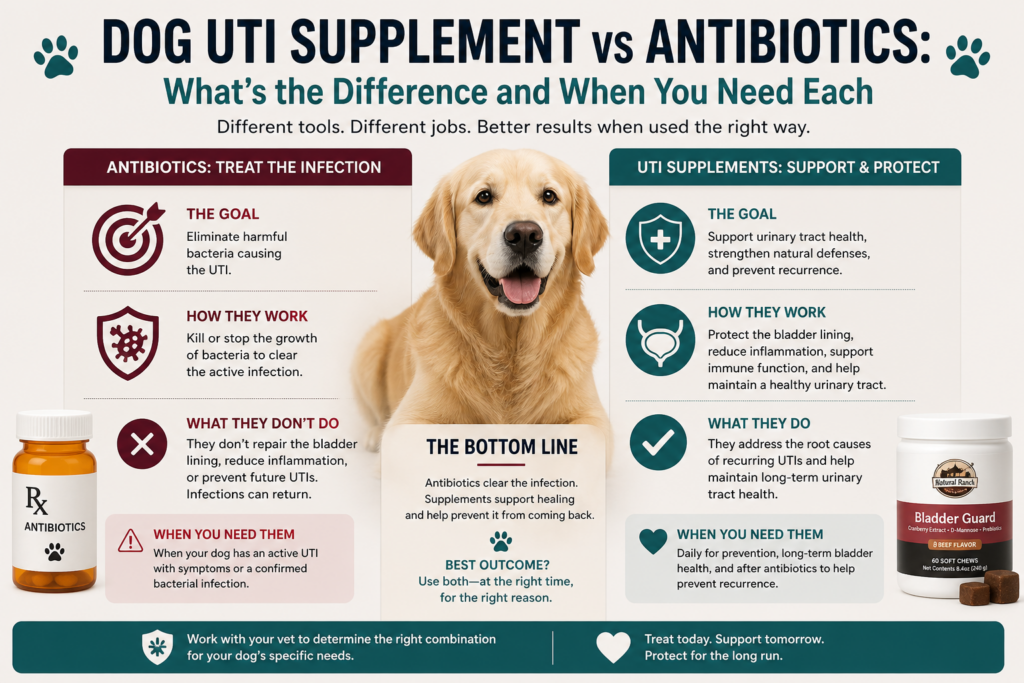
What Antibiotics Do — And What They Don’t
Dog UTI Supplement vs Antibiotics: Understanding the Options
Antibiotics are bactericidal or bacteriostatic agents — they either kill bacteria directly or prevent them from reproducing. For an active bacterial UTI where bacteria have established in the bladder and are causing clinical symptoms, antibiotics are the only evidence-based treatment for clearing the infection.
Only patients with bacteriuria and clinical signs of urinary tract infection should be treated with antibiotics. This distinction matters — the presence of bacteria in urine alone, without clinical symptoms, doesn’t automatically warrant antibiotic treatment. Treatment of subclinical bacteriuria is not indicated for dogs or cats, and up to 12% of healthy dogs have subclinical bacteriuria.
When a genuine UTI is present — with symptoms like straining, frequent urination, blood in urine, or discomfort — antibiotics do what nothing else can: eliminate the active bacterial population that’s causing those symptoms. For uncomplicated UTI, seven or fewer days of antibiotic therapy is recommended. For complicated UTI, antibiotic therapy for up to four weeks may be required.
But here’s what antibiotics don’t do — and this is where the supplement question becomes relevant.
- They don’t restore the GAG layer that each infection degrades
- They don’t address the gut microbiome disruption they cause
- They don’t change the urinary environment that allowed bacteria to establish
- They don’t prevent the next exposure from establishing a new infection
- They don’t support bladder muscle tone or address incontinence
For the full explanation of why antibiotics sometimes fail to prevent recurrence: Why Antibiotics Sometimes Fail in Recurring Dog UTIs
What Urinary Supplements Do — And What They Don’t
Urinary supplements work through entirely different mechanisms than antibiotics. They don’t kill bacteria — and this is not a limitation, it’s by design. Their role is to influence the urinary environment in ways that make it harder for bacteria to establish, persist, and recur.
When effective, dietary supplements may help to prevent but not treat UTIs. When selecting cranberry-based treatments, one should choose an extract that has a higher concentration of proanthocyanidins, the antioxidants thought to be responsible for antibacterial effects.
This is the critical distinction: supplements are prevention tools, not treatment tools. Using them during an active infection won’t replace the need for antibiotics. Using them consistently between infections — and during the recovery period after antibiotic treatment — is where they produce their most meaningful results.
Here’s what each key ingredient actually does:
Cranberry PACs — reduce bacterial adhesion to the bladder wall. Bacteria that can’t attach are more likely to be flushed out during urination before establishing an infection. This is a prevention mechanism, not a treatment mechanism.
D-Mannose — gives certain bacteria an alternative binding target, supporting natural clearance through urination. Works alongside cranberry PACs through a complementary anti-adhesion pathway.
Marshmallow Root and NAG — support the bladder lining and GAG layer that each infection degrades. Particularly important during recovery from an active infection — the tissue support that antibiotics don’t provide.
Probiotics — restore gut microbiome balance disrupted by antibiotic treatment, supporting the systemic immune function that protects the urinary tract between infections.
Vitamin C — contributes to urine acidification and immune support, maintaining a urinary environment less favorable for bacterial persistence.
For the full ingredient breakdown: Best Dog UTI Supplement: What to Actually Look For
When Antibiotics Are Required — Non-Negotiable Situations
There is no supplement equivalent for antibiotic treatment when a genuine bacterial infection is active. Contact your vet promptly — not watchfully — when your dog shows any of these signs:
- Straining or vocalizing during urination
- Blood in the urine
- Frequent urination with little or no output
- Accidents in a house-trained dog
- Fever, lethargy, or loss of appetite alongside urinary symptoms
- Vomiting alongside urinary symptoms — may indicate kidney involvement
- Any urinary symptom in a dog with diabetes, Cushing’s disease, or kidney disease
These symptoms indicate an active infection requiring veterinary diagnosis — including urinalysis and ideally urine culture and sensitivity testing — and appropriate antibiotic treatment. Starting supplements while these symptoms are present is not a substitute for veterinary care. Supplements can be used alongside antibiotic treatment, but they cannot replace it.
When Supplements Are Most Valuable — The Strategic Windows
Window 1: Between Infections — Daily Ongoing Prevention
This is where supplements produce their most significant long-term impact. A dog whose bladder environment is consistently supported by daily anti-adhesion ingredients, GAG layer support, and immune function maintenance is less likely to allow the next bacterial exposure to establish into a full infection.
Consistency is everything here. Cranberry PACs and D-Mannose need to be present in the urinary environment daily to influence bacterial behavior. Using them only when symptoms appear defeats the purpose — by the time symptoms appear the infection is already established and antibiotics are needed.
Window 2: During Antibiotic Treatment — Supportive Alongside
Urinary support ingredients can be used alongside antibiotic treatment — they don’t interfere with antibiotic mechanisms and there are no known contraindications between standard urinary supplement ingredients and commonly used UTI antibiotics. During treatment the most valuable supplement components are probiotics — which help maintain gut microbiome balance while antibiotics are simultaneously disrupting it — and bladder lining support ingredients like marshmallow root and NAG that support tissue recovery alongside bacterial clearance.
Always confirm with your veterinarian before adding any supplement during active antibiotic treatment, particularly if your dog has other health conditions or is on multiple medications.
Window 3: After Antibiotic Treatment — The Critical Recovery Period
This is the most important and most overlooked window. When antibiotics end the active bacterial population has been reduced — but several vulnerability factors remain. The GAG layer has been further degraded by the recent infection. The gut microbiome has been disrupted by the antibiotic course. The urinary environment that allowed the infection to establish hasn’t fundamentally changed.
Starting or intensifying daily supplement support immediately after completing antibiotics addresses exactly these remaining vulnerabilities — rebuilding gut microbiome balance, supporting GAG layer recovery, and maintaining the anti-adhesion environment that reduces the risk of the next infection establishing before the bladder has fully recovered.
For the full science on what happens in the bladder during this recovery window: Signs Your Dog’s UTI Is Coming Back (And What to Do Before It Gets Worse)
The Antimicrobial Stewardship Angle — Why This Matters Beyond Your Dog
There’s a broader reason why using supplements strategically to reduce antibiotic dependence matters. Unnecessarily prolonged antibiotic durations may contribute to the development of resistance in both humans and animals. Every unnecessary antibiotic course — whether too long, too frequent, or prescribed for subclinical bacteriuria that didn’t require treatment — contributes to antimicrobial resistance patterns that affect both veterinary and human medicine.
Dogs who receive consistent daily urinary supplement support may need fewer antibiotic courses over time — not because the supplements replace antibiotics when they’re genuinely needed, but because they reduce the frequency of the infections that require antibiotic treatment in the first place. This is the most practical expression of antimicrobial stewardship at the individual dog level.
How to Use Both Together — A Practical Framework
For dogs with recurring UTIs, here’s how antibiotics and supplements work together as a complete strategy rather than as competing options:
Active infection present: Veterinary evaluation first. Urinalysis and ideally urine culture and sensitivity testing. Appropriate antibiotic based on culture results. Begin or continue probiotic and bladder lining support alongside antibiotic treatment.
During antibiotic course: Complete the full course — never stop early because symptoms improved. Continue probiotics daily. Continue marshmallow root and NAG for bladder lining support. Increase hydration deliberately.
After antibiotic course ends: Follow-up urinalysis 7-14 days after completing antibiotics to confirm full clearance. Begin or intensify full daily supplement protocol — cranberry PACs, D-Mannose, marshmallow root, NAG, Vitamin C, and probiotics. Maintain consistently.
Between infections: Daily supplement support every day — not reactively when symptoms appear. Consistent hydration. Regular bathroom breaks. Track patterns and share with your vet.
This is the approach Bladder Guard Soft Chews from Natural Ranch Products is designed to support — a complete daily formula covering anti-adhesion, bladder lining integrity, bladder muscle tone, pH support, and immune function through cold-pressed manufacturing that preserves the bioavailability of every active compound.
→ See Bladder Guard Soft Chews
For dogs where urinary health is an ongoing management priority, the Total Defense System pairs Bladder Guard with the Natural Ranch Daily Multivitamin for complete foundational support.
→ See the Total Defense System
For the Complete Prevention Picture
For a complete daily prevention routine that goes beyond supplements: Dog UTI Prevention: Daily Habits That Actually Matter
For the timeline of how long supplements take to produce results: How Long Does a Dog UTI Supplement Take to Work?
For the science on why some infections recur despite appropriate treatment: Why Some Dogs Keep Getting UTIs (And What Actually Helps Long-Term)
Can dog UTI supplements replace antibiotics?
No. Urinary supplements are prevention tools — they influence the bladder environment to make infections less likely to establish and recur. They cannot eliminate an active bacterial infection. Active UTIs with clinical symptoms require veterinary diagnosis and appropriate antibiotic treatment. Supplements work best used consistently between infections and alongside antibiotic treatment during and after active infection episodes.
Can I give my dog urinary supplements while they are on antibiotics?
Yes — urinary supplement ingredients like cranberry PACs, D-Mannose, marshmallow root, NAG, and probiotics are generally compatible with antibiotic treatment and don’t interfere with antibiotic mechanisms. Probiotics are particularly valuable during antibiotic treatment to help maintain gut microbiome balance. Always confirm with your veterinarian before adding any supplement during active treatment, particularly if your dog has other health conditions.
How do I know when my dog needs antibiotics vs supplements?
Any dog showing active UTI symptoms — straining during urination, blood in urine, frequent urination with small output, accidents in a house-trained dog, or behavioral changes alongside urinary symptoms — needs veterinary evaluation and likely antibiotic treatment. Supplements are not a substitute for veterinary care when symptoms are present. Supplements are most valuable as daily ongoing prevention between infections and during recovery after antibiotic treatment ends.
Why does my dog keep getting UTIs even after antibiotics?
Antibiotics clear the active bacterial population but don’t address the underlying conditions that make recurrence likely — the degraded GAG layer, disrupted gut microbiome, urinary environment characteristics, or anatomical factors. Without addressing these through daily prevention support, the next bacterial exposure finds the same vulnerable environment that allowed the previous infection to establish. Dogs with three or more UTIs in twelve months should have a thorough diagnostic workup to identify underlying contributing factors.
What is the most important time to use urinary supplements?
The three most strategic windows are: between infections as consistent daily prevention, during antibiotic treatment specifically for probiotic and bladder lining support, and immediately after completing antibiotics when the bladder is most vulnerable to recurrence. The post-antibiotic window is often the most overlooked — the gut microbiome is disrupted, the GAG layer is compromised, and the urinary environment hasn’t changed. Starting or intensifying supplement support immediately after antibiotics end directly addresses these remaining vulnerabilities.
Do urinary supplements reduce the need for antibiotics in dogs?
Dogs who receive consistent daily urinary supplement support may need fewer antibiotic courses over time — not because supplements replace antibiotics when they are genuinely needed, but because they reduce the frequency of infections that require antibiotic treatment. This is also relevant from an antimicrobial stewardship perspective — reducing unnecessary antibiotic exposure benefits both the individual dog and the broader resistance picture.
References
Acierno M. “Making sense of the new UTI antimicrobial recommendations.” dvm360 Fetch Coastal Conference. 2024.
International Society for Companion Animal Infectious Diseases. “Antimicrobial Use Guidelines for Treatment of Urinary Tract Disease in Dogs and Cats.” PMC.
Merck Veterinary Manual. “Pharmacotherapeutics in Bacterial Urinary Tract Infections in Animals.” Updated June 2025.
Byron JK. “Urinary Tract Infection.” Veterinary Clinics of North America: Small Animal Practice. 2019.
VCA Animal Hospitals. “Urinary Tract Infections (UTIs) in Dogs.” vcahospitals.com