
Dog Probiotics: What They Actually Do, Which Strains Matter, and What to Look For
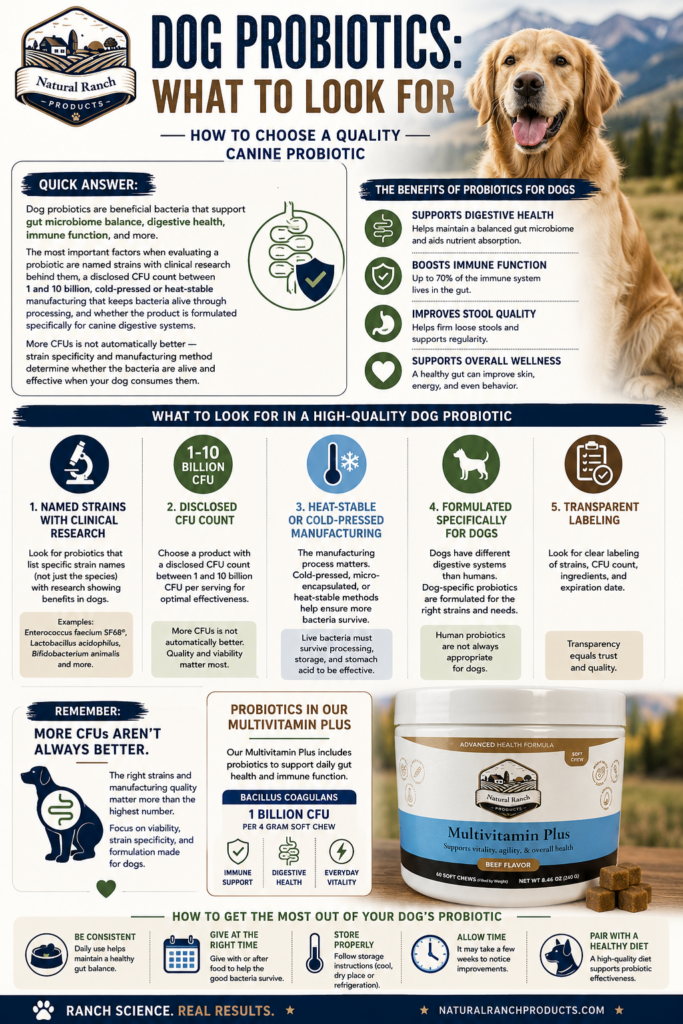
Quick Answer: Dog probiotics are beneficial bacteria that support gut microbiome balance, digestive health, immune function, and more. The most important factors when evaluating a probiotic are named strains with clinical research behind them, a disclosed CFU count between 1 and 10 billion, cold-pressed or heat-stable manufacturing that keeps bacteria alive through processing, and whether the product is formulated specifically for canine digestive systems. More CFUs is not automatically better — strain specificity and manufacturing method determine whether the bacteria are alive and effective when your dog consumes them.
The word probiotic gets used loosely across pet supplements — sprinkled into ingredient lists alongside dozens of other compounds, often without strain names, CFU counts, or any indication of whether the bacteria survived manufacturing. Understanding what dog probiotics actually do, which strains matter, and what separates a functional probiotic from a label claim changes how you evaluate every supplement your dog takes.
What Probiotics Actually Are — The Biology
Probiotics are beneficial microorganisms that support your dog’s digestion, immune health, and overall well-being. They are live bacteria and yeasts that, when present in adequate numbers in the gut, actively shift the intestinal environment in ways that benefit the host. They are not passive additives — they compete with pathogenic organisms for nutrients and attachment sites, produce compounds that alter gut pH, and communicate with the immune system through the intestinal wall.
The canine gut microbiome contains trillions of microorganisms — bacteria, fungi, viruses, and other microbes — that collectively influence digestion, nutrient absorption, immune function, inflammatory response, and even behavior. In dogs, gut microbiome dysbiosis is associated with several health conditions, including gastrointestinal disease. Probiotic supplementation can support a balanced gut microbiome.
Dysbiosis — an imbalance in the microbial populations of the gut — occurs when pathogenic or opportunistic species overgrow relative to beneficial ones. Antibiotics, dietary changes, stress, illness, and aging all shift this balance. Probiotics reintroduce beneficial bacterial populations that help restore the balance disrupted by these factors.
What Dog Probiotics Actually Do — The Mechanisms
Digestive Support
Probiotics normalize the conditions in the intestines by changing the local acidity of the digestive tract and releasing short-chain fatty acids. Short-chain fatty acids — particularly butyrate — are the primary energy source for colonocytes, the cells lining the colon. They support the integrity of the intestinal barrier, reduce inflammation in the gut lining, and regulate the speed of digestion in ways that improve stool quality and consistency.
Research, including a 2024 Canadian Veterinary Journal study, has shown that dogs taking probiotics often have better stool quality and fewer tummy upsets. Loose stools, excessive gas, and inconsistent stool quality — common complaints in dogs on exclusively processed diets — often improve with consistent probiotic supplementation because the bacterial populations that support efficient digestion are being actively maintained rather than left to deplete between antibiotic courses and dietary disruptions.
Immune Function
Approximately 70% of the immune system is located in or around the gut — in the form of gut-associated lymphoid tissue (GALT) that continuously samples the intestinal environment and calibrates immune responses accordingly. Beneficial bacteria in the gut communicate with GALT, helping train the immune system to distinguish between harmful pathogens and harmless environmental proteins.
This gives dogs a leg up if they end up ingesting harmful bacteria such as Salmonella. Probiotics help inhibit the growth of these bacteria by competing for the same nutrients and resources. This competitive exclusion mechanism — beneficial bacteria occupying the attachment sites and consuming the nutrients that pathogenic species require — is one of the primary ways probiotics reduce infection risk and support immune resilience.
Allergy and Skin Support
Probiotics can help manage diarrhea, reduce allergic reactions, and support mental calmness in dogs. The gut-skin axis — the bidirectional communication between gut microbiome composition and skin immune response — means that dysbiosis in the gut contributes to the allergic skin inflammation that drives itching, hotspots, and recurring yeast infections. Dogs with atopic dermatitis consistently show altered gut microbiome composition compared to non-allergic dogs. Probiotic support that addresses gut dysbiosis can reduce the inflammatory load that the skin barrier is managing — working alongside topical and dietary allergy management rather than replacing it.
For the complete guide to skin barrier support and the nutritional connection: Why the Canine Skin Barrier Matters More Than Most Dog Owners Realize
Urinary Tract Health
The gut-urinary axis — less studied than the gut-skin axis but increasingly recognized in veterinary research — means that gut microbiome composition influences the urinary tract environment. Beneficial gut bacteria produce compounds that reduce the adhesion capacity of uropathogens like E. coli, the organism responsible for most canine UTIs. Dogs with chronic UTI history often show dysbiosis that reduces this protective effect — which is why probiotic support alongside targeted urinary supplements like cranberry PACs and D-Mannose addresses the problem at multiple biological layers simultaneously.
For the complete guide to canine urinary health and the multi-mechanism approach: Dog Urinary Tract Health: A Complete Guide
Behavior and Stress Response
The gut-brain axis — the bidirectional communication between gut microbiome and central nervous system via the vagus nerve and enteric nervous system — means that gut health influences behavior and stress response. Certain strains, like Bifidobacterium longum BL999, may also support calm behavior in dogs during stress. This is an emerging area of research rather than an established clinical standard — but the mechanism is real and strain-specific, meaning not every probiotic produces behavioral benefit.
Which Strains Matter — Not All Probiotics Are Equal
The most important thing to understand about probiotics is that benefits are strain-specific — not genus or species specific. Lactobacillus acidophilus is not the same as Lactobacillus rhamnosus LGG, even though both are Lactobacillus species. The clinical evidence for one strain doesn’t transfer to another strain in the same genus. This is why strain names matter on probiotic labels — and why “probiotic blend” without named strains is a meaningless label claim.
The most clinically studied strains for dogs include:
- Enterococcus faecium SF68 / NCIMB 10415 — the most extensively studied canine probiotic strain, with documented benefits for diarrhea management and immune function. Present in several veterinary-grade formulations including Fortiflora
- Bacillus coagulans — a spore-forming strain that survives heat processing and stomach acid more reliably than most Lactobacillus strains. Particularly relevant for supplement manufacturing because it maintains viability through the conditions that kill most probiotics
- Lactobacillus rhamnosus LGG — well-studied for diarrhea management, particularly antibiotic-associated diarrhea
- Bifidobacterium longum BL999 — studied specifically for stress-related behavioral support in dogs
- Bifidobacterium lactis and Enterococcus faecium IDCC combinations — a 2024 study demonstrated metabolic support including weight management in dogs consuming high-fat diets
Usually, multiple culture strains are more effective than supplements with a single strain. However, as the number of strains in one probiotic product increases, there is a chance that your dog may experience side effects like excessive gas or diarrhea. Starting with a formula containing two to four well-studied strains and monitoring stool quality for the first two weeks allows adjustment before increasing strain complexity.
CFU Count — What the Numbers Mean
Ideally, a high-quality probiotic supplement should contain between 1 and 10 billion CFUs (colony-forming units) per day, depending on the strain(s) included in the product. Manufacturers often include an oversupply of specific strains to compensate for the inevitable loss of some live organisms during the product’s shelf life.
More CFUs aren’t always better — the right potency depends on why you’re using the probiotic and how it’s formulated. A high-CFU product with strains that have been killed by heat processing delivers zero active bacteria regardless of what the label says. A lower-CFU product with heat-stable spore-forming strains like Bacillus coagulans may deliver more viable bacteria than a higher-CFU product made with fragile Lactobacillus strains that don’t survive manufacturing temperatures.
Why Manufacturing Method Is the Most Important Factor
Most commercial dog supplement chews are manufactured using high-heat extrusion — temperatures regularly exceeding 160-180°C to form the soft chew matrix at scale. The problem is that most probiotic strains are killed at temperatures above 40-50°C. A product that lists Lactobacillus acidophilus at 500 million CFU on the label may have had those bacteria killed during manufacturing before the product is even sealed.
This is why strain selection and manufacturing method interact — and why Bacillus coagulans is the preferred probiotic strain for supplement chews specifically. Bacillus coagulans forms heat-resistant spores during its life cycle that survive high temperatures and harsh stomach acid conditions, germinating in the intestinal environment where they’re needed. It’s not the most clinically studied strain for every application — but it’s the only major probiotic strain that reliably survives the manufacturing process used to make soft chews.
Cold-extrusion manufacturing — which never reaches nutrient-damaging temperatures — preserves the biological activity of even heat-sensitive probiotic strains alongside the other functional ingredients in a formula. This is the manufacturing standard Natural Ranch Products uses for both Bladder Guard and the Daily Multivitamin — ensuring the Bacillus coagulans listed on the label is alive and viable when your dog eats the chew.
For the complete science on cold-extrusion manufacturing and why it matters for every ingredient in a supplement: Why Cold-Extruded Supplements Preserve Nutrients Better Than High-Heat Processing
When Dogs Benefit Most From Probiotic Support
- During and after antibiotic treatment — antibiotics eliminate beneficial bacteria alongside the pathogenic ones being targeted. Probiotic supplementation during and after a course helps restore the beneficial populations that antibiotics disrupt. Give probiotics at least two hours apart from antibiotic doses to avoid the antibiotic killing the probiotic bacteria before they reach the gut
- During dietary transitions — changing food shifts the microbial populations adapted to the previous diet. Probiotic support during transitions reduces the digestive upset that dietary changes commonly cause
- During periods of stress — boarding, travel, new environments, and household changes all shift gut microbiome composition through stress hormone pathways. Probiotic support during stress-heavy periods maintains the populations most vulnerable to cortisol-driven disruption
- In senior dogs — gut microbiome diversity naturally narrows with age, reducing the beneficial populations that support nutrient absorption, immune function, and digestive efficiency. Daily probiotic support in dogs seven and above maintains populations that age-related decline reduces
- In dogs with recurring UTIs — gut microbiome support addresses the systemic dysbiosis that contributes to urinary tract vulnerability alongside targeted anti-adhesion supplements
- In dogs with allergic skin disease — gut-skin axis support reduces the inflammatory load contributing to skin barrier compromise and secondary infection susceptibility
- As daily maintenance — dogs on exclusively processed commercial diets don’t receive the naturally occurring probiotic populations that whole food diets provide. Daily supplementation maintains the populations that processing removes
Prebiotics — What Feeds the Probiotics
Prebiotics are the dietary fibers that probiotic bacteria consume as their food source. Without adequate prebiotic substrate the probiotic populations introduced through supplementation struggle to establish and maintain viable populations in the gut environment. Prebiotics are fiber upon which the probiotics feed. Both occur naturally, but can be given as supplements or added to your dog’s food.
The most effective probiotic formulas pair named probiotic strains with prebiotic fiber — typically inulin, fructooligosaccharides (FOS), or chicory root — creating a synbiotic combination that introduces beneficial bacteria and simultaneously feeds them. A probiotic without prebiotic support is like planting seeds in nutrient-depleted soil.
What to Look for on the Label
| Factor | What to look for | Red flag |
| Strain names | Named strains with alphanumeric designations (e.g. Bacillus coagulans GBI-30 6086) | “Probiotic blend” without named strains |
| CFU count | 1-10 billion CFU clearly stated per dose | No CFU count listed |
| Viability guarantee | “CFU at time of use” — not just “at time of manufacture” | CFU count only at manufacture — doesn’t account for die-off |
| Manufacturing method | Cold-pressed, cold-extruded, or heat-stable spore-forming strains | No manufacturing method mentioned; heat-sensitive strains in heat-processed chews |
| Canine-specific formulation | Formulated for dogs; strains with canine clinical research | Human probiotic repackaged for dogs |
| Prebiotic inclusion | Prebiotic fiber alongside probiotic strains | Probiotics only with no prebiotic support |
The Bladder Guard and Daily Multivitamin from Natural Ranch Products both include Bacillus coagulans — a heat-stable spore-forming probiotic strain that survives cold-extrusion manufacturing intact and germinate in the canine gut environment. The cold-extrusion manufacturing process that protects the cranberry PACs and omega fatty acids in our formulas also protects the probiotic viability that most commercial chew manufacturing destroys.
Do dogs need probiotics?
Not every dog requires supplemental probiotics — dogs with access to diverse whole food diets and minimal antibiotic exposure maintain relatively healthy gut microbiomes without supplementation. However, most dogs on exclusively processed commercial diets, dogs with recurring digestive issues, dogs who receive antibiotics regularly, senior dogs, and dogs with allergic skin disease or chronic UTI history benefit meaningfully from daily probiotic support. The gut microbiome continuously depletes under the conditions most modern dogs live in — antibiotic exposure, processed food diets, stress, and age-related decline all reduce beneficial populations that supplementation maintains.
Can I give my dog human probiotics?
Human probiotics contain strains selected for the human gut environment and human intestinal pH and transit time — which differ meaningfully from canine digestive systems. While human probiotics are unlikely to harm dogs they are less effective than canine-specific formulations. Dog-specific probiotics contain strains with clinical research conducted in dogs, formulated for canine intestinal conditions. If a canine-specific probiotic isn’t immediately available a human probiotic is better than nothing — but it should be replaced with a canine-formulated product as soon as possible.
How long does it take for probiotics to work in dogs?
Digestive improvements from probiotic supplementation — better stool consistency, reduced gas, less bloating — typically appear within 1-2 weeks of consistent daily use. Immune function improvements and reductions in allergy-related skin symptoms develop over 4-8 weeks as microbial populations establish and begin communicating with gut-associated immune tissue. Urinary tract health improvements from the gut-urinary axis mechanism develop over similar timelines. Probiotics need to be taken consistently every day to maintain their effect — sporadic use doesn’t allow the bacterial populations to establish at therapeutic levels.
What are the signs my dog needs a probiotic?
The most common signs of gut dysbiosis that probiotics address are loose or inconsistent stools, excessive gas or bloating, frequent digestive upset after dietary changes, slow recovery from antibiotic courses, recurring skin infections or yeast overgrowth, and frequent illness or slow recovery from minor infections. Senior dogs losing gut microbiome diversity with age often show progressive digestive changes on the same diet they’ve eaten for years — indicating declining microbial populations rather than a diet problem. Any dog who has received multiple antibiotic courses in the past year has had their gut microbiome significantly disrupted and benefits from probiotic restoration.
Should I give my dog probiotics with antibiotics?
Yes — but timing matters. Give probiotics at least two hours apart from antibiotic doses. Antibiotics taken simultaneously with probiotics kill the probiotic bacteria before they reach the gut, eliminating the benefit. Spacing them by two hours gives the antibiotic time to clear the stomach before the probiotic dose arrives. Continue probiotic supplementation for at least two to four weeks after the antibiotic course ends — the microbiome disruption from antibiotics persists long after the course is complete.
What is the difference between probiotics and prebiotics for dogs?
Probiotics are live beneficial bacteria that, when present in adequate numbers in the gut, actively support digestion, immune function, and microbiome balance. Prebiotics are the dietary fibers that probiotic bacteria consume as their food source — inulin, fructooligosaccharides (FOS), and chicory root are common prebiotic sources. Without adequate prebiotic substrate the probiotic populations introduced through supplementation struggle to establish. The most effective formulas pair named probiotic strains with prebiotic fiber — creating a synbiotic combination that both introduces beneficial bacteria and feeds them simultaneously.
References
Cornell University College of Veterinary Medicine. “The Power of Probiotics.” vet.cornell.edu.
PetMD Editorial. “Probiotics for Dogs: Does Your Dog Need Them?” Updated July 2025.
Dr. Buzby’s ToeGrips. “Probiotics for Dogs: A Vet’s Guide to Benefits and Picking the Right One.” April 2026.
Assessing Probiotic Efficacy: Short-Term Impact on Canine Gut Microbiota Using an In Vitro Colonic Fermentation Model. Pets. 2025;2(4):33.
North Hound Life. “7 Essential Good Probiotic For Dogs Picks in 2026.” December 2025.
PetMD Editorial. “9 Best Probiotics for Dogs in 2025, Recommended By Vets.” April 2026.