
Can Dogs Eat Blueberries? Benefits, Safety, and How Much to Feed
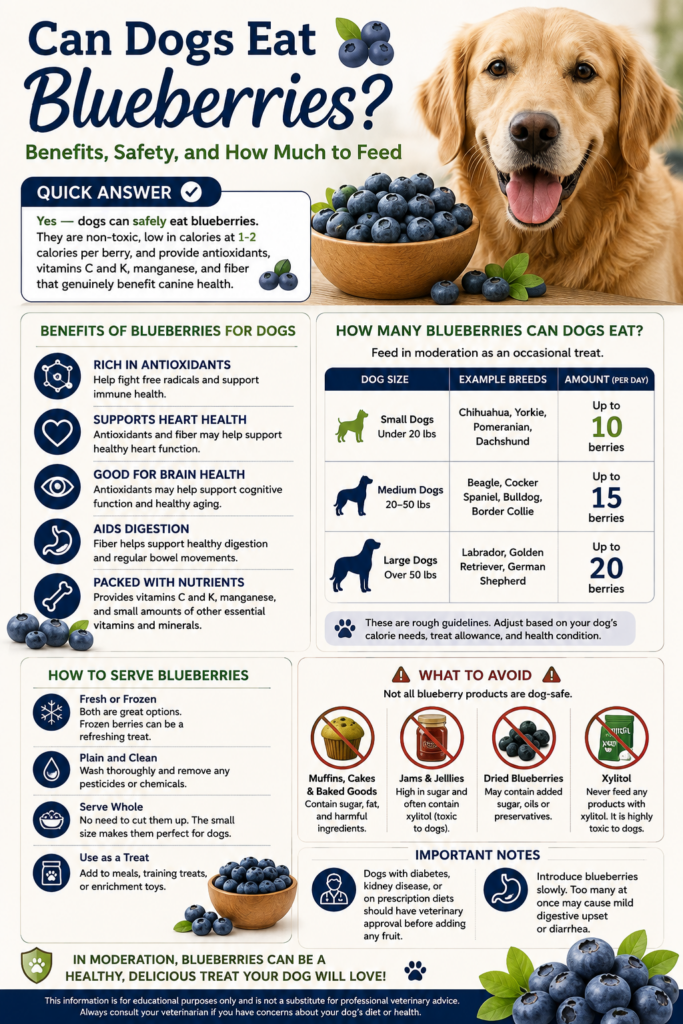
Quick Answer: Yes — dogs can safely eat blueberries. They are non-toxic, low in calories at 1-2 calories per berry, and provide antioxidants, vitamins C and K, manganese, and fiber that genuinely benefit canine health. Feed fresh or frozen, plain and unwashed of pesticides, in amounts appropriate to your dog’s size — no more than 10 berries for small dogs, up to 20 for large dogs as a rough guide. Avoid all processed blueberry products including muffins, jams, dried blueberries with additives, and any product containing xylitol. Dogs with diabetes, kidney disease, or prescription diets should have veterinary approval before adding any fruit.
Blueberries are one of the questions dog owners ask most frequently about human foods — and one of the most consistently positive answers in canine nutrition. Unlike grapes, raisins, and many other fruits that carry genuine toxicity risks for dogs, blueberries are not only safe but genuinely nutritious at appropriate serving sizes. The question isn’t really whether dogs can eat blueberries — they can — but what they actually provide, how much is appropriate, and which blueberry products to avoid entirely. Can dogs eat blueberries?
Are Blueberries Safe for Dogs?
Yes, dogs can safely eat blueberries. These tiny superfruits are packed with antioxidants, vitamins, and fiber. Blueberries are not on the ASPCA toxic foods list, are not associated with any known toxicity mechanism in dogs, and have been studied in canine nutrition research with consistently positive outcomes. Blueberries are safe for dogs and they pack a punch of vitamins and minerals in one tiny package.
The important safety distinction is between plain fresh or frozen blueberries — which are safe — and blueberry-flavored or blueberry-containing processed human foods — most of which are not appropriate for dogs and some of which are actively harmful. The blueberry itself is fine. The muffin, the jam, the trail mix, and the blueberry-flavored treat are where problems arise.
What Blueberries Provide — The Nutritional Profile
Antioxidants — Particularly Anthocyanins
Blueberries contain many essential vitamins and trace minerals, along with significant levels of antioxidants such as anthocyanins, which are also responsible for the fruit’s deep blue color. Anthocyanins are polyphenol compounds that neutralize free radicals — the reactive oxygen species generated by normal metabolism, exercise, inflammation, and environmental exposures that damage cell membranes, DNA, and proteins over time.
The antioxidant concentration in blueberries is among the highest of any commonly consumed fruit — which is why they’ve accumulated the “superfood” designation in both human and canine nutrition contexts. For dogs, the relevance of antioxidant support spans immune function, inflammatory response regulation, cognitive aging, and skin cell protection — all areas where oxidative damage accumulates progressively over a dog’s life.
The anthocyanin family in blueberries is structurally similar to the proanthocyanidins in cranberry — the polyphenol class responsible for cranberry’s anti-adhesion effect in the urinary tract. Both are polyphenol antioxidants working through related mechanisms, which is why berry-based nutritional support is increasingly featured in functional dog supplement formulas.
Vitamins C and K
Blueberries are rich in vitamins C and K — which can help support immune function and healthy cell activity. Vitamin C supports collagen synthesis — the protein framework of skin, tendons, and connective tissue — and provides additional antioxidant activity in water-soluble cellular compartments. Dogs synthesize their own vitamin C and are not prone to deficiency the way humans are, but dietary vitamin C from whole food sources provides antioxidant support that complements rather than duplicates the dog’s own synthesis.
Vitamin K supports blood clotting factor synthesis and bone metabolism. Manganese — also present in meaningful amounts in blueberries — supports bone development, energy metabolism, and cartilage formation. These are not the primary reason to feed blueberries, but they represent genuine nutritional contributions rather than trace amounts present only on paper.
Fiber
Blueberries provide both soluble and insoluble fiber — the same fiber fractions discussed in the context of probiotic support. Soluble fiber feeds the beneficial gut bacteria that produce short-chain fatty acids. Insoluble fiber adds bulk and supports transit regularity. For dogs on exclusively processed diets that are typically low in fiber, blueberries as an occasional treat contribute fiber that supports the gut microbiome alongside whatever probiotic supplementation is in place.
Low Calorie Density
Since the average blueberry contains roughly 1-2 calories, this makes them incredibly flexible as a treat. The 10% treat rule — the veterinary guideline that all treats combined should constitute no more than 10% of daily caloric intake — is extremely easy to stay within with blueberries. A 30-pound dog eating around 700 calories daily has 70 treat calories to work with. At 1-2 calories per berry that’s 35-70 berries before hitting the limit — far more than any reasonable serving. The caloric constraint with blueberries is essentially irrelevant for most dogs, which makes them genuinely useful as training rewards alongside their nutritional value.
The 2025 University Research — Exercise Recovery
A 2025 study at the Universitat Autònoma de Barcelona found that dogs fed a diet including blueberries had lower levels of creatine kinase — an enzyme that rises with heat and physical stress. This suggests blueberries may help very active dogs recover more quickly from exercise. The same 2025 study found that Beagle dogs consistently preferred meals containing blueberries, and the addition of blueberries did not negatively affect nutrient absorption or digestion.
Creatine kinase elevation is a marker of muscle cell damage from exercise stress — its reduction in blueberry-fed dogs suggests that the anthocyanin antioxidants are providing measurable protection against exercise-induced oxidative damage at the cellular level. This is the same mechanism that makes blueberries popular in human athletic recovery nutrition, now demonstrated in a canine population specifically.
How Many Blueberries Can Dogs Eat — Serving Size by Weight
| Dog Size | Weight | Recommended serving |
| Extra small | Under 10 lbs | 2-3 berries |
| Small | 10-25 lbs | 3-5 berries |
| Medium | 25-60 lbs | 5-10 berries |
| Large | 60-100 lbs | 10-15 berries |
| Extra large | Over 100 lbs | 15-20 berries |
These are daily serving guidelines — not per-treat guidelines. If your dog gets blueberries as training rewards throughout the day, count the total across all sessions. For most dogs these amounts are well within safe digestive tolerance. Exceeding them significantly — particularly in dogs not accustomed to fruit — may cause loose stools or digestive upset from the fiber load.
How to Serve Blueberries to Dogs
- Fresh — wash thoroughly to remove pesticide residue, serve whole for most dogs or halved for small breeds that gulp food quickly
- Frozen — a popular warm weather option; frozen blueberries are nutritionally equivalent to fresh and the texture many dogs find appealing as a treat. Thaw slightly for senior dogs or dogs with dental sensitivity
- Mashed into food — for dogs who won’t eat them whole, mashing into their regular meal adds the nutritional benefit without requiring the dog to accept the whole berry format
- Mixed into homemade treats — plain blueberries baked into dog-safe treat recipes without added sugar, salt, or problematic ingredients
Blueberry Products to Avoid Entirely
Blueberry muffins or pies: Not recommended for dogs. These products are often high in calories, sugar, and fat. Shop-bought versions may also contain sweeteners, chocolate, or other ingredients that are potentially toxic to dogs.
- Blueberry muffins, pies, and baked goods — high sugar, high fat, often contain xylitol or chocolate in commercial versions
- Blueberry jam and preserves — concentrated sugar, often contain xylitol which is highly toxic to dogs
- Dried blueberries — the drying process concentrates sugars significantly; many commercial dried varieties contain added sweeteners or preservatives
- Trail mix containing blueberries — frequently also contains raisins, chocolate, or macadamia nuts — all toxic to dogs
- Blueberry-flavored dog treats — check ingredient lists carefully; flavored doesn’t mean it contains actual blueberries, and the other ingredients matter
- Blueberry smoothies made for humans — may contain yogurt ingredients, protein powders, sweeteners, or other additions that aren’t appropriate for dogs
- Canned blueberries in syrup — excessive sugar load from the syrup regardless of blueberry content
When to Check With Your Vet First
Dogs with diabetes, certain food sensitivities, or medical conditions that require prescription diets should generally avoid high-sugar fruits unless approved by a veterinarian. The sugar content of blueberries — though modest at natural fruit levels — is relevant for diabetic dogs whose blood glucose requires careful management through diet. Dogs on prescription kidney diets have specific phosphorus and potassium restrictions that require veterinary coordination before adding any new food. Dogs with documented food allergies should have new foods introduced with veterinary guidance to distinguish reactions from allergy versus tolerance.
For healthy adult dogs without chronic conditions, blueberries don’t require veterinary approval before introducing — start with 2-3 berries, see how your dog responds, and go from there.
The Antioxidant Connection — Berries and Canine Skin Health
The polyphenol antioxidants in blueberries — anthocyanins, flavonoids, and quercetin — support skin cell integrity through the same antioxidant mechanisms that make them valuable for general health. Oxidative stress contributes to the inflammatory cascade that drives allergic skin disease and the barrier compromise that makes secondary yeast and bacterial infections more likely.
Whole food antioxidant sources like blueberries complement the nutritional skin barrier support provided by omega fatty acids, zinc, and vitamin E — working as part of a complete inside-out approach to canine skin health rather than as a standalone solution. The Ranch Science approach to skin health addresses all of these layers simultaneously:
For the complete skin barrier science: Why the Canine Skin Barrier Matters More Than Most Dog Owners Realize
For the inside-out itch protocol combining nutritional and grooming support: → See the Skin and Coat Defense Duo
Can dogs eat blueberries every day?
Yes — blueberries can be fed daily in appropriate amounts without harm to healthy adult dogs. The serving size guidelines (2-3 berries for small dogs, up to 15-20 for large dogs) reflect daily totals within the 10% treat rule rather than a per-occasion limit. Daily feeding at appropriate serving sizes is nutritionally reasonable given blueberries’ low calorie density and genuine antioxidant content. Dogs with diabetes, kidney disease, or prescription diets should have veterinary approval before daily fruit feeding.
How many blueberries can I give my dog?
As a general guide: 2-3 berries for dogs under 10 lbs, 3-5 berries for dogs 10-25 lbs, 5-10 berries for dogs 25-60 lbs, 10-15 berries for dogs 60-100 lbs, and 15-20 berries for dogs over 100 lbs. These are daily totals — count all blueberries given throughout the day against these amounts. All treats combined should stay within 10% of your dog’s total daily calorie intake, which blueberries fit easily given their 1-2 calorie per berry density.
Are frozen blueberries safe for dogs?
Yes — frozen blueberries are nutritionally equivalent to fresh and many dogs prefer the texture, particularly as a warm weather treat. Thaw slightly for senior dogs or dogs with dental sensitivity to avoid tooth stress from the hardness of fully frozen berries. Avoid frozen blueberry products that contain added sweeteners, syrups, or other ingredients — plain frozen blueberries only.
Can blueberries be toxic to dogs?
No — plain blueberries are not toxic to dogs and are not on the ASPCA toxic foods list. They are one of the safest fruits dogs can eat. The toxicity risk with blueberry-related foods comes from the products that contain blueberries rather than the blueberry itself — muffins may contain xylitol, trail mixes may contain raisins or chocolate, jams may contain xylitol. The fruit itself is safe; the processed products containing it are where caution is warranted.
What are the benefits of blueberries for dogs?
Blueberries provide anthocyanin antioxidants that neutralize free radicals and support immune function, vitamins C and K for immune health and blood clotting support, manganese for bone development and metabolism, fiber for gut microbiome support, and high water content for hydration. A 2025 study at the Universitat Autònoma de Barcelona found that dogs fed blueberries had lower levels of creatine kinase — suggesting blueberries support exercise recovery in active dogs. They are also extremely low in calories at 1-2 calories per berry, making them suitable for weight-conscious dogs.
Can puppies eat blueberries?
Yes — blueberries are safe for puppies in small amounts appropriate to their size. Start with 1-2 berries to assess tolerance before incorporating them as a regular treat. Puppies have smaller digestive systems and lower daily calorie requirements than adults, so serving sizes should be reduced accordingly. Introduce any new food gradually and monitor for digestive upset — soft stools or gas indicate the amount should be reduced rather than discontinued entirely.
References
PetMD Editorial. “Can Dogs Eat Blueberries? Benefits and Risks.” Updated July 25, 2025.
Dogster Editorial. “Can Dogs Eat Blueberries? Vet-Verified Nutrition Facts and Tips.” February 5, 2025.
Petco Editorial. “Can Dogs Eat Blueberries? Yes — Here’s How.” petco.com.
Healthy Dogs Meals. “Can Dogs Eat Blueberries?” Citing Universitat Autònoma de Barcelona 2025 study. May 17, 2026.
Campfire Treats. “Can Dogs Eat Blueberries? Health Benefits, Risks, and Feeding Tips.” March 31, 2026.
Warrick Veterinary Clinic. “Are Blueberries Safe and Healthy for Dogs?” September 26, 2024.Why Gut Health and Urinary Health Are Connected in Dogs (And Why Treating One Without the Other Falls Short)Best Dog UTI Supplement: What to Actually Look For (And Why Most Fall Short)Why Gut Health and Urinary Health Are Connected in Dogs (And Why Treating One Without the Other Falls Short)Why the Canine Skin Barrier Matters More Than Most Dog Owners RealizeWhy Whole-Food Multinutrient Support Matters in Dogs (and Why Processing Changes Everything)