Why Does My Dog Smell Like Corn Chips?
You lean in to give your dog a cuddle and catch a familiar smell — unmistakably corn chips. Not a bag you left out. Not something they rolled in. It’s coming directly from their paws. If you’ve experienced this, you’ve discovered what veterinarians and dog owners have been calling “Frito feet” for decades — one of the most commonly noticed and most commonly misunderstood canine quirks.So have you everwondered why does my dog smell like corn chips?
The short answer is that the corn chip smell is usually normal. The longer answer — which matters for your dog’s health — is that normal Frito feet and problematic Frito feet look very different, and knowing the difference determines whether you need to do anything about it.
What Causes the Corn Chip Smell — The Microbiology
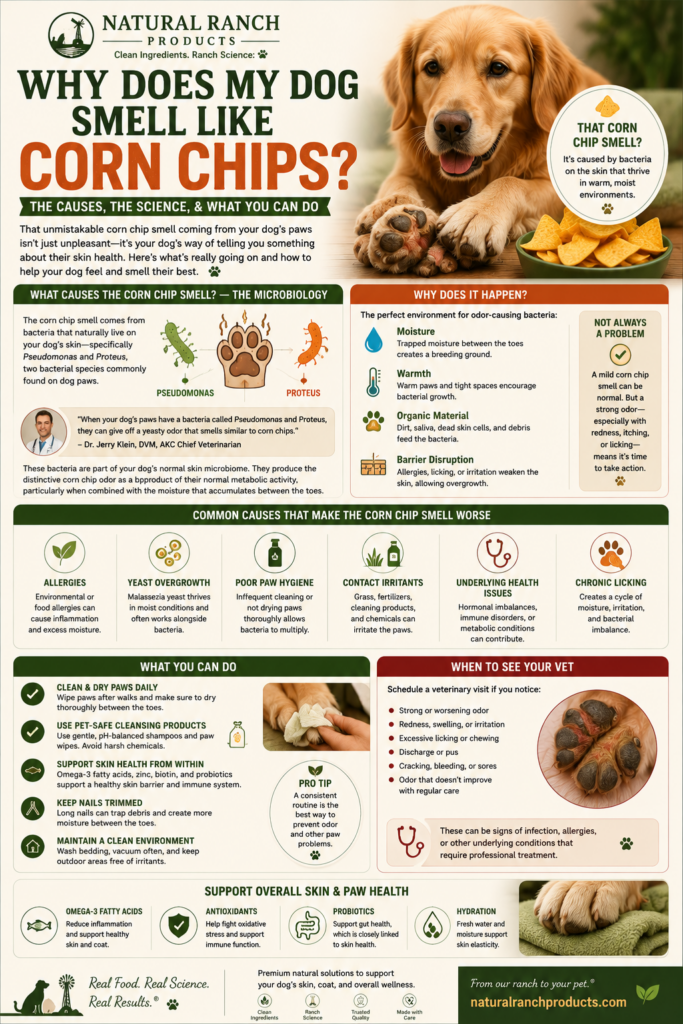
The corn chip smell comes from bacteria that naturally live on your dog’s skin — specifically Pseudomonas and Proteus, two bacterial species commonly found on dog paws. “When your dog’s paws have a bacteria called Pseudomonas and Proteus, they can give off a yeasty odor that smells similar to corn chips,” explains AKC Chief Veterinarian Dr. Jerry Klein, DVM.
These bacteria are part of your dog’s normal skin microbiome — the community of microorganisms that live on the skin surface without causing harm under normal conditions. They produce the distinctive corn chip odor as a byproduct of their normal metabolic activity, particularly when combined with the moisture that accumulates between the toes.
Dogs only have sweat glands in their nose and paws — unlike humans who sweat across their entire body surface. This makes the paws a consistently warm, moist environment where bacteria and yeast find ideal growing conditions. The warmth, the moisture from sweat and outdoor surfaces, the limited airflow between the toes, and the constant contact with ground-level microorganisms all contribute to the corn chip scent that most dog owners eventually notice.
Yeast — particularly Malassezia pachydermatis — also contributes to the smell alongside bacteria. Yeast normally lives on dog skin without causing problems, and at balanced levels produces little noticeable odor. The characteristic scent intensifies when moisture, warmth, or other factors shift the microbial balance toward more active growth.
Is Frito Feet Normal — When to Relax and When to Act
For most dogs a mild corn chip smell from the paws is entirely normal and requires no intervention. “If it’s just a smell, and that’s the only thing going on, I would not do anything — I would just leave the dog alone,” says Dr. Heather Edginton, DVM, assistant professor of dermatology at Cornell University College of Veterinary Medicine. Attempting to eliminate the bacteria causing the smell can actually cause problems — disrupting the natural microbial balance and creating an opening for pathogenic organisms to establish.
The distinction that matters is whether the Frito smell is the only thing you’re noticing — or whether it’s accompanied by other signs. A mild familiar corn chip scent that’s been present for a while and isn’t getting stronger is normal. A smell that’s intensifying, changing character, or accompanied by any of the signs below warrants veterinary attention.
Warning Signs That the Corn Chip Smell Is No Longer Normal
- The smell has changed from corn chips to something more foul or rancid — “If your dog’s feet normally smell like Fritos and now they’re starting to smell like moldy cheese, that’s when you need to contact your veterinarian,” according to veterinary sources cited by the AKC. A change in odor character is a more significant signal than the smell itself.
- Excessive licking or chewing at the paws — the most commonly noticed sign that something has shifted from normal to problematic. “Usually people notice the licking,” notes Dr. Collins. “It might be when they’re trying to sleep and they hear the dog go, ‘Lap, lap, lap.’ Then they’ll look at the dog’s foot and it’s all wet and red.”
- Rust-brown or reddish staining between the toes — caused by chronic saliva contact during repeated licking. This discoloration indicates the licking has been happening for long enough to stain the fur and signals that something is driving it beyond the normal brief grooming behavior.
- Redness, swelling, or inflammation between the toes or on the paw pads
- Greasy or thickened skin texture in the interdigital spaces
- Hair loss around the paw pads or between the toes
- Visible discharge, crusting, or open sores
- Limping or reluctance to walk
Any of these signs alongside the corn chip smell suggests the microbial balance has shifted from normal coexistence to active overgrowth — typically yeast, bacteria, or both — that requires veterinary evaluation and treatment.
What Makes the Smell Get Worse — The Factors That Shift Normal to Problematic
Allergies — The Most Common Driver
Environmental and food allergies are the most common reason a normal Frito smell intensifies into a problematic infection. Allergies produce skin inflammation that compromises the barrier between toes and paw pads — creating entry points for bacteria and yeast to penetrate deeper tissue. The immune response changes the local skin environment in ways that favor pathogenic over commensal microbial growth. And the licking that allergic itching drives creates persistent moisture that further tips the microbial balance toward overgrowth.
Dogs with environmental allergies are three times more likely to develop secondary paw yeast infections than non-allergic dogs — because every element of the allergic paw environment favors Malassezia and bacterial overgrowth simultaneously.
Moisture Trapping
Excess moisture between the toes from swimming, wet grass, rain, or inadequate drying after bathing creates the ideal yeast and bacterial growth environment. Dogs with long fur between the toes trap moisture more effectively than short-coated breeds — which is why regular trimming of interdigital fur is a meaningful preventive step for these dogs. Thoroughly drying the paws and especially between the toes after any water exposure significantly reduces the moisture levels that drive odor intensification.
Nutritional Deficiencies
A dog deficient in essential fatty acids, zinc, or vitamin E may produce a skin environment more prone to microbial imbalance. “If a dog is deficient in certain nutrients, it may lead to excess oil or yeast production, making the Frito smell stronger or more persistent,” notes Whitney Veterinary Hospital. The skin barrier’s ability to maintain appropriate microbial balance is nutritionally dependent — the lipid matrix that separates commensal populations from opportunistic ones requires adequate fatty acid and micronutrient inputs to maintain its protective function.
Immune Suppression
Dogs with weakened immune systems — from chronic illness, prolonged antibiotic use, or immune-suppressing medications — are more susceptible to opportunistic yeast and bacterial overgrowth. The immune system’s role in maintaining microbial balance on the skin surface means that anything that compromises immune function shifts the balance toward organisms that would normally be kept in check.
Paw Care That Supports Healthy Microbial Balance
The goal of paw care for Frito feet is not to eliminate the bacteria causing the smell — it’s to maintain the conditions that keep normal bacterial populations in balance and prevent the shift toward pathogenic overgrowth.
- Wipe paws after outdoor time — removes accumulated allergens, debris, and surface contaminants before they’re ingested during grooming or have time to penetrate the skin. Unscented alcohol-free wipes or a damp cloth between the toes and around the paw pads is sufficient for routine maintenance.
- Dry thoroughly after water exposure — paying particular attention to the interdigital spaces where moisture is trapped longest. This single step significantly reduces the moisture environment that drives yeast and bacterial intensification.
- Trim fur between the toes — particularly for breeds with long interdigital fur. Reduces moisture trapping and debris accumulation and makes the spaces between toes easier to inspect and clean.
- Regular paw inspection — checking between all toes, under the paw pads, and around nail beds for early signs of redness, swelling, or odor change. Early detection prevents minor microbial imbalance from progressing to established infection.
- pH-balanced sulfate-free bathing — when bathing is needed, using a shampoo formulated for canine skin pH preserves the acid mantle that supports the beneficial bacterial populations you want to keep. Standard human shampoos at pH 5.5 disrupt the canine acid mantle at pH 6.2-7.5 — potentially worsening rather than improving the microbial environment.
For dogs with allergies driving the paw licking cycle that intensifies Frito feet, a colloidal oatmeal and aloe formula used with appropriate contact time removes surface allergens while actively supporting skin barrier function: → See Natural Ranch Oat and Aloe Dog Shampoo
The Skin Barrier and Frito Feet — The Nutritional Connection
The skin barrier’s lipid matrix — produced from dietary fatty acids — is what maintains the physical separation between commensal and pathogenic microbial populations on the skin surface. When this barrier is intact, normal bacteria like Pseudomonas and Proteus occupy their appropriate ecological niche. When the barrier is compromised through nutritional deficiency, allergic inflammation, or inappropriate grooming, the separation breaks down and opportunistic organisms establish more easily.
Supporting the skin barrier through adequate omega fatty acids, zinc, biotin, and vitamin E addresses the nutritional foundation that microbial balance depends on — working alongside topical paw care rather than replacing it.
For the complete science on the skin barrier and what it needs: Why the Canine Skin Barrier Matters More Than Most Dog Owners Realize
For dogs where paw licking is already a chronic problem: Why Does My Dog Keep Licking Their Paws? 7 Causes and How to Stop It
For the complete inside-out skin support approach: → See the Skin and Coat Defense Duo
Why does my dog smell like corn chips?
The corn chip smell — commonly called Frito feet — comes from Pseudomonas and Proteus bacteria that naturally live on dog skin, particularly on the paws. These bacteria produce a yeasty odor that resembles corn chips as a byproduct of their normal metabolic activity, especially when combined with the moisture that accumulates between the toes from paw sweat glands and outdoor surfaces. Yeast also contributes to the smell. In most cases this is entirely normal and not a cause for concern.
Is it normal for dogs to smell like Fritos?
Yes — a mild corn chip or Frito smell from a dog’s paws is completely normal and present in most dogs to some degree. The bacteria and yeast responsible are part of the natural skin microbiome and play a role in maintaining skin health. Attempting to eliminate them entirely can disrupt the microbial balance and create problems. The smell only warrants attention if it intensifies, changes character (from corn chips to something more rancid or foul), or is accompanied by redness, swelling, excessive licking, rust-colored staining between the toes, or hair loss.
Why do my dog’s paws smell worse in summer?
Warmer temperatures increase paw sweat gland activity, creating more moisture between the toes. Higher humidity reduces evaporation from the interdigital spaces. And summer outdoor activity exposes paws to more grass, pollen, and ground-level microorganisms that add to the microbial environment. All three factors favor more active bacterial and yeast growth — which is why the corn chip smell often intensifies in summer even without any underlying health change.
How do I get rid of the Frito smell on my dog’s paws?
You don’t need to eliminate it entirely — and attempting to do so by using harsh products can disrupt the beneficial microbial balance that your dog’s skin depends on. For routine maintenance, wiping paws after outdoor time, drying thoroughly between the toes after water exposure, and trimming interdigital fur are sufficient. If the smell is intensifying or accompanied by other symptoms, veterinary evaluation is needed rather than home remedies — which won’t address an underlying infection or allergy.
When should I take my dog to the vet for Frito feet?
See a vet if the corn chip smell becomes significantly stronger or changes character to something more rancid or foul, if your dog is excessively licking or chewing at their paws, if you notice redness, swelling, or inflammation between the toes or on the paw pads, if rust-brown staining has developed in the interdigital fur from chronic licking, or if there’s any discharge, hair loss, or visible skin changes. These signs indicate microbial overgrowth beyond normal levels that requires prescription treatment rather than home management.
Can diet affect how much my dog’s paws smell?
Yes — nutritional deficiencies in essential fatty acids, zinc, and vitamin E can compromise the skin barrier and lead to a skin environment more prone to microbial imbalance and intensified odor. A diet adequate in these nutrients supports the lipid matrix that maintains appropriate separation between commensal and opportunistic organisms on the skin surface. Dogs with food allergies may also show worsening paw odor when eating their trigger ingredient — because the allergic skin inflammation shifts the local microbial environment toward conditions that favor yeast and bacterial overgrowth.
References
American Kennel Club. “Why Do My Dog’s Feet Smell Like Fritos or Corn Chips?” Updated March 2026.
Chewy Editorial. “Why Do My Dog’s Feet Smell Like Fritos? Is This Normal?” April 2025.
Dogster Editorial. “Frito Feet: Why Your Dog’s Paws Smell Like Corn Chips.” Updated October 2025.
Whitney Veterinary Hospital. “Why Do Dogs Smell Like Fritos?” April 2025.
Back Bay Veterinary Clinic. “Why Does My Dog Smell Like Corn Chips?”
PetMD Editorial. “Yeast Infection in Dog Ears, Skin, and Paws.” Updated March 2025.