
Dog Incontinence vs UTI
Quick Answer: The key difference between dog incontinence and a UTI is awareness. Dogs with UTIs are aware they’re urinating — they actively go but more frequently and urgently, often with straining, blood in the urine, and strong odor. Dogs with incontinence leak or dribble urine without awareness or conscious control, often while sleeping or resting. Both conditions can cause accidents in house-trained dogs but require completely different diagnosis and treatment. A urinalysis is the first diagnostic step for both.
Your house-trained dog is having accidents. You find wet spots on the bed, on the floor, in places that make no sense for a dog who has been reliably trained for years. The instinct is to assume something is wrong with their bladder — but which something matters enormously, because a urinary tract infection and urinary incontinence are two fundamentally different problems that look similar from the outside and require completely different management approaches.Lets look at the difference between dog incontinence vs UTI.
Getting the distinction right before your vet appointment helps you describe symptoms accurately, ask the right questions, and understand the treatment plan that follows.
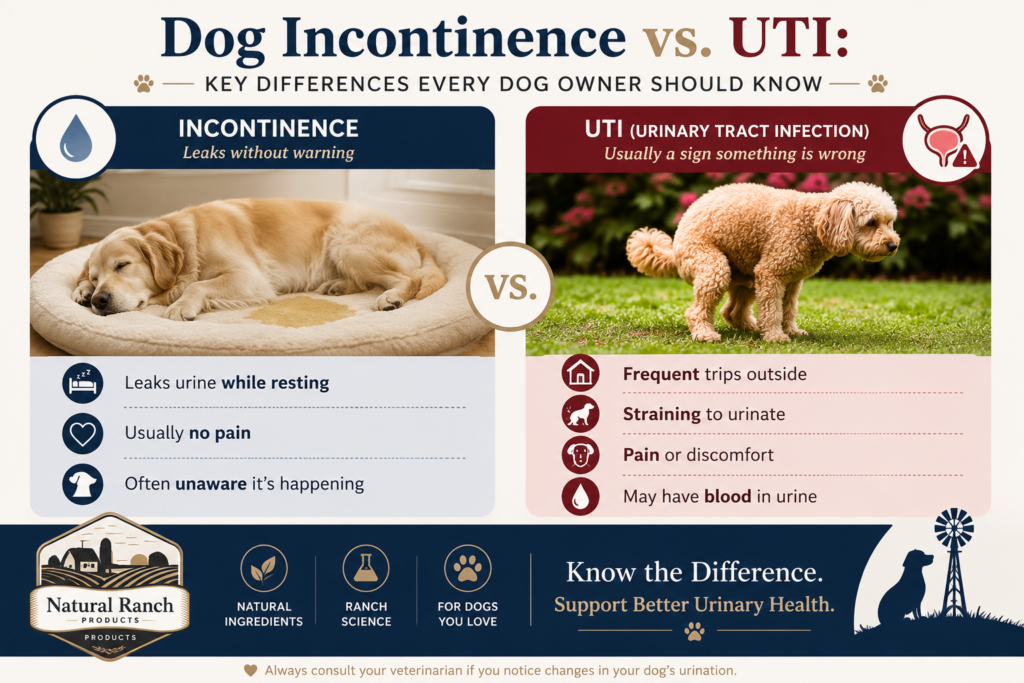
The Single Most Important Distinction between dog incontinence vs UTI — Awareness
The clearest way to distinguish a UTI from incontinence is whether your dog is aware they are urinating.
Dogs with UTIs are aware they’re urinating — they actively urinate, but they need to go more frequently than normal and may have accidents as a result of the urgency overcoming their ability to hold it until they reach the appropriate spot. They squat or lift a leg, they posture, they make an effort. The frequency and urgency are the problem, not the awareness or muscular control.
Dogs with urinary incontinence leak or dribble urine without awareness or conscious control. They aren’t choosing to urinate and aren’t aware it’s happening. Incontinence is defined as the passive and involuntary leakage of urine. A dog who wakes up from sleep on a wet bed, who leaves damp spots while walking through the house, or who drips urine without squatting or posturing is showing incontinence — not a UTI.
This distinction matters because the causes, diagnostic tests, and treatments for each condition are fundamentally different. A UTI requires antibiotic treatment. Incontinence requires identifying and addressing the underlying mechanical or hormonal cause — and antibiotics alone won’t fix it.
Symptoms of a UTI — What to Look For
The classical signs of a UTI in dogs include frequent urination with small output, straining or discomfort during urination, blood in the urine, strong or unusual urine odor, and excessive licking at the genital area. A dog with a UTI typically wants to go outside more often, may urgently need to go and not make it in time, and shows visible effort during urination.
- Frequent urination with small output — the inflamed bladder signals urgency before it’s actually full, producing many small urinations rather than normal volume
- Straining or discomfort during urination — squatting longer than usual, whimpering, or appearing uncomfortable
- Blood in the urine — visible pink or red tinge, or drops of blood after urination
- Strong or unusual urine odor — bacterial infection changes urine chemistry and odor significantly
- Cloudy urine — bacterial debris and white blood cells cloud the urine
- Excessive genital licking — a response to discomfort and irritation
- Accidents in a house-trained dog — urgency overcoming control, not loss of control itself
For the complete guide to UTI symptoms, causes, and prevention: Dog Urinary Tract Health: A Complete Guide to UTIs, Prevention, and Long-Term Support
Symptoms of Urinary Incontinence — What to Look For
Urinary incontinence presents very differently from a UTI. The dog is not urgently trying to urinate — they are leaking urine without awareness or effort. The 2024 ACVIM consensus statement on canine urinary incontinence defines it as passive and involuntary urine leakage, ranging from occasional damp spots on bedding to persistent dripping throughout the day and night.
- Wet spots found on bedding or where the dog was lying — the dog was not attempting to urinate, the leakage happened passively during rest or sleep
- Dribbling urine while walking — urine escapes without posturing or squatting
- Damp fur around the hindquarters or vulva — chronic low-grade leakage that the owner notices as persistent moisture rather than discrete accidents
- No apparent urgency or awareness — the dog doesn’t signal they need to go, doesn’t rush to the door, and may be completely unaware the leakage is occurring
- Worsens when resting or during increased abdominal pressure — incontinence characteristically worsens when the dog lies down, relaxes, or coughs and sneezes
The Overlap — When Both Are Present Simultaneously
An important complication: UTIs and incontinence can occur simultaneously. In fact up to 39% of incontinent dogs had signs of UTI in the one to two years before their incontinence was diagnosed. Incontinent dogs are predisposed to UTIs because incomplete bladder emptying creates stagnant urine pools where bacteria can establish, and because urine pooling around the vulva in females increases bacterial access to the urethral opening.
A dog can have incontinence that requires hormonal or mechanical treatment alongside a concurrent UTI that requires antibiotics — and treating only one without identifying the other will leave the dog partially managed at best. This is why veterinary diagnosis — not home assessment alone — is essential when accidents begin.
Causes of UTIs in Dogs
Most canine UTIs are caused by bacteria — most commonly E. coli — traveling up the urethra and establishing in the bladder. Female dogs are significantly more susceptible due to their shorter urethra and the proximity of the vulva to the anal area. Risk factors include spayed status, senior age, underlying health conditions like diabetes and Cushing’s disease, bladder stones, and immune suppression from medications.
For the science on why some dogs keep getting UTIs and what actually breaks the cycle: Why Some Dogs Keep Getting UTIs (And What Actually Helps Long-Term)
Causes of Urinary Incontinence in Dogs
The most common cause of urinary incontinence in adult dogs — accounting for approximately 60% of cases — is urethral sphincter mechanism incompetence (USMI). This is a weakening of the urethral sphincter’s ability to maintain closure against bladder pressure, most commonly occurring in spayed female dogs due to hormonal changes after spaying that reduce estrogen-dependent sphincter tone.
Other causes of incontinence include neurological conditions affecting the spinal cord, anatomical abnormalities including ectopic ureters (more common in young dogs with incontinence present since puppyhood), bladder stones or masses that affect normal bladder function, age-related muscle weakness, and certain medications.
Incontinence that has been present since puppyhood in a young dog is more likely to have a congenital anatomical cause — particularly ectopic ureters — than hormonally driven USMI which typically develops in middle-aged to senior spayed females.
Diagnosis — What to Expect at the Vet
Both UTIs and incontinence start with the same first diagnostic step — urinalysis. A urine sample checks for bacteria, white blood cells, red blood cells, crystals, and concentration — providing the first picture of what’s driving the urinary symptoms. A urine culture identifies the specific bacteria and its antibiotic sensitivity, essential for selecting effective treatment.
For UTI without incontinence, urinalysis and culture are usually sufficient to guide antibiotic treatment. For incontinence — or suspected concurrent incontinence — additional diagnostics follow. Imaging including X-ray and ultrasound assess bladder anatomy, check for stones or masses, and evaluate bladder emptying. Neurological examination assesses spinal cord involvement. In some cases urodynamic testing evaluates sphincter function directly.
Bring a fresh urine sample collected within two hours to any appointment for urinary symptoms — it significantly improves the diagnostic picture and avoids the need for catheterization in many cases.
Treatment Differences — Why Getting the Diagnosis Right Matters
UTI treatment — confirmed bacterial UTIs require antibiotic treatment guided by culture and sensitivity testing. Treatment duration is typically 3-7 days for uncomplicated lower UTIs. Follow-up urinalysis 5-7 days after completing antibiotics confirms clearance. Daily urinary supplement support with cranberry PACs, D-Mannose, marshmallow root, and probiotics addresses the prevention layer between infection episodes.
Incontinence treatment — depends entirely on the underlying cause. USMI in spayed females responds well to phenylpropanolamine (PPA), a medication that increases urethral sphincter tone, with good to excellent response in most cases. Estrogen supplementation is a secondary option. Pumpkin seed extract supports bladder muscle tone and sphincter function as a daily supplement alongside medical management. Anatomical causes like ectopic ureters may require surgical correction. Neurological causes require management of the underlying spinal condition.
Antibiotics treat UTIs. They do not treat the underlying causes of incontinence — and a dog whose incontinence is mistaken for a UTI and treated with antibiotics alone will continue to leak after the course is complete.
The Comparison Table — UTI vs Incontinence at a Glance
| Feature | UTI | Incontinence |
| Dog’s awareness | Aware — actively urinating | Unaware — passive leakage |
| When it happens | During conscious urination attempts | During rest, sleep, or movement |
| Urgency | Yes — strong urgency to go | No — no urge signal |
| Straining | Common | Absent |
| Blood in urine | Common | Less common unless concurrent UTI |
| Strong urine odor | Common | Less common |
| Wet bedding/floor while resting | Uncommon | Characteristic sign |
| Most common in | Female dogs, senior dogs | Spayed female dogs, middle-aged to senior |
| Primary treatment | Antibiotics | PPA, hormonal therapy, or surgery depending on cause |
| Can both occur together? | Yes — frequently | Yes — frequently |
Daily Support for Dogs With Urinary Concerns
Whether the primary issue is recurring UTIs or incontinence with concurrent UTI risk, daily urinary supplement support addresses the biological mechanisms that determine how hospitable the bladder environment is to bacterial growth.
Cranberry Type-A PACs and D-Mannose maintain continuous anti-adhesion coverage. Marshmallow root and NAG support bladder lining integrity. Pumpkin seed supports bladder muscle tone and sphincter function — particularly relevant for dogs with USMI-related incontinence. Probiotics support the gut-immune connection that defends the urinary tract between episodes.
→ See Bladder Guard Soft Chews
For the complete UTI prevention guide: Dog UTI Prevention: Daily Habits That Actually Matter
For dogs where incontinence is the primary concern alongside UTI history: Senior Dog Urinary Health: Why Older Dogs Are More Vulnerable
How do I know if my dog has a UTI or incontinence?
The key distinction is awareness. Dogs with UTIs are aware they’re urinating — they actively try to go but more frequently and urgently, often with straining, blood in the urine, and strong odor. Dogs with incontinence leak urine passively without awareness or conscious control — often while sleeping or resting, leaving wet spots where they were lying without any posturing or effort. If your dog is actively trying to urinate frequently with visible discomfort, UTI is more likely. If you’re finding wet spots where your dog was sleeping with no apparent awareness, incontinence is more likely.
Can a dog have both a UTI and incontinence at the same time?
Yes — and this is common. Incontinent dogs are predisposed to UTIs because incomplete bladder emptying creates stagnant urine pools where bacteria can establish, and urine pooling around the vulva increases bacterial access to the urethra. Up to 39% of incontinent dogs had signs of UTI in the one to two years before their incontinence diagnosis. A dog can require both antibiotic treatment for the UTI and hormonal or mechanical treatment for the incontinence simultaneously. This is why veterinary diagnosis is essential — treating only one condition when both are present will leave the dog partially managed.
What causes urinary incontinence in dogs?
The most common cause — accounting for approximately 60% of cases — is urethral sphincter mechanism incompetence (USMI), a weakening of the urethral sphincter most commonly occurring in spayed female dogs due to reduced estrogen after spaying. Other causes include neurological conditions affecting the spinal cord, congenital anatomical abnormalities like ectopic ureters (more common in young dogs with incontinence since puppyhood), bladder stones or masses, age-related muscle weakness, and certain medications. The cause determines the treatment — which is why diagnosis precedes management.
Will antibiotics fix my dog’s incontinence?
No — antibiotics treat bacterial UTIs, not the underlying causes of incontinence. If a dog’s incontinence is mistaken for a UTI and treated with antibiotics alone, the leakage will continue after the antibiotic course because the urethral sphincter weakness, neurological issue, or anatomical cause driving the incontinence is still present. If a concurrent UTI is confirmed alongside incontinence, antibiotics address the bacterial component — but the incontinence itself requires its own treatment, typically phenylpropanolamine (PPA) for USMI or surgical correction for anatomical causes.
Why is my spayed female dog suddenly leaking urine?
Spayed female dogs are the most common demographic for urethral sphincter mechanism incompetence (USMI) — the leading cause of adult-onset urinary incontinence in dogs. Spaying reduces estrogen production, and estrogen plays a role in maintaining urethral sphincter tone. Without estrogen support the sphincter weakens over time, producing the passive urine leakage characteristic of USMI — typically noticed first as damp spots on bedding or wet fur around the hindquarters. USMI typically responds well to phenylpropanolamine (PPA) with good to excellent results in most cases.
What supplements help dogs with incontinence?
Pumpkin seed extract supports bladder muscle tone and urethral sphincter function — addressing the mechanical component of incontinence as a daily supplement alongside veterinary management. For dogs with incontinence who are also prone to UTIs — which is common — cranberry Type-A PACs, D-Mannose, marshmallow root, NAG, and probiotics address the anti-adhesion, bladder lining, and immune layers that determine UTI frequency. Supplements support the biological environment but don’t replace veterinary treatment for the underlying cause of incontinence itself.
References
Kendall A, et al. “ACVIM consensus statement on diagnosis and management of urinary incontinence in dogs.” Journal of Veterinary Internal Medicine. 2024.
Falceto MV, et al. “An international survey on canine urinary incontinence: case frequency, diagnosis, treatment and follow-up.” Frontiers in Veterinary Science. 2024.
Today’s Veterinary Practice. “Diagnosing and Managing Urinary Incontinence in Canine Patients.” December 2025.
Vetster Editorial. “A Pet Owner’s Guide to Urinary Tract Infections in Dogs.” November 2025.
Byron JK. “Urinary Tract Infection.” Veterinary Clinics of North America: Small Animal Practice. 2019.
VCA Animal Hospitals. “Urinary Tract Infections (UTIs) in Dogs.” vcahospitals.com.