
Why is my dog itching so much
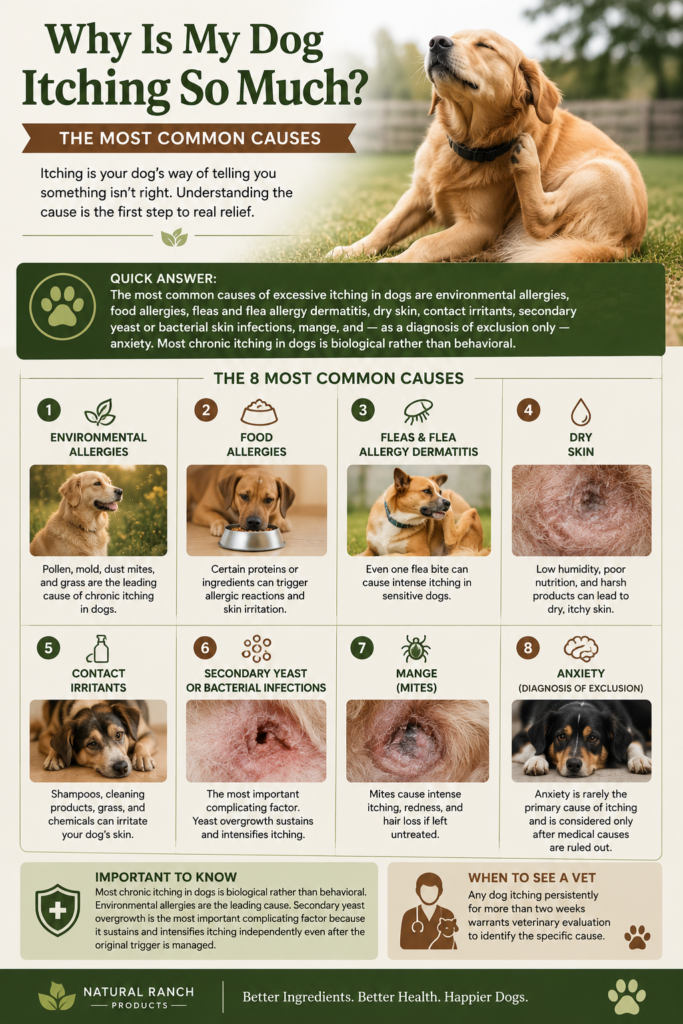
Quick Answer: The most common causes of excessive itching in dogs are environmental allergies, food allergies, fleas and flea allergy dermatitis, dry skin, contact irritants, secondary yeast or bacterial skin infections, mange, and — as a diagnosis of exclusion only — anxiety. Most chronic itching in dogs is biological rather than behavioral. Environmental allergies are the leading cause. Secondary yeast overgrowth is the most important complicating factor because it sustains and intensifies itching independently even after the original trigger is managed. Any dog itching persistently for more than two weeks warrants veterinary evaluation to identify the specific cause.
Your dog won’t stop scratching. They’re biting at their paws, rubbing their face on the carpet, scratching their ears, and chewing at the base of their tail. You’ve checked for fleas, you haven’t changed their food, nothing obvious has changed — and yet the scratching is constant, getting worse, and starting to damage the skin.
Itching — medically called pruritus — is one of the most common reasons dogs see a veterinarian. It’s also one of the most frequently mismanaged because the symptom is the same regardless of cause, and the right treatment depends entirely on identifying the right cause. This guide covers the eight most common drivers of dog itching, the pattern differences that help identify which one is at work, and why chronic itching tends to worsen over time without proper intervention.
The Itch-Scratch Cycle — Why Itching Gets Worse Over Time
Before getting into causes it’s worth understanding why dog itching tends to escalate rather than stabilize. When a dog scratches, bites, or licks in response to itch, the physical trauma damages the skin barrier — the outermost layer that limits allergen penetration, moisture loss, and pathogenic microbial colonization. Each scratching episode creates micro-tears and inflammation that make the barrier more permeable, allowing allergens to penetrate more deeply and pathogenic bacteria and yeast to establish more easily.
The result is a self-reinforcing cycle: itching damages the barrier, barrier damage increases susceptibility to secondary infection and allergen penetration, secondary infection and allergen penetration increase itching. This is why a dog who was mildly itchy in spring can be intensely itchy and skin-damaged by fall — not because the original trigger got worse, but because the itch-scratch cycle progressively compromised the skin’s ability to resist it.
Breaking the cycle requires addressing both the original trigger and any secondary complications — particularly secondary yeast and bacterial infections — simultaneously rather than sequentially.
Cause 1 — Environmental Allergies (Atopic Dermatitis)
Environmental allergies — medically called atopic dermatitis — are the most common cause of chronic itching in dogs. Affected dogs develop immune sensitization to environmental proteins: grass and tree pollens, dust mites, mold spores, and storage mites in dry food. On each subsequent exposure the sensitized immune system mounts an inflammatory response that produces the itch, redness, and skin changes of an allergic episode.
Pattern indicators: Seasonal worsening coinciding with pollen peaks — spring tree pollens and fall weed pollens are the most common triggers. Itching affecting paws, face, armpits, groin, and ears simultaneously — these are the areas with most direct allergen contact and most active immune tissue. Year-round dust mite and mold allergies produce less seasonal variation. Most dogs develop atopic dermatitis between one and three years of age. The condition typically worsens progressively each year as immune sensitization deepens and the itch-scratch cycle progressively damages barrier function.
For the complete guide to year-round environmental allergy management: Dog Skin Allergies: How to Manage Year-Round
Cause 2 — Food Allergies and Food Sensitivities
Food allergies produce skin itching through the same immune mechanism as environmental allergies — but with a different temporal pattern and a different distribution of symptoms. The most common dietary allergens in dogs are animal proteins: chicken, beef, dairy, and eggs. These are also the most common primary proteins in commercial dog food, which is why food allergy is underdiagnosed — owners and vets often overlook the food connection when the dog has been eating the same diet without obvious reaction for months or years.
Pattern indicators: Year-round itching without meaningful seasonal variation. Recurring ear infections alongside skin itching — the combination of bilateral ear infections and diffuse skin itching in a young to middle-aged dog is particularly suggestive of food allergy. Perianal itching. Gastrointestinal signs including soft stools or vomiting in some food-allergic dogs. Onset often between six months and two years of age.
Diagnosing food allergy requires a strict dietary elimination trial — eight to twelve weeks on a novel protein or hydrolyzed protein diet with no other protein sources. Blood and skin prick testing for food allergies in dogs has poor diagnostic accuracy. The elimination diet is the only reliable method.
Cause 3 — Fleas and Flea Allergy Dermatitis
Flea allergy dermatitis is the most common skin condition in dogs globally — more common than atopic dermatitis in most geographic areas. In sensitized dogs a single flea bite triggers an intense allergic reaction disproportionate to the number of fleas present. A dog can be intensely itchy from flea allergy dermatitis without a large flea burden — sometimes from a single bite by a flea that isn’t found on the dog during examination.
Pattern indicators: Itching concentrated at the base of the tail, lower back, inner thighs, and abdomen — the areas fleas preferentially feed. Flea dirt (black specks that turn red when wet) in the coat. Seasonal worsening in warmer months in colder climates, year-round in warm climates. Intense scratching disproportionate to the number of fleas visible.
Year-round flea prevention eliminates flea allergy dermatitis as a variable regardless of other allergy management in place — and should be confirmed before investigating other causes.
Cause 4 — Secondary Yeast Infection (Malassezia Dermatitis)
Secondary yeast overgrowth is the most important complicating factor in allergic dog itching — because Malassezia dermatitis produces intense itching that continues and intensifies independently even when the original allergic trigger is managed. A dog who is only mildly itchy from allergies can become severely itchy once secondary yeast infection develops — and will remain severely itchy until both the allergy and the yeast are addressed simultaneously.
Pattern indicators: Distinctive musty, sour-milk, or intensified corn chip odor from affected skin or paws. Greasy or oily skin texture. Rust-brown staining between the toes or in other affected areas from chronic licking. Skin thickening and darkening in chronically affected areas. The itch is characteristically intense and the dog seems unable to get relief regardless of how much scratching occurs.
For the complete guide to yeast overgrowth, diagnosis, and treatment: Dog Skin Yeast Infection: Symptoms, Causes, and What Actually Works
Cause 5 — Dry Skin
Dry skin — medically called seborrhea sicca — produces itching through a different mechanism than allergies. Rather than immune-mediated inflammation, dry skin itching comes from moisture loss through a compromised lipid matrix and the physical discomfort of tightened, flaky skin. The itch is typically milder and more diffuse than allergic itching and doesn’t produce the intense focused scratching of atopic dermatitis or yeast infection.
Pattern indicators: Worsens in winter when indoor heating reduces ambient humidity. Visible dandruff or white flakes on dark fur. Skin feels tight and looks dull rather than oily or red. Improves with dietary omega fatty acid supplementation and pH-balanced moisturizing grooming. Common in breeds with naturally drier skin and in dogs with nutritional deficiencies in essential fatty acids.
Nutritional support for the skin barrier — particularly omega-3 and omega-6 fatty acids in appropriate balance, zinc, and vitamin E — addresses the lipid matrix deficiency that underlies dry skin itching from the inside out: → See the Skin and Coat Defense Duo
Cause 6 — Secondary Bacterial Skin Infection (Pyoderma)
Bacterial skin infections — pyoderma — develop when Staphylococcus pseudintermedius and other bacterial species establish in skin damaged by scratching, barrier compromise, or underlying disease. Pyoderma produces intense itching alongside visible pustules, crusting, and circular skin lesions with raised scaly edges — called epidermal collarettes — that are characteristic of bacterial infection.
Pattern indicators: Visible pustules, crusting, or circular scaly lesions on the abdomen, armpits, or groin. Redness and inflammation around affected hair follicles. Often occurs alongside or following yeast infection — bacterial and yeast co-infections are common in allergic dogs. Responds to antibiotic treatment but recurs if the underlying allergy or barrier compromise isn’t managed.
Cause 7 — Mange (Sarcoptic and Demodectic)
Mange produces intense itching from parasitic mite infestation of the skin. Sarcoptic mange — caused by Sarcoptes scabiei — produces the most intense itch of any common canine skin condition and is contagious to other dogs and to humans. Demodectic mange — caused by Demodex canis — lives in hair follicles and produces itching alongside hair loss and skin thickening.
Pattern indicators for sarcoptic mange: Extremely intense itching, often disproportionate to visible skin changes early in the infestation. Affecting ear margins, elbows, and face first — locations Sarcoptes preferentially colonizes. Spreading rapidly and producing itching in human family members. Onset often following contact with dogs at shelters, dog parks, or boarding facilities.
Pattern indicators for demodectic mange: Hair loss in circular patches, particularly on the face around the eyes and muzzle in young dogs. Less intense itching than sarcoptic mange — some demodex cases produce minimal itch. Develops in young dogs whose immune systems haven’t fully matured or in adult dogs with immune suppression.
Both forms of mange require veterinary diagnosis by skin scraping and prescription treatment — they cannot be managed with over-the-counter products.
Cause 8 — Contact Irritants
Contact irritants produce localized itching at the skin areas that contacted the offending substance. Common contact irritants in dogs include lawn chemicals and herbicides, road salt and de-icing products, certain grooming products — particularly those with pH mismatched to canine skin, cleaning products used on floors the dog walks on, and synthetic materials in bedding.
Pattern indicators: Acute onset following a specific exposure. Itching localized to the areas of contact — paw pads and belly if the irritant is on the ground, face and neck if it’s in bedding. Resolves relatively quickly after removing the exposure. Recurs predictably when the dog re-contacts the same substance.
Wiping paws after outdoor time removes contact irritants before they’re ingested during grooming or penetrate the skin surface.
Quick Reference — Pattern Guide to Itch Causes
| Cause | Pattern | Key distinguishing sign |
| Environmental allergies | Seasonal, worsens spring/fall | Paws, face, ears, groin, armpits |
| Food allergies | Year-round, no seasonal pattern | Bilateral ear infections alongside itching |
| Fleas/FAD | Tail base, lower back, inner thighs | Flea dirt visible; intense itch from few fleas |
| Yeast (Malassezia) | Often secondary to allergies | Musty odor, greasy skin, rust-brown staining |
| Dry skin | Worse in winter/dry conditions | White flakes, dull coat, mild diffuse itch |
| Bacterial pyoderma | Often secondary to allergies | Pustules, crusting, circular scaly lesions |
| Sarcoptic mange | Rapidly spreading, ear margins first | Extreme itch, itching in human contacts |
| Contact irritant | Acute, localized to contact areas | Resolves quickly after removing exposure |
When Itching Needs Veterinary Attention
Any of the following warrants veterinary evaluation rather than continued home management:
- Itching that has persisted for more than two weeks without an obvious cause that can be removed
- Skin that is red, swollen, oozing, or producing a strong odor
- Visible pustules, crusting, circular lesions, or hair loss
- Scratching intense enough to break skin or produce bleeding
- Itching spreading to human family members — possible sarcoptic mange
- Systemic signs alongside itching — lethargy, appetite changes, weight change, increased thirst — suggesting hormonal involvement
- A dog who has had two or more skin infections in one year
The Inside-Out Approach to Skin Support
Regardless of the specific cause driving itching, the skin barrier’s resilience — its ability to limit allergen penetration, moisture loss, and secondary microbial colonization — determines how severely a dog responds to each trigger and how well they recover between episodes.
Supporting the skin barrier nutritionally through adequate omega fatty acids, zinc, vitamin E, and biotin works alongside allergen management and veterinary treatment rather than replacing it — reducing the inflammatory intensity of each allergic episode and improving the barrier’s ability to resist secondary infection between them.
pH-balanced sulfate-free bathing removes allergen load from the coat surface while supporting rather than disrupting the acid mantle that maintains microbial balance. Together these approaches address the inside and outside of the barrier simultaneously — which is why dogs on a complete skin support protocol typically show better long-term outcomes than those managed with medical treatment alone.
For the complete skin barrier science: Why the Canine Skin Barrier Matters More Than Most Dog Owners Realize
For the inside-out itch protocol combining nutritional and grooming support: → See the Skin and Coat Defense Duo
Why is my dog itching so much all of a sudden?
Sudden onset intense itching most commonly indicates flea allergy dermatitis, contact with an irritant, sarcoptic mange, or an acute allergic reaction. Check for flea dirt at the base of the tail and on the belly. Review any recent exposures — new grooming products, lawn treatments, cleaning products, or bedding materials. If the itching is extremely intense and spreading rapidly, particularly affecting the ear margins and elbows, sarcoptic mange warrants same-day veterinary evaluation as it’s contagious to other dogs and to humans. Sudden onset itching that doesn’t have an obvious removable cause warrants veterinary evaluation within a few days rather than a few weeks.
Why is my dog itching but has no fleas?
The absence of visible fleas doesn’t rule out flea allergy dermatitis — a sensitized dog can react intensely to a single flea bite without a large flea burden, and the flea may no longer be present when the owner checks. Beyond fleas, the most common causes of itching without visible external parasites are environmental allergies, food allergies, secondary yeast infection, secondary bacterial infection, dry skin, and contact irritants. A dog who is itching without visible fleas and whose flea prevention is current warrants investigation for allergies as the primary cause.
What can I give my dog for itching?
This depends entirely on the cause of the itching. For environmental allergies during a flare, veterinary-prescribed antihistamines, apoquel, cytopoint, or corticosteroids reduce the allergic inflammatory response. For yeast infection, veterinary antifungal shampoos and medications are required. For bacterial infection, antibiotics are needed. For dry skin, omega fatty acid supplementation and pH-balanced moisturizing grooming help. Giving antihistamines or other treatments without knowing the cause may temporarily reduce itching while the underlying condition worsens. A correct diagnosis before treatment is more important than rapid symptomatic relief.
Why does my dog itch more at night?
Several factors make itching worse at night. Dust mite populations are highest in sleeping areas — pillows, beds, and carpets — making dust mite allergic dogs significantly more itchy where they sleep. Body temperature rises slightly during sleep, which intensifies the inflammatory response that drives allergic itching. The absence of daytime distraction makes nighttime itching more noticeable and harder for the dog to ignore. And the quiet of nighttime means owners notice scratching sounds that would be masked during daytime activity. If nighttime itching is the primary pattern, dust mite allergy is worth investigating.
Is my dog’s itching behavioral or physical?
Chronic itching in dogs is almost always physical rather than behavioral. Behavioral itching — licking or scratching driven by anxiety or compulsive behavior rather than skin discomfort — should only be concluded after allergies, infection, parasites, and other physical causes have been ruled out. Physical itching produces secondary skin changes: redness, hair loss, rust-brown staining from saliva contact, skin thickening, and odor. Purely behavioral licking typically doesn’t produce these secondary changes. If secondary skin changes are visible, a physical cause is driving the behavior regardless of whether anxiety is also present.
How do I know if my dog’s itching is from allergies?
Allergy-driven itching in dogs typically affects specific areas — paws, face, ears, armpits, groin, and belly — and shows a seasonal pattern if environmental allergens are involved, or a year-round pattern if food or dust mite allergies are the driver. Environmental allergy typically develops between ages one and three and worsens each year as immune sensitization deepens. Food allergy often shows alongside recurring ear infections. The diagnosis is confirmed by veterinary examination, skin cytology to rule out secondary infection, intradermal skin testing or blood allergy testing for environmental allergens, and dietary elimination trial for food allergy.
References
American Kennel Club. “Why Is My Dog So Itchy? Causes and Treatments for Dog Itching.” Updated 2025.
VCA Animal Hospitals. “Itching (Pruritus) in Dogs.” vcahospitals.com.
PetMD Editorial. “Why Is My Dog So Itchy?” Updated 2025.
Veterinary Partner — VIN. “Pruritus (Itching) in Dogs.”
Rosychuk RAW, Hillier A. “Antimicrobial hypersensitivity in dogs.” Veterinary Clinics of North America: Small Animal Practice. 2002.
Hensel P, et al. “Canine atopic dermatitis: detailed guidelines for diagnosis and allergen identification.” BMC Veterinary Research. 2015.