
Why Some Dog UTIs Return: The Role of Dormant Bacteria in the Bladder
Dormant bacteria in dogs may help explain one of the most frustrating patterns in canine urinary health — an infection that appears to resolve completely, only to return weeks or months later. From an owner’s perspective this pattern is confusing — the infection seemed to clear, the dog got better, and then the problem came back.
Reinfection from new bacterial exposure is one explanation. But researchers studying bacterial behavior in the urinary tract have identified another biological mechanism that contributes to recurrence patterns in some dogs: bacterial dormancy. Understanding how dormant bacteria behave inside the bladder helps explain why some canine urinary infections appear to resolve completely — and then return.
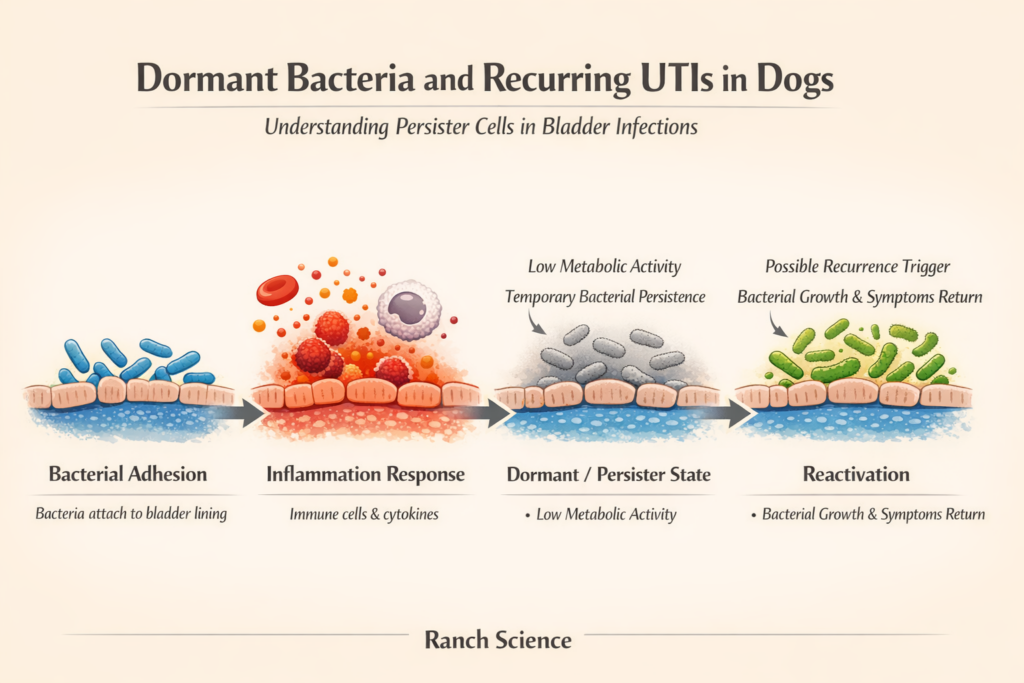
The First Step: How Bacteria Establish in the Bladder
Urinary infections typically begin when bacteria reach the bladder and attach to the bladder lining — a process called adhesion. This attachment allows bacteria to remain in place instead of being flushed out during urination. Without adhesion, most bacteria would be cleared before establishing an infection.
Once attached, bacteria trigger the body’s immune response — the release of inflammatory signaling molecules and the recruitment of immune cells to the infection site. This inflammatory cascade is the body’s defense mechanism, but it also alters the surface environment of the bladder in ways that can influence how bacteria behave in the tissue afterward.
For the full science on how bacterial adhesion works: How Bacteria Adhere to the Bladder Wall in Dogs (and Why Recurring UTIs Keep Coming Back)
For the science on what happens after bacteria attach: What Happens After Bacteria Stick? The Inflammatory Cascade Inside the Canine Bladder
What Are Dormant Bacteria — And Why Do They Matter for Recurring UTIs in Dogs?
Not all bacteria behave the same way during infection. While most bacterial cells actively grow and divide — and are targeted by both antibiotics and the immune response — some cells can shift into a dramatically different state: dormancy.
Microbiologists call these persister cells. Persister cells are not genetically resistant to antibiotics. They do not carry resistance genes or mutations that protect them from treatment. Instead they temporarily slow their metabolism and reduce growth activity to near-zero. In this dormant state the cells become essentially invisible to most treatment mechanisms — because antibiotics and immune cells primarily target actively growing bacteria.
The critical point: dormancy is reversible. Once the conditions that triggered dormancy change — once antibiotic pressure is gone, once the immune response has moved on, once the bladder environment shifts — persister cells can resume normal metabolic activity. They wake up, begin growing again, and trigger a new cycle of infection.
This biological behavior has been observed across many bacterial species and is an active area of research in infectious disease — particularly in the context of recurrent infections that don’t respond as expected to standard antibiotic treatment.
How Dormant Bacteria Persist in the Dog Bladder
Inside the bladder, several conditions create an environment where bacterial dormancy can occur. After adhesion to the bladder wall, some bacterial cells can be internalized by the bladder’s epithelial cells — literally taken inside the cells that line the bladder. This process, studied extensively in E. coli UTI research, allows bacteria to exist within the bladder tissue itself rather than just on the surface.
Once inside bladder cells, bacteria can form intracellular bacterial communities — protected from both antibiotic penetration and immune surveillance. Some of these intracellular bacteria can flux back out of the cells and re-establish surface infection after antibiotic treatment has ended. Others may remain dormant within the tissue for extended periods before reactivating.
The bladder’s glycosaminoglycan (GAG) layer plays an important role in this dynamic. When this protective surface coating is intact it limits bacterial adhesion and reduces the number of bacteria that can establish in the first place. When it becomes disrupted — through inflammation, repeated infection cycles, or chronic irritation — more bacterial binding sites are exposed and deeper tissue penetration becomes more likely.
For the full science on the GAG layer and how to support it: The Bladder’s Protective Barrier: Understanding the GAG Layer in Dogs
Why Symptoms Disappear Before Recurrence
This is the part that confuses most dog owners — and most accurately describes the clinical pattern of dormant bacterial recurrence.
When antibiotic treatment begins, the actively growing bacterial population is rapidly reduced. Symptoms improve — urgency decreases, straining resolves, blood in the urine clears. A follow-up urinalysis may show significant improvement or even appear normal. The dog seems recovered.
But if a subpopulation of persister cells has established within the bladder tissue, those cells remain. They are not captured by the urinalysis because they aren’t actively growing or releasing the markers that standard urine tests detect. They wait.
Weeks or months later when the bladder environment shifts — perhaps due to a new minor stress, a change in hydration, a reduction in immune activity, or simply the passage of time — those dormant cells reactivate. They resume growth, recolonize the bladder surface, and the dog develops symptoms again.
From the owner’s perspective it looks like a new infection. Biologically it may be the same bacterial population that never fully cleared. This distinction has significant implications for how recurring infections should be managed — and why the same antibiotic that worked before sometimes works less well the second time.
For the full breakdown of why antibiotics sometimes fail in recurring infections: Why Antibiotics Sometimes Fail in Recurring Dog UTIs
The Role of the Bladder Environment in Bacterial Dormancy
The bladder environment isn’t passive — it actively influences how bacteria behave. Several factors affect the conditions that either support or limit bacterial persistence:
Hydration and urine concentration directly affect the chemical environment bacteria encounter in the bladder. Concentrated urine creates conditions more favorable for bacterial persistence and reactivation. Dilute urine from adequate hydration is less hospitable and flushes bacterial populations more effectively during urination.
For the full science on how hydration affects the urinary environment: Why Hydration Determines Whether Urinary Health Strategies Work in Dogs
GAG layer integrity determines how much surface area bacteria can access on the bladder wall. A compromised GAG layer means more binding sites, more opportunity for bacterial adhesion, and more potential for the kind of deep tissue interaction that leads to dormant persistence. Supporting this layer through NAG and marshmallow root reduces the surface vulnerability that allows dormancy to establish.
Inflammatory state of the bladder tissue influences both bacterial behavior and immune surveillance. Chronic low-grade inflammation — common in dogs with repeated infection cycles — creates a bladder environment where the conditions for bacterial dormancy are more favorable than in a healthy, non-inflamed bladder.
Immune function determines the body’s ability to identify and clear bacterial populations before they can establish dormant states. Dogs with compromised immune systems — including those with repeated antibiotic disruption to their gut microbiome — have reduced capacity to prevent bacterial persistence between active infection episodes.
Dormant Bacteria and Biofilms: Two Related Persistence Mechanisms
Dormant bacteria and biofilms are often studied together because both represent bacterial strategies for surviving in the urinary tract between active infection episodes — and both contribute to the recurring UTI patterns that standard antibiotic treatment struggles to break.
Where persister cells operate through individual cellular dormancy, biofilms operate through community organization — bacteria cooperating to produce a protective matrix that anchors them to tissue surfaces and shields them from antibiotics and immune cells simultaneously. Both mechanisms can be present in the same dog at the same time.
For the full science on biofilms in canine UTIs: Biofilms in Canine UTIs: Why Some Infections Keep Coming Back
What This Means for Managing Recurring UTIs in Dogs
Understanding bacterial dormancy has practical implications for how recurring UTIs are approached — both medically and in terms of daily prevention.
Follow-up urinalysis after antibiotic treatment matters. A urinalysis taken while treatment is still suppressing bacterial activity may appear normal even when dormant bacteria remain. A follow-up culture 7-14 days after completing antibiotics gives a clearer picture of whether the infection has genuinely cleared or is simply suppressed.
Completing the full antibiotic course is essential. Stopping antibiotics early because symptoms have improved is one of the most common contributors to incomplete clearance and subsequent dormant bacterial recurrence. Symptoms can resolve well before the bacterial population has been reduced enough to prevent re-establishment.
Supporting the bladder environment between infections reduces the conditions that favor dormancy. Consistent hydration, daily anti-adhesion support with cranberry PACs and D-Mannose, GAG layer support with NAG and marshmallow root, and probiotic support for immune function all contribute to a bladder environment that is less favorable for bacterial persistence — not just during active treatment but between episodes.
Urine culture — not just urinalysis — should be standard for recurring infections. Culture and sensitivity testing identifies the specific bacteria present and which antibiotics it responds to. For dogs with recurrence patterns consistent with dormant bacterial persistence, this information is essential for selecting an antibiotic that has adequate tissue penetration rather than just surface activity.
For a complete daily prevention strategy that addresses the bladder environment between infections: Dog UTI Prevention: Daily Habits That Actually Matter
For a practical evaluation of supplement ingredients that support the bladder environment daily: Best Dog UTI Supplement: What to Actually Look For
What are dormant bacteria in dogs?
Dormant bacteria — also called persister cells — are bacterial cells that temporarily reduce their metabolic activity to near-zero. In this low-activity state they are not actively growing and are therefore largely invisible to antibiotics and immune cells that target active bacteria. They can remain dormant within bladder tissue for extended periods before reactivating when conditions change.
Can dormant bacteria cause recurring UTIs in dogs?
Yes — researchers believe dormant bacterial populations contribute to recurrence patterns in some canine UTIs. When a subpopulation of persister cells survives antibiotic treatment by entering a dormant state, symptoms may resolve as the active bacterial population decreases, but the persister cells remain in bladder tissue. When conditions change — antibiotic pressure ends, immune activity reduces, or the bladder environment shifts — those cells can reactivate and trigger a new infection cycle.
What are persister cells in bacterial infections?
Persister cells are bacteria that enter a temporary low-metabolism dormant state rather than actively growing. Unlike antibiotic-resistant bacteria, persister cells are not genetically different — they can be killed by antibiotics when they are actively growing. The challenge is that in their dormant state they are not susceptible to the mechanisms most antibiotics use to kill bacteria. Once the antibiotic treatment ends and conditions become favorable again, they resume growth.
Why do dog UTI symptoms disappear and then return?
Symptoms typically improve as the actively growing bacterial population is reduced by antibiotics and immune response. But if a subpopulation of persister cells has established within bladder tissue, those cells remain dormant and are not detected by standard urine tests taken during or shortly after treatment. Weeks or months later when the bladder environment shifts, dormant cells can reactivate, recolonize the bladder surface, and trigger symptoms again — sometimes appearing as a new infection that is biologically a continuation of the previous one.
How is bacterial dormancy different from antibiotic resistance?
Antibiotic resistance involves genetic changes that permanently protect bacteria from specific antibiotics regardless of their activity state. Bacterial dormancy is a temporary, reversible metabolic state that makes bacteria less susceptible to antibiotics while dormant — but when they resume active growth they can be killed by the same antibiotics that were ineffective against them in their dormant state. This distinction matters because resistance requires different antibiotics, while dormancy requires different treatment strategies focused on timing, duration, and environmental conditions.
What reduces the risk of dormant bacterial recurrence in dogs?
Supporting the bladder environment between infections reduces the conditions that favor bacterial persistence. Consistent hydration dilutes urine and flushes bacteria more effectively. Daily anti-adhesion support with cranberry PACs and D-Mannose reduces the initial adhesion that leads to deeper tissue interaction. GAG layer support with NAG and marshmallow root maintains the protective surface barrier. Completing the full antibiotic course and following up with urine culture 7-14 days after treatment are essential medical steps.
Scientific References
Lewis K. “Persister cells.” Annual Review of Microbiology. 2010.
Hultgren SJ, et al. “Bacterial adhesion and persistence in urinary tract infections.” Nature Reviews Microbiology. 2004.
Flores-Mireles AL, et al. “Urinary tract infections: epidemiology, mechanisms of infection and treatment options.” Nature Reviews Microbiology. 2015.
Mulvey MA, et al. “Establishment of persistent infection by intracellular bacterial communities.” Science. 2001.
Costerton JW, et al. “Bacterial biofilms: a common cause of persistent infections.” Science. 1999.
VCA Animal Hospitals. “Urinary Tract Infections (UTIs) in Dogs.” vcahospitals.com