
Signs Your Dog’s UTI Is Coming Back (And What to Do Before It Gets Worse)
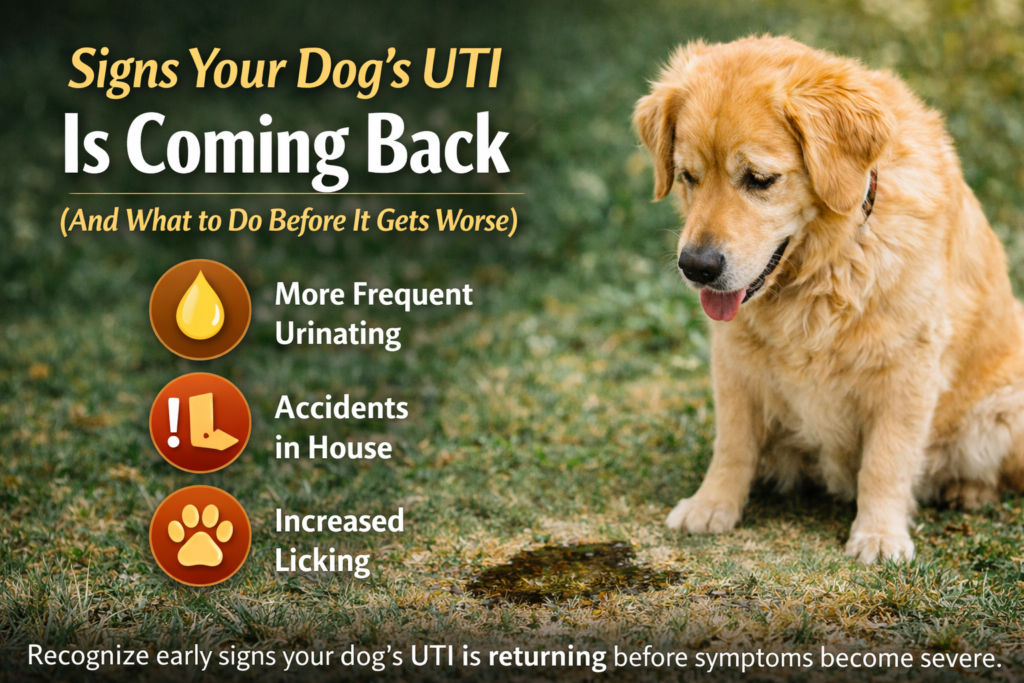
Knowing the signs your dog’s UTI is coming back could be the difference between catching a relapse early and waiting until a full infection takes hold. If your dog has had a urinary tract infection before, you already know what it looks like at its worst — the accidents, the straining, the discomfort you can’t explain away. What’s harder to recognize is what it looks like early. The subtle signs that appear days or even weeks before a full infection takes hold. The behavioral shifts that are easy to chalk up to something else. For dogs prone to recurring UTIs, catching those early signals is the difference between a simple course of antibiotics and a much longer, more complicated road.
If your dog has had a urinary tract infection before, you already know what it looks like at its worst — the accidents, the straining, the discomfort you can’t explain away.
What’s harder to recognize is what it looks like early. The subtle signs that appear days or even weeks before a full infection takes hold. The behavioral shifts that are easy to chalk up to something else.
For dogs prone to recurring UTIs, catching those early signals is the difference between a simple course of antibiotics and a much longer, more complicated road.
This is what to watch for — and what to do when you see it.
Why Some Dogs Keep Getting UTIs
Before getting into the signs, it helps to understand why recurrence happens at all.
A single UTI is fairly common. About 14% of dogs are affected by urinary tract infections (PetMD) , and many recover without lasting complications. Recurrence is a different problem. Recurrent UTIs are defined as more than three infections in a twelve-month period (PetMD) , and they typically indicate something beyond bad luck.
Predisposing factors — including diabetes, kidney disease, Cushing’s disease, bladder stones, incontinence, and immunosuppression — can make UTIs difficult to fully resolve and likely to return if left unaddressed. (VCA Animal Hospitals)
Female dogs are more prone to UTIs than male dogs due to their shorter, wider urethras, which allow bacteria to ascend into the bladder more easily. (VCA Animal Hospitals) Senior dogs, spayed females, and overweight dogs are also at higher risk.
The bottom line: if your dog has had more than one UTI, there’s usually a reason — and identifying it matters more than just treating each episode as it comes.
Signs Your Dog’s UTI Is Coming Back: What to Watch For Early”
The problem with recurring UTIs is that dogs are good at hiding discomfort. By the time symptoms are obvious, the infection is already established. These are the earlier, subtler signals worth paying attention to.
Increased frequency with smaller amounts of urine
Dogs with UTIs generally attempt to urinate frequently whenever they go outside, and may strain or cry when urinating as it can be painful. (VCA Animal Hospitals) But before the straining starts, the first sign is often just more trips outside with less to show for each one.
If your dog is asking to go out more often than usual but producing only small amounts of urine each time, that urgency without output is an early warning sign.
Accidents in a house-trained dog
A break in house training is a red flag that something is wrong in the bladder. (VCA Animal Hospitals) This one is easy to misread as a behavioral issue — especially in older dogs where accidents might be attributed to age. But if your dog has been reliably house-trained and suddenly can’t hold it, think urinary before thinking behavior.
Excessive licking of the genital area
Licking or inflammation of the genital region — sometimes with salivary staining, the copper-colored fur discoloration from repeated contact — can signal a UTI. (PetMD) Dogs do this to self-soothe irritation they can’t otherwise address. It’s easy to miss if you’re not looking for it.
Changes in urine appearance or smell
Cloudy urine, urine with a stronger odor than usual, or any visible blood are signs that something is off. Blood in the urine occurs due to irritation and inflammation of the bladder lining, and even a small amount warrants prompt attention, as it could also indicate bladder stones or other conditions. (Missionroadanimalclinic)
Behavioral shifts
When infection causes discomfort, a dog may seem “off” or less playful than usual. (Missionroadanimalclinic) Low energy, reluctance to move, or unusual irritability during handling can all be signs of pain that a dog can’t communicate directly.
Signs That Require Immediate Veterinary Attention
Some signs go beyond early warning and indicate a more serious or progressed situation. These warrant a vet visit the same day:
Straining without producing urine, lethargy, blood in the urine, or the development of fever or vomiting (Petfolk) are all signs that the infection may have progressed or that something else is going on. In male dogs especially, difficulty urinating is always a red flag. (VEG ER for Pets)
UTIs can worsen quickly, and some dogs hide discomfort until the problem is advanced. (Petfolk) Don’t wait to see if symptoms resolve on their own.
The Relapse Window: When Recurrence Is Most Likely
One of the most important things to understand about recurring UTIs is when they tend to come back.
Signs of a relapse infection can take anywhere from a week to a month or more to fully appear after treatment. (Gallant) This means a dog can appear fully recovered — and still be in the early stages of a returning infection.
Most relapses occur when the infection doesn’t fully respond to, or isn’t completely eradicated by, the treating antibiotic. (Gallant) This is why finishing the full course of medication matters, and why a follow-up urinalysis after treatment is often recommended — not just to confirm resolution, but to catch incomplete clearance before symptoms reappear.This is the window where the signs your dog’s UTI is coming back are easiest to miss.”
Why “Treated” Doesn’t Always Mean “Resolved”
This is the part that frustrates a lot of pet owners.
You complete the antibiotics. Your dog seems fine. A few weeks later, you’re back at the vet with the same symptoms.
If a urinary tract infection keeps coming back, it indicates the need for further investigation and diagnostic tests — there is usually an underlying issue making the dog more prone to developing UTIs. (Bond Vet)
Sometimes that underlying issue is anatomical — a recessed or hooded vulva in female dogs, for example, can trap moisture and bacteria in a way that creates ideal conditions for repeated infections. (Providence Vet)
Sometimes it’s systemic — a condition like diabetes or Cushing’s disease that affects the immune environment of the urinary tract.
And sometimes it’s about bacterial behavior within the bladder itself — the kind of persistence that standard treatment doesn’t always fully address. That’s covered in more depth in: Biofilms in Canine UTIs: Why Some Infections Keep Coming Back.https://naturalranchproducts.com/biofilms-in-canine-utis-why-some-infections-keep-coming-back/
What You Can Do Between Vet Visits
Veterinary care is non-negotiable when an active infection is present. But the window between infections — or during recovery — is where daily habits and consistent support make the biggest difference.
Track patterns. Keeping a journal of urination habits, water intake, and behavioral changes helps veterinarians identify subtle patterns and catch recurrences earlier. (Petfolk) Dates, symptoms, how long after the previous infection — this information is genuinely useful at your next appointment.Tracking the signs your dog’s UTI is coming back gives your vet the pattern data they need.Not all urinary supplements are built the same — here’s how to evaluate what you’re giving your dog: https://naturalranchproducts.com/best-dog-uti-supplement-fall/
Prioritize hydration. Well-hydrated dogs produce more dilute urine, which flushes bacteria out before they can establish. (Petfolk) If your dog is a reluctant drinker, a pet water fountain or a splash of low-sodium broth can help. This is one of the most impactful — and most overlooked — daily habits. More on this in: Dog UTI Prevention: Daily Habits That Actually Matter.https://naturalranchproducts.com/dog-uti-prevention-daily-habits-that-actually-matter/
Support the urinary environment daily. Ingredients like cranberry and D-Mannose influence how bacteria interact with the bladder wall. Marshmallow root supports the bladder lining. Vitamin C helps maintain a less hospitable urinary pH. Probiotics reinforce immune function. None of these replace treatment — but used consistently, they contribute to an environment where infections are less likely to take hold in the first place.Learn more about the ingredients https://naturalranchproducts.com/best-ingredients-for-dog-urinary-health-and-what-they-actually-do/
That’s the role Bladder Guard Soft Chews from Natural Ranch Products are designed to fill — not as a treatment, but as the kind of daily, multi-mechanism support that makes the gap between infections longer and the recurrence cycle easier to break.
[→ Learn more about Bladder Guard Soft Chews]https://naturalranchproducts.com/product/bladder-guard-soft-chews-for-dogs/
When to Call Your Vet
If your dog shows any of the following, contact your vet promptly rather than waiting to see how things develop:
Urinating more frequently with small output — licking the genital area repeatedly — accidents in a previously house-trained dog — cloudy, dark, or bloody urine — unusual odor — straining without result — visible pain or distress during urination — lethargy or behavioral changes alongside any urinary symptom.
Supplements are not a treatment for active infections. However, ingredients like cranberry, D-Mannose, and probiotics can support a daily urinary environment that is less favorable for bacterial adhesion and recurrence, when used consistently alongside veterinary care. Knowing the signs your dog’s UTI is coming back — and acting on them early — is what breaks the recurring cycle.
References
Byron JK. “Urinary Tract Infection.” Veterinary Clinics of North America: Small Animal Practice. 2019.
Flores-Mireles AL, et al. “Urinary Tract Infections: Epidemiology, Mechanisms, and Treatment Options.” Nature Reviews Microbiology.
Howell AB. “Bioactive Compounds in Cranberry and Their Role in Urinary Tract Health.” Advances in Nutrition.
Kranjčec B, et al. “D-Mannose in Recurrent Urinary Tract Infections.” World Journal of Urology.
VCA Animal Hospitals. “Urinary Tract Infections (UTIs) in Dogs.” https://vcahospitals.com/know-your-pet/urinary-tract-infections-utis-in-dogs
Written by [Natural Ranch Products Team ], Pet Wellness Advocate at Natural Ranch. Passionate about holistic dog care and high-quality nutrition.”
How do I know if my dog’s UTI is coming back?
The earliest signs are often subtle: more frequent urination with smaller output, accidents in a house-trained dog, excessive licking of the genital area, or a change in urine odor or color. Behavioral changes like low energy or irritability can also indicate discomfort before more obvious symptoms appear.
How soon can a UTI come back after treatment?
Relapses can appear anywhere from one week to a month or more after treatment ends. This is why follow-up urinalysis after completing antibiotics is often recommended.
Why does my dog keep getting UTIs even after antibiotics?
Recurring infections usually indicate an underlying factor — anatomical, systemic, or related to bacterial persistence in the bladder. Repeated infections without investigation into the underlying cause tend to continue.
Can supplements help prevent recurring UTIs in dogs?
Supplements are not a treatment for active infections. However, ingredients like cranberry, D-Mannose, and probiotics can support a daily urinary environment that is less favorable for bacterial adhesion and recurrence, when used consistently alongside veterinary care.
Is a recurring UTI dangerous for dogs?
If left untreated or repeatedly undertreated, UTIs can progress to kidney infections or more serious systemic complications. Recurring infections should always be evaluated by a veterinarian to identify the underlying cause.