Best Dog Multivitamin: What to Actually Look For
Searching “best dog multivitamin” returns hundreds of options, dozens of comparison lists, and more “vet-recommended” badges than any single veterinary profession could plausibly endorse. Most of these lists rank products based on Amazon reviews, affiliate commission rates, or brand recognition — not on the formulation criteria that actually determine whether a multivitamin delivers what it promises.
This guide gives you a different approach: a practical evaluation framework built around the specific formulation signals that separate genuinely effective dog multivitamins from ones that look impressive on the label while delivering a fraction of their stated value. Apply this checklist to any product and you’ll know within two minutes whether it’s worth buying.
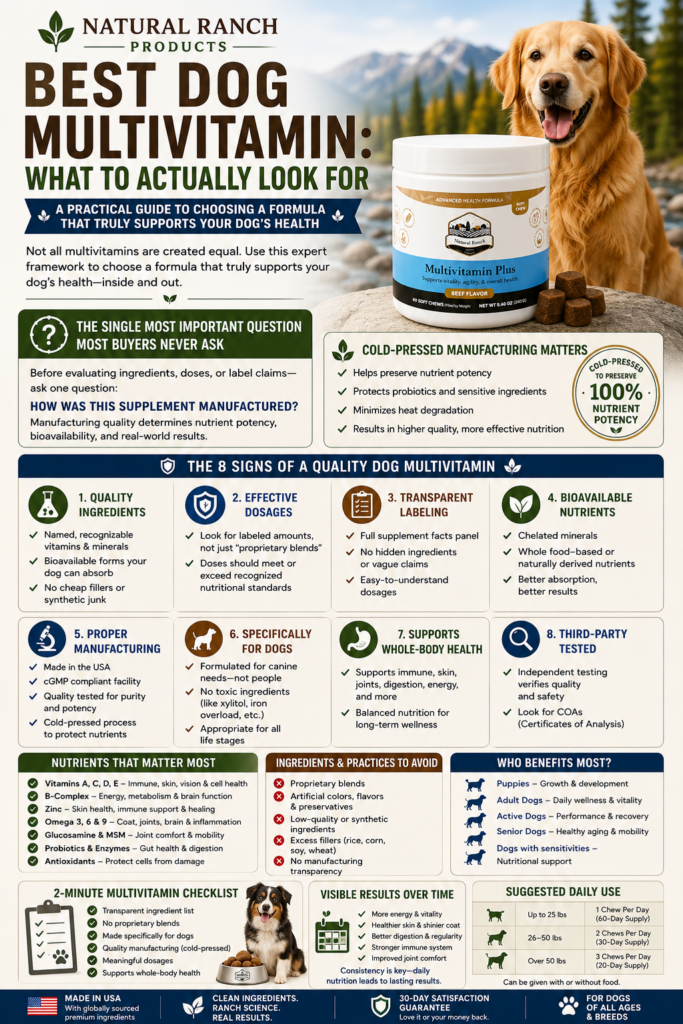
The Single Most Important Question Most Buyers Never Ask what are the best dog multivitamins
Before evaluating ingredients, doses, or label claims — ask one question: how was this supplement manufactured?
High-heat steam extrusion — the dominant manufacturing method for soft chew supplements — processes ingredients at temperatures exceeding 150-180°C. At these temperatures probiotics lose viability, B vitamins degrade, omega fatty acids oxidize from anti-inflammatory to pro-inflammatory, and cranberry PACs lose their anti-adhesion molecular structure. A supplement can accurately list every ingredient at stated amounts while delivering minimal biological activity because the manufacturing process destroyed them before the product was sealed.
Cold-pressed or cold-form manufacturing keeps temperatures low throughout production, preserving the biological activity of heat-sensitive compounds. If a manufacturer doesn’t disclose their manufacturing method — assume standard high-heat processing. The burden of proof is on them to demonstrate they’ve taken steps to preserve bioavailability.
This single factor can make a larger difference in actual outcomes than any ingredient comparison. Two products with identical labels will produce different results if one was cold-pressed and one was heat-extruded.
The Complete Evaluation Checklist — What to Look For
1. Full B-Complex — All Eight or It’s Incomplete
The B vitamins work as a system — B1, B2, B3, B5, B6, B12, Folic Acid, and Biotin each serve distinct functions in cellular energy metabolism, nervous system maintenance, red blood cell production, and DNA synthesis. Formulas that include only Biotin and B12 — the two most marketable B vitamins — leave the rest of the system unsupported.
B vitamins are water-soluble and not stored in the body, requiring daily replenishment. They are among the most heat-sensitive nutrients in pet food manufacturing — making supplemental sources particularly important for dogs on processed commercial diets that degrade them during production. Check the label specifically for all eight B vitamins listed individually, not just “B-complex” as a catch-all claim without disclosure of which Bs are actually included.
2. Vitamin D3 Not D2 — The Bioavailability Distinction
Vitamin D comes in two supplemental forms: D3 (cholecalciferol) and D2 (ergocalciferol). D3 is significantly more bioavailable for dogs — it is the same form that animals naturally produce and use. D2 requires additional metabolic conversion steps and produces lower blood levels per equivalent dose. Quality formulas specify D3. Generic “Vitamin D” without specifying the form may be the cheaper D2.
3. Chelated Minerals — Absorption Form Matters as Much as Amount
Minerals exist in multiple chemical forms with dramatically different absorption rates. Zinc bisglycinate — a chelated form where zinc is bound to an amino acid — absorbs significantly more efficiently than zinc oxide, the cheap form used in most commercial supplements. The same principle applies to selenium — selenium from organic sources (selenomethionine) is more bioavailable than sodium selenite.
Look specifically for “chelated” minerals or named organic forms on the label. If the label just says “zinc” or “selenium” without specifying the form, check the full ingredient list for zinc oxide or sodium selenite — the indicators of a formula that prioritized cost over absorption.
4. Named Probiotic Strains With CFU Count — Non-Negotiable
A probiotic inclusion on a label means nothing without two specific disclosures: the strain name and the colony-forming unit count. Named strains — Lactobacillus acidophilus, Bacillus coagulans, Enterococcus faecium — tell you which organisms are present and allow you to evaluate whether they are documented for canine gut health. The CFU count tells you how many viable organisms are present per dose.
“Proprietary probiotic blend” without strain names or CFU count cannot be evaluated. The organisms could be present at any dose — including doses too low to produce any meaningful gut colonization effect. This disclosure gap is one of the most common quality indicators most buyers overlook.
5. Quality Carrier Oil — The Most Overlooked Label Element
Every soft chew supplement uses an oil or fat component to bind the formula and provide palatability. Most manufacturers use the cheapest available option — corn oil, soybean oil, or generic vegetable oil. These are nutritionally inert fillers that add calories without contributing functional value.
The carrier oil is an opportunity to add meaningful nutritional contribution to every chew. Cold-pressed plant oils with balanced omega profiles — particularly those providing Omega-3, Omega-6, and Omega-9 in a stable ratio — support skin barrier lipid production, systemic inflammation management, and cellular health alongside the labeled vitamins and minerals.
Check the inactive ingredient list specifically for the carrier oil. Corn oil or soybean oil as the primary fat source signals a formula where this opportunity was missed. Cold-pressed seed oils with disclosed omega profiles signal a manufacturer thinking about what every ingredient contributes.
6. Glucosamine HCl for Joint Support — Verify the Specific Form
Glucosamine appears in most complete multivitamins as a joint cartilage support ingredient. Two forms are commonly used: glucosamine HCl and glucosamine sulfate. Glucosamine HCl has a higher percentage of actual glucosamine by weight — approximately 83% compared to 65% for glucosamine sulfate. It is also more stable in manufacturing. For joint support specifically, glucosamine HCl at a disclosed milligram amount is the quality indicator to look for.
7. Digestive Enzymes — Supporting Absorption of Everything Else
Digestive enzymes — amylase, protease, lipase — support the breakdown and absorption of nutrients from food. Their inclusion in a multivitamin formula addresses the absorption layer that determines how effectively all the other ingredients are utilized. For senior dogs whose enzyme output declines with age, and for dogs on heavily processed diets that have eliminated naturally occurring food enzymes through heat treatment, supplemental enzyme support is particularly meaningful.
8. Transparent Individual Doses — No Proprietary Blends
Individual ingredient amounts in milligrams must be disclosed for you to evaluate whether active ingredients are at functional doses. Proprietary blends that list a combined total weight without individual ingredient amounts make this evaluation impossible — the blend could contain 500mg of one filler ingredient and trace amounts of everything else while accurately listing all ingredients.
This is the transparency standard that separates manufacturers confident in their formulation from those obscuring underdosed ingredients behind proprietary blend labeling.
What to Avoid in a Dog Multivitamin
- Artificial colors — Red 40, Yellow 5, Blue 2, and similar synthetic dyes serve no nutritional purpose and signal a formula optimized for visual appeal to human buyers rather than nutritional value for dogs.
- Added sugar or corn syrup — used for palatability in low-quality formulas. Counterproductive for dogs with metabolic health concerns or urinary issues where bacterial substrate reduction matters.
- BHA and BHT preservatives — synthetic preservatives with ongoing safety questions. Natural preservation through tocopherols, rosemary extract, or the natural antioxidants in quality carrier oils is preferable.
- Undisclosed manufacturing method — if a manufacturer doesn’t say how the product was made, assume standard high-heat processing degraded the heat-sensitive ingredients.
- Xylitol — toxic to dogs. Appears in some human supplement products that find their way into pet supplement marketing. Check the inactive ingredient list specifically.
- Partial B-complex — formulas listing only Biotin or B12 while calling themselves complete are incomplete. All eight B vitamins should be individually named.
The Label Reading Process — Applied in Practice
When evaluating any dog multivitamin label apply this sequence:
Step 1 — Manufacturing method. Is cold-pressed, cold-extruded, or cold-form manufacturing disclosed anywhere on the label or product page? If not — note it and factor it into your evaluation of every heat-sensitive ingredient that follows.
Step 2 — B-Complex completeness. Count the B vitamins listed. Are all eight present individually? Or just Biotin and B12?
Step 3 — Mineral forms. Find zinc and selenium in the ingredient list. Do they specify chelated forms or organic sources? Or do they list zinc oxide and sodium selenite?
Step 4 — Probiotic disclosure. Are strain names and CFU count disclosed? Or just “probiotic blend”?
Step 5 — Carrier oil. Find the fat source in inactive ingredients. What is it? Cheap filler oil or a quality omega-contributing source?
Step 6 — Individual doses. Are ingredient amounts in milligrams for each active ingredient? Or is anything hidden in a proprietary blend?
Step 7 — Inactive ingredient check. Scan for artificial colors, added sugar, BHA/BHT, and xylitol.
Most products will fail at least two of these steps. That’s useful information — it tells you specifically what you’re getting and what you’re not, rather than making a purchasing decision based on label claims and Amazon review scores.
How Natural Ranch Daily Multivitamin Reads Against This Checklist
- Cold-pressed manufacturing throughout ✓
- Full B-Complex — B1, B2, B3, B5, B6, B12, Folic Acid, and Biotin all included ✓
- Vitamin D3 specifically ✓
- Chelated Zinc for optimal absorption ✓
- Selenium at appropriate dose ✓
- Named probiotic strains with CFU count ✓
- Cold-pressed Canine Royal Oil™ — balanced 1:1:1 Omega-3, 6, 9 from cranberry seed oil ✓
- Glucosamine HCl for joint cartilage support ✓
- Digestive enzymes for absorption support ✓
- Individual ingredient doses disclosed ✓
- Zero sugar — grain-free and sugar-free formula ✓
- No artificial colors, BHA, BHT, or synthetic preservatives ✓
- Natural beef flavor from powdered beef stock ✓
- Made in the USA ✓
- 30-day money-back guarantee ✓
→ See the Natural Ranch Daily Multivitamin — $36.00
For dogs where urinary health is also a concern, the Total Defense System pairs the Daily Multivitamin with Bladder Guard Soft Chews — both cold-pressed, both sugar-free, both with individually disclosed ingredient doses.
→ See the Total Defense System
For the complete guide to what each essential nutrient does and which dogs benefit most: Dog Multivitamin: The Complete Guide to Benefits, Nutrients, and What to Look For
For the seven specific signs that indicate your dog may have nutritional gaps: 7 Signs Your Dog Needs a Multivitamin
What should I look for in a dog multivitamin?
The most important evaluation criteria are cold-pressed or cold-form manufacturing to preserve heat-sensitive nutrients, full B-Complex with all eight B vitamins individually listed, Vitamin D3 not D2, chelated minerals for better absorption, named probiotic strains with CFU count, individual ingredient doses rather than proprietary blend, quality carrier oil contributing functional omega fatty acids, and a clean inactive ingredient list free from artificial colors, added sugar, and synthetic preservatives.
How do I know if a dog multivitamin is high quality?
The clearest quality signals are manufacturing transparency — cold-pressed manufacturing disclosed rather than assumed — complete B-Complex with all eight vitamins individually named, chelated mineral forms rather than zinc oxide or sodium selenite, named probiotic strains with CFU count rather than generic probiotic blend, individual ingredient milligram amounts rather than proprietary blend, and a carrier oil that contributes functional nutritional value rather than cheap filler oil. A 30-day money-back guarantee signals manufacturer confidence in outcomes.
Is a more expensive dog multivitamin always better?
Not automatically — but quality ingredients, cold-pressed manufacturing, chelated minerals, and named probiotic strains do cost more to source and produce than their lower-quality equivalents. Price is not a guarantee of quality but the cheapest options rarely have the manufacturing investment required to preserve heat-sensitive ingredients. The cost per day of use — not the sticker price — is the relevant comparison metric. A $36 60-count product at 1-2 chews daily costs $0.60-$1.20 per day, which is meaningful only relative to what that daily dose is actually delivering.
What is the difference between chelated and non-chelated minerals in dog supplements?
Chelated minerals are bound to amino acids or organic acids that significantly improve their absorption through the gut wall. Zinc bisglycinate (chelated) absorbs more efficiently than zinc oxide (non-chelated). Selenomethionine (chelated) is more bioavailable than sodium selenite. The same milligram amount of a chelated mineral delivers more to the dog’s body than a non-chelated form. Look for mineral forms that specify bisglycinate, glycinate, methionine, or similar amino acid chelation on the label.
Why does manufacturing temperature matter for dog multivitamins?
High-heat steam extrusion — used for most pet supplement chews — processes ingredients at temperatures that degrade probiotics, B vitamins, omega fatty acids, and heat-sensitive polyphenols. A supplement can accurately list these ingredients at stated amounts while delivering minimal biological activity because heat processing destroyed them before the product was sealed. Cold-pressed manufacturing preserves biological activity. If manufacturing method isn’t disclosed on the label or product page, assume standard high-heat processing and factor this into your evaluation of every heat-sensitive ingredient.
How long does it take to see results from a dog multivitamin?
Coat improvements are typically visible within 6-10 weeks of consistent daily use. Energy and digestive improvements may be noticed within 2-4 weeks. Immune support benefits are cumulative — they show up over time as reduced illness frequency and faster recovery rather than as an immediately observable change. Joint support develops gradually over 60-90 days. Consistency is essential — a multivitamin used daily for 90 days produces fundamentally different outcomes than one given sporadically whenever you remember.
References
American Kennel Club. “What Are the Benefits of Using Multivitamins for Dogs?” akc.org.
National Research Council. Nutrient Requirements of Dogs and Cats. National Academies Press. 2006.
Association of American Feed Control Officials. “Nutritional Adequacy Statements and Pet Food Labeling.” aafco.org.
Larsen J., Fascetti A. “Evaluation of recipes for home-prepared diets for dogs and cats.” Journal of the American Veterinary Medical Association. 2019.
Howell AB, et al. “A-type cranberry proanthocyanidins and uropathogenic bacterial anti-adhesion activity.” Phytochemistry. 2005.
VCA Animal Hospitals. “Vitamins and Minerals for Dogs.” vcahospitals.com.