Why Does My Dog Keep Licking Their Paws?
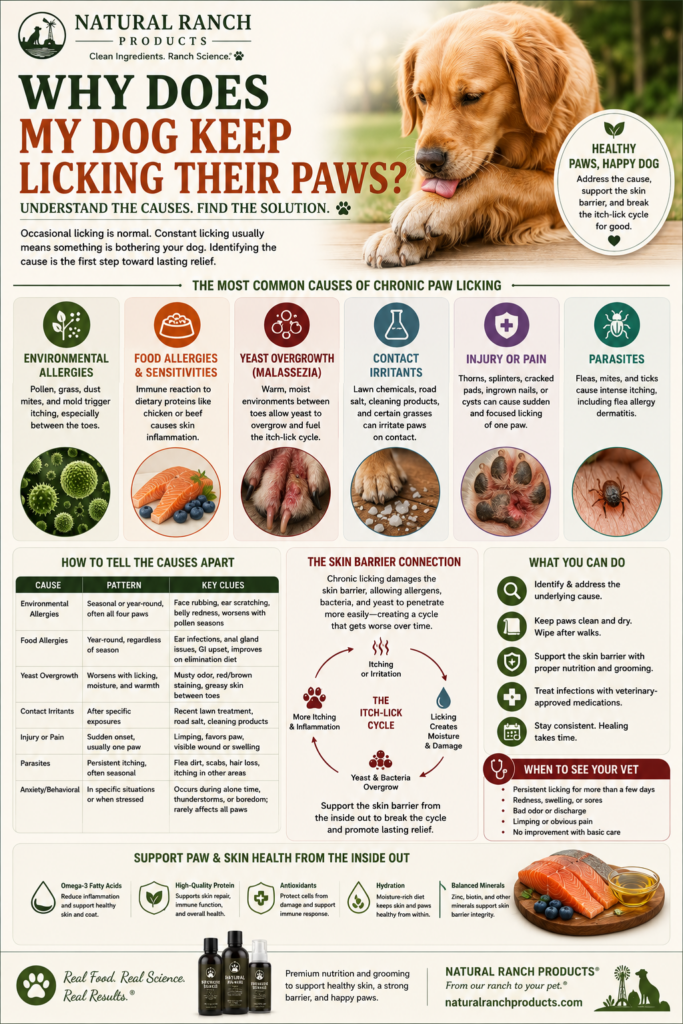
Quick Answer: Chronic paw licking in dogs is almost always biological rather than behavioral. The most common causes are environmental allergies, food allergies, secondary yeast overgrowth (Malassezia), contact irritants, injury or foreign bodies, parasites, and — as a diagnosis of exclusion only — anxiety. Environmental allergies are the leading cause. Yeast overgrowth is the most important secondary cause because it sustains the licking cycle independently even after the original trigger is addressed. Behavioral licking should only be concluded after allergies, infection, injury, and parasites have been ruled out.
Occasional paw licking is normal dog behavior — a quick cleaning after a walk, a brief scratch between the toes. What isn’t normal is the dog who can’t stop. The one who licks the same paw for twenty minutes at a stretch, wakes up to lick at night, or has developed rust-colored staining between their toes from months of chronic contact with saliva.Do you want to Learn why does my dog keep licking their paws ?
Chronic paw licking is almost always a sign of something biological rather than behavioral — and identifying which cause applies to your dog determines whether the solution is a dietary change, a grooming adjustment, a vet visit, or a combination of all three. This guide covers every major cause, how to tell them apart, and what the complete management approach looks like.
The Most Common Cause — Environmental Allergies
Environmental allergies are the leading cause of chronic paw licking in dogs. Pollen, grass proteins, dust mites, and mold spores settle on the paw surface during outdoor time and penetrate the skin barrier between the toes — triggering the immune response that produces itching. The paws are particularly vulnerable because they have direct contact with ground-level allergens on every walk and because the warm, moist environment between the toes provides ideal conditions for the secondary infections that develop from repeated licking.
Environmental allergy paw licking has a characteristic pattern — it tends to be seasonal or worsen during specific pollen seasons, it often involves all four paws rather than one, and it frequently accompanies other allergy signs including face rubbing, ear scratching, and belly redness. Dogs with environmental allergies were found to be three times more likely to develop secondary paw yeast infections than non-allergic dogs, according to a 2024 study in the Journal of Veterinary Dermatology — because chronic licking creates exactly the warm, moist environment that yeast requires to overgrow.
For the complete guide to year-round allergy management including bathing protocols that reduce allergen load: Dog Skin Allergies: How to Manage Year-Round
Food Allergies and Sensitivities — The Cause Most Often Missed
Food allergies produce paw licking through the same immune mechanism as environmental allergies — an immune response to a dietary protein that manifests as skin inflammation. The difference is the pattern: food allergy paw licking doesn’t follow seasonal cycles. It’s year-round and consistent regardless of pollen counts or seasonal changes.
Chicken and beef are the most common dietary allergens in dogs — which matters because both are also the most common protein sources in commercial dog food. A dog showing year-round paw licking alongside ear infections, anal gland problems, and gastrointestinal symptoms has a clinical picture that points toward food sensitivity more than environmental allergy.
Food allergy investigation requires a proper elimination diet trial — 8-12 weeks on a novel protein or hydrolyzed protein diet with no other protein sources during the trial period. This is the only reliable way to identify food allergens because blood and skin testing for food allergies in dogs has poor diagnostic accuracy compared to dietary elimination trials.
For dogs identified as chicken or beef sensitive, salmon-based diets and treats provide complete protein nutrition without triggering the same immune response: Salmon for Dogs: Benefits, Safety, and Nutrition
Yeast Overgrowth — The Secondary Infection That Perpetuates the Cycle
Yeast overgrowth between the toes is one of the most common secondary consequences of chronic paw licking — and one of the most important to identify because it perpetuates the licking cycle independently even after the original trigger is addressed. The culprit is almost always Malassezia pachydermatis — a yeast species that normally lives on dog skin without causing problems but multiplies rapidly in warm, moist environments.
Chronic licking creates exactly those conditions between the toes. The moisture from saliva, the warmth of skin-to-skin contact between toes, and the barrier disruption from repeated licking all favor Malassezia overgrowth. Once established, the yeast infection produces its own itching that drives more licking — which worsens the yeast environment and sustains the cycle regardless of whether the original allergen trigger is present.
Signs that yeast is involved: a distinctive musty or corn chip odor from the paws (sometimes called “Frito feet”), rust-brown or reddish staining of the fur between the toes from chronic saliva contact, skin that appears greasy or thickened between the toes, and redness that extends into the interdigital spaces rather than just on the paw surface.
Yeast overgrowth requires veterinary treatment — antifungal medications and medicated shampoos — rather than home remedies. Frequently suggested home treatments like vinegar foot soaks, Epsom salt baths, hydrogen peroxide, or witch hazel sprays are ineffective and not supported by clinical research.
Contact Irritants — What the Paws Touch Between Walks
Contact irritants are environmental substances the paw comes into direct contact with that produce localized irritation without involving the immune system in the same way as allergies. The most common are lawn treatment chemicals and fertilizers, road salt and ice melt products in winter, cleaning products used on floors the dog walks on, and certain grasses or plants that produce physical irritation on contact.
Contact irritant licking is typically more acute in onset than allergy licking — the dog licks after specific exposures rather than continuously. Wiping paws thoroughly after outdoor time with a damp cloth removes surface irritants before they have time to penetrate or be ingested during grooming. For dogs on treated lawns, waiting until the product has fully dried or rinsed before allowing access significantly reduces contact exposure.
Injury or Pain — When Only One Paw Is Involved
When a dog suddenly starts licking one specific paw — particularly if the behavior began abruptly rather than developing gradually — injury or localized pain is the most likely explanation. Thorns, splinters, glass fragments, cracked paw pads, broken or ingrown nails, and interdigital cysts are all common causes of acute single-paw licking.
A thorough visual inspection of the affected paw — including between all toes, under the paw pads, and around the nail beds — often identifies the problem. Use good lighting and gently separate the toes. If you find a foreign object don’t attempt deep removal at home — surface debris can be removed, but anything embedded in the tissue needs veterinary attention to avoid worsening the injury or introducing infection.
Parasites — Fleas, Mites, and Ticks
Fleas, mites, and ticks can cause intense paw itching that drives licking. Flea allergy dermatitis — the immune response to flea saliva in sensitized dogs — often manifests as intense lower body and paw itching even when only a small number of fleas are present. Sarcoptic mange mites preferentially affect the feet, ears, and elbows. Demodectic mange produces localized hair loss and irritation that can affect the paws.
Year-round parasite prevention is the most effective management for parasite-driven paw licking — and eliminates flea allergy dermatitis as a contributing factor for sensitized dogs. Even indoor dogs can be exposed to fleas carried in on clothing and shoes.
Anxiety and Behavioral Licking — The Diagnosis of Exclusion
Anxiety-driven paw licking is real — but it is genuinely a diagnosis of exclusion, meaning it should only be concluded after allergies, infection, injury, and parasites have been ruled out. Dogs do use paw licking as a self-soothing behavior when anxious or understimulated, and over time stress-related licking can become compulsive and habitual.
The pattern that distinguishes behavioral from physical licking: behavioral licking tends to occur in specific contexts — when the owner leaves, during thunderstorms, during periods of boredom — rather than continuously regardless of context. It often involves one paw more than others and may not produce the secondary changes (staining, redness, odor) that develop with allergic or infectious licking. Addressing behavioral causes requires identifying and reducing the anxiety trigger — increased exercise and enrichment, behavioral modification, and sometimes veterinary-prescribed anti-anxiety support.
How to Tell the Causes Apart — A Practical Guide
| Pattern | Most likely cause |
| All four paws, seasonal worsening, other allergy signs | Environmental allergies |
| All four paws, year-round, ear infections, GI symptoms | Food allergy or sensitivity |
| Corn chip odor, rust staining between toes, greasy skin | Yeast overgrowth (secondary) |
| One paw, sudden onset, no other symptoms | Injury or foreign body |
| Worsens after walks on specific surfaces or treated lawns | Contact irritant |
| Lower body itching, visible fleas or flea dirt | Flea allergy dermatitis |
| Context-specific — separation, storms, boredom | Anxiety or behavioral |
The Skin Barrier Connection — Why Chronic Licking Compounds Over Time
One of the most important things to understand about chronic paw licking is that it progressively damages the skin barrier — the structure that protects against allergen penetration and bacterial and yeast colonization. The more a dog licks, the more compromised the barrier becomes, the more susceptible the paws are to secondary infection, and the more the secondary infection drives further licking. This self-reinforcing cycle is why chronic paw licking tends to worsen over time without intervention rather than resolving on its own.
Addressing the skin barrier directly — through appropriate grooming with pH-balanced sulfate-free products and nutritional support for barrier lipid production — is part of breaking this cycle rather than just treating symptoms as they appear.
For the complete science on the skin barrier and what supports it: Why the Canine Skin Barrier Matters More Than Most Dog Owners Realize
For dogs with environmental allergies driving paw licking, a pH-balanced oatmeal and aloe shampoo used at appropriate contact time removes surface allergens while actively supporting barrier function rather than stripping it: → See Natural Ranch Oat and Aloe Dog Shampoo
For the complete inside-out skin support approach: → See the Skin and Coat Defense Duo
Why does my dog keep licking their paws?
Chronic paw licking in dogs is most commonly caused by environmental allergies (pollen, grass, dust mites), food allergies or sensitivities, secondary yeast or bacterial infections, contact irritants, injury or foreign bodies, parasites, or anxiety. Environmental allergies are the most common cause — the paws have direct contact with ground-level allergens on every walk and the warm, moist environment between the toes makes them particularly susceptible to the secondary yeast overgrowth that perpetuates chronic licking.
How do I know if my dog’s paw licking is allergies or something else?
Environmental allergy paw licking tends to involve all four paws, follow seasonal patterns, and accompany other allergy signs like face rubbing, ear scratching, and belly redness. Food allergy licking is year-round and consistent regardless of season, often alongside ear infections and digestive symptoms. Injury-driven licking typically involves one paw with sudden onset. Yeast overgrowth produces a distinctive corn chip or musty odor alongside rust-colored staining of the fur between the toes from chronic saliva contact. Behavioral licking occurs in specific anxiety-provoking contexts rather than continuously.
What does a yeast infection between a dog’s toes look, feel, and smell like?
Yeast overgrowth between a dog’s toes typically produces a distinctive musty or corn chip odor (sometimes called Frito feet), rust-brown or reddish staining of the fur between the toes from chronic saliva contact, skin that appears greasy or thickened in the interdigital spaces, and redness extending between the toes rather than just on the surface. The dog will typically lick and chew persistently even when the original trigger that started the licking is no longer present, because the yeast infection itself produces itching that sustains the cycle.
Should I stop my dog from licking their paws?
Yes — chronic paw licking damages the skin barrier, creates the warm moist environment that yeast and bacteria require to overgrow, and perpetuates the very cycle it’s responding to. Physical deterrents like paw covers or bitter sprays can interrupt the behavior, but addressing the underlying cause is the only way to resolve it long-term. Stopping the licking without identifying and treating the cause provides temporary relief at best.
Does wiping my dog’s paws after walks help with paw licking?
Yes — for dogs with environmental allergies, paw wiping after outdoor time removes accumulated pollen, grass proteins, and ground-level allergens before they have time to penetrate the skin or be ingested during grooming. A damp cloth or pet-safe wipe between the toes and around the paw pads after each walk can meaningfully reduce allergen load. During high pollen seasons, weekly bathing with a pH-balanced sulfate-free shampoo provides more thorough allergen removal alongside barrier support.
When should I take my dog to the vet for paw licking?
See a vet if paw licking is persistent rather than occasional, if you notice redness, swelling, odor, discharge, or skin changes between the toes, if the licking is causing the dog visible distress or interrupting sleep, or if home management hasn’t produced improvement within 1-2 weeks. Yeast overgrowth and bacterial infections require prescription treatment and won’t resolve with home care alone. Any single-paw sudden-onset licking warrants a paw inspection and vet visit if you can’t identify an obvious cause like a visible splinter or cracked pad.
References
PetMD Editorial. “Yeast Infection in Dog Ears, Skin, and Paws.” Updated March 2025.
Whole Dog Journal. “What to Do About a Dog Paw Yeast Infection.” May 2025.
Dr. Buzby’s ToeGrips. “Dog Paw Yeast Infections: Symptoms, Treatment, and Prevention.” Updated September 2025.
Animal Family Veterinary Care Center. “What to Do if Your Dog Has a Paw Pad Yeast Infection.” February 2025.
Oakhurst Veterinary Hospital. “Stop Excessive Dog Paw Licking: Causes and Solutions.” February 2026.
Wood Hill Veterinary Clinic. “Understanding Excessive Paw Licking: Signs, Causes, and Care.” August 2024.