
Dog UTI in Male Dogs
Most dog owners know that female dogs are more prone to urinary tract infections. What many don’t know is that male dogs get UTIs too — and when they do, the presentation is often different, the underlying causes are frequently more serious, and the risk of complications including urethral obstruction is significantly higher than in females. Understanding the implications of a UTI in male dogs is essential for proper care.
Understanding UTIs in male dogs specifically — why they’re less common but often more concerning when they occur, what symptoms to watch for, what underlying conditions to investigate, and what the management approach looks like — helps owners of male dogs respond appropriately rather than assuming their dog is protected by anatomy.
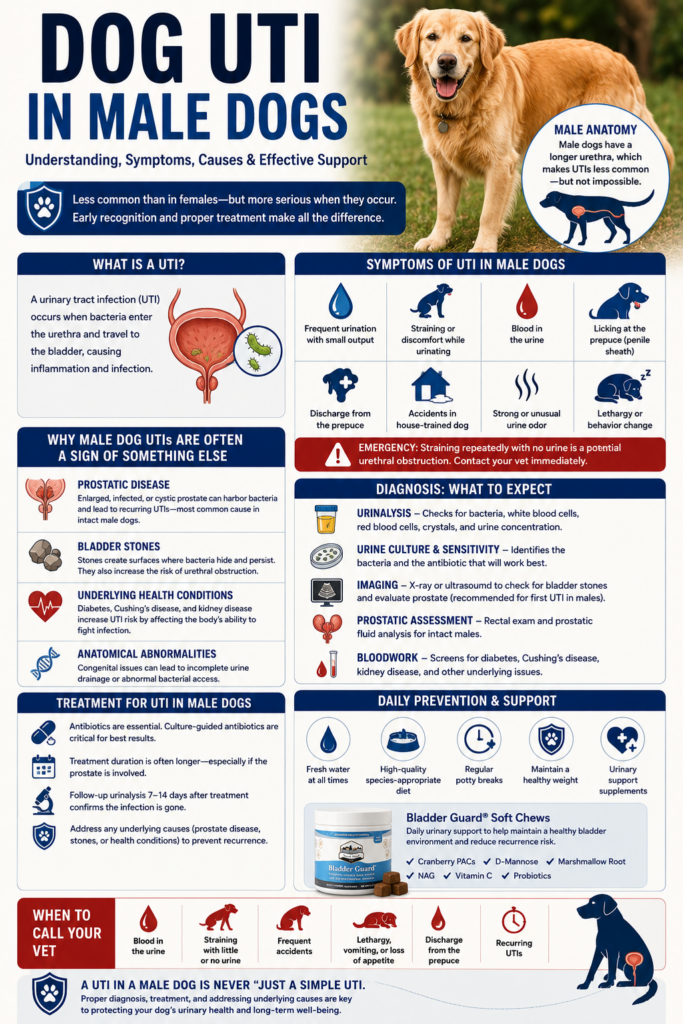
Why Male Dogs Get UTIs Less Often — But the Anatomy Isn’t Fully Protective
Male dogs have a longer urethra than females — significantly longer in fact, which means bacteria traveling from the urethral opening toward the bladder have a much greater distance to cover before establishing infection. This anatomical difference is the primary reason UTIs are more common in female dogs than male dogs.
But longer doesn’t mean impenetrable. Male dogs can and do develop UTIs — and when they do, it’s worth investigating more thoroughly than a first UTI in a female dog. A UTI in a male dog may indicate an underlying anatomical abnormality, prostatic disease, bladder stones, or another predisposing condition that allowed bacteria to establish despite the anatomical protection. A UTI in a male dog that isn’t explained by an obvious cause warrants investigation beyond just antibiotic treatment.
Symptoms of UTI in Male Dogs — What to Look For
Recognizing the signs of a UTI in male dogs can lead to early diagnosis and treatment, which is crucial for their health.
The core symptoms of a UTI in male dogs are the same as in females — but male dogs may show some presentation differences worth knowing:
- Frequent urination with small output — the inflamed bladder signals urgency before it’s actually full, producing many small urinations rather than normal volume urinations
- Straining or discomfort during urination — male dogs may posture repeatedly, strain without producing much urine, or whimper during urination
- Blood in the urine — visible pink or red tinge to urine, or blood drops after urination
- Licking at the prepuce (penile sheath) — the male equivalent of excessive genital licking seen in females with UTIs
- Discharge from the prepuce — yellow or green discharge may indicate infection involving the prepuce or prostate alongside the bladder
- Accidents in a house-trained dog — urgency overcoming bladder control
- Strong or unusual urine odor — bacterial infection changes urine chemistry and odor significantly
- Lethargy or behavioral change — pain and discomfort from UTI affects overall demeanor
The emergency symptom to know: a male dog straining repeatedly without producing any urine is a potential urethral obstruction — a medical emergency. Male dogs have a narrower urethra than females and are significantly more vulnerable to complete obstruction from bladder stones or urethral plugs. If your male dog is posturing repeatedly and producing nothing — contact your vet immediately.
Why Male Dog UTIs Are Often a Sign of Something Else
Because the male anatomy provides more natural bacterial protection than the female anatomy, a UTI that establishes in a male dog often indicates a predisposing factor that allowed bacteria to overcome that protection. The most important ones to investigate:
Prostatic Disease — The Most Important Male-Specific Cause
Intact male dogs are significantly more prone to prostatic disease than neutered males — and prostatic disease is one of the most common underlying causes of UTIs in intact male dogs. The prostate gland surrounds the urethra in male dogs. When the prostate enlarges (benign prostatic hyperplasia), becomes infected (prostatitis), or develops cysts or abscesses, it creates conditions that predispose to ascending bladder infection and can harbor bacteria that perpetuate recurring UTIs despite appropriate antibiotic treatment.
Signs of prostatic involvement alongside UTI symptoms include straining to defecate as well as urinate, ribbon-like stools, bloody discharge from the prepuce independent of urination, and abdominal pain on palpation. Any intact male dog with a UTI should have prostatic health assessed — the UTI may be secondary to prostatic disease that requires its own management.
Bladder Stones — Creating Bacterial Refuges
Male dogs are at higher risk of urethral obstruction from bladder stones than females because of their narrower urethra. Bladder stones create rough porous surfaces inside the bladder where bacteria can embed and persist between antibiotic courses — one of the primary reasons some male dogs with recurring UTIs don’t respond as expected to appropriate antibiotics. Any male dog with recurring UTIs should have imaging to rule out bladder stones before another antibiotic course.
For the full science on how bladder stones and UTIs fuel each other: Dog Bladder Stones vs UTI: What’s the Difference and Why It Matters
Underlying Health Conditions
Diabetes mellitus, Cushing’s disease, and chronic kidney disease all significantly increase UTI susceptibility in both male and female dogs — but because UTIs are less expected in male dogs, these underlying conditions may be identified through the UTI investigation in males when they might otherwise have gone undetected longer. A male dog’s first UTI is a reasonable prompt to screen for these conditions through bloodwork alongside the urinary workup.
Anatomical Abnormalities
Urethral abnormalities, ectopic ureters, and other congenital anatomical variations can predispose male dogs to recurring UTIs by creating areas of incomplete urine drainage or abnormal bacterial access. These are typically identified through imaging — ultrasound or contrast radiography — during the workup for recurring UTIs in young male dogs without obvious predisposing conditions.
Diagnosing UTIs in Male Dogs — What to Expect
The diagnostic process for a UTI in a male dog typically follows the same initial steps as for female dogs — but with additional investigation warranted more readily given the lower baseline susceptibility.
Urinalysis — the first step. Checks urine pH, concentration, and for the presence of bacteria, white blood cells, red blood cells, and crystals. Provides initial evidence of infection and information about stone risk.
Urine culture and sensitivity — identifies the specific bacteria and the antibiotic it responds to. Essential for male dog UTIs where empirical antibiotic prescribing without culture risks selecting the wrong antibiotic and driving resistance.
Imaging — X-ray and ultrasound are particularly important for male dogs given the higher risk of bladder stones and the need to assess prostatic health in intact males. Recommended for any male dog with a first UTI rather than being reserved for recurring cases as in females.
Prostatic assessment — for intact male dogs, rectal palpation of the prostate and prostatic fluid cytology help identify prostatic disease as a contributing factor.
Bloodwork — complete blood count and serum biochemistry to screen for underlying conditions including diabetes, Cushing’s, and kidney disease that may be predisposing to the UTI.
Treatment for UTI in Male Dogs
Active bacterial UTIs in male dogs require antibiotic treatment — the same as for female dogs. Culture-guided antibiotic selection is particularly important for male dogs because the underlying predisposing conditions common in males (prostatic disease, bladder stones) often create conditions that reduce antibiotic effectiveness, making the right antibiotic choice more critical.
Treatment duration for male dogs with UTIs is often longer than for females — particularly when prostatic involvement is present, as antibiotics must reach therapeutic concentrations in prostatic tissue which has limited drug penetration for many antibiotic classes. Fluoroquinolone antibiotics (like enrofloxacin) have better prostatic tissue penetration than beta-lactam antibiotics and are often preferred for UTIs with suspected prostatic involvement.
Follow-up urinalysis 7-14 days after completing treatment confirms clearance — particularly important for male dogs where underlying predisposing conditions make incomplete clearance more common.
Neutering and UTI Risk in Male Dogs
Neutering significantly reduces prostatic disease risk — and with it, one of the most common underlying causes of UTIs in intact male dogs. Benign prostatic hyperplasia, prostatitis, and prostatic cysts are almost exclusively diseases of intact males. Neutered male dogs retain the anatomical advantage of a longer urethra while eliminating the prostatic disease risk that can overcome that advantage in intact males.
For intact male dogs with recurring UTIs where prostatic disease is identified as a contributing factor, neutering alongside appropriate antibiotic treatment produces better long-term outcomes than antibiotic treatment alone.
Daily Prevention Support for Male Dogs
The same prevention principles that reduce UTI risk in female dogs apply to male dogs — consistent hydration to dilute urine and flush bacteria, quality diet supporting appropriate urine pH, regular bathroom breaks, and daily supplement support addressing the biological mechanisms that determine bacterial adhesion in the bladder.
Cranberry Type-A PACs and D-Mannose maintain continuous anti-adhesion coverage. Marshmallow root and NAG support bladder lining integrity. Probiotics maintain gut microbiome balance that drives urinary tract immune defense. For male dogs whose UTIs are secondary to prostatic disease or bladder stones being managed concurrently, daily urinary supplement support addresses the bladder environment layer while the primary conditions are treated.
→ See Bladder Guard Soft Chews
For the complete daily prevention guide: Dog UTI Prevention: Daily Habits That Actually Matter
For the full guide to UTIs in female dogs for comparison: UTI in Female Dogs: Why They’re More Vulnerable and What Actually Helps
For the complete science on UTI causes and recurring infection management: Dog Urinary Tract Health: A Complete Guide to UTIs, Prevention, and Long-Term Support
Can male dogs get UTIs?
Yes — male dogs can and do get UTIs, though they occur significantly less frequently than in females due to their longer urethra giving bacteria a greater distance to travel before reaching the bladder. When a UTI does occur in a male dog it warrants more thorough investigation than a first UTI in a female — because the male’s anatomical protection means an underlying predisposing condition like prostatic disease, bladder stones, or a systemic health condition often contributed to allowing bacteria to establish.
What are the symptoms of UTI in male dogs?
Symptoms of UTI in male dogs include frequent urination with small output, straining or discomfort during urination, blood in the urine, excessive licking at the prepuce, discharge from the prepuce, accidents in a house-trained dog, and strong or unusual urine odor. A male dog straining repeatedly without producing any urine is a potential emergency — male dogs have a narrower urethra than females and are at higher risk of complete urethral obstruction from bladder stones or plugs. This requires immediate veterinary attention.
Why would a male dog keep getting UTIs?
Recurring UTIs in male dogs most commonly indicate prostatic disease in intact males — benign prostatic hyperplasia, prostatitis, or prostatic cysts that harbor bacteria and perpetuate recurring infections despite appropriate antibiotic treatment. Bladder stones are another common cause — they create surfaces where bacteria persist between antibiotic courses. Underlying health conditions including diabetes, Cushing’s disease, and kidney disease all increase UTI susceptibility. Any male dog with more than one UTI warrants imaging to rule out bladder stones and prostatic assessment if intact.
How is a UTI in a male dog treated?
Active bacterial UTIs in male dogs require antibiotic treatment guided by urine culture and sensitivity testing. Treatment duration is often longer for male dogs than females — particularly when prostatic involvement is present, as antibiotics must reach therapeutic concentrations in prostatic tissue which has limited drug penetration for many antibiotic classes. Follow-up urinalysis 7-14 days after completing treatment confirms clearance. Underlying predisposing conditions — prostatic disease, bladder stones, systemic health conditions — require their own management alongside antibiotic treatment for the UTI.
Does neutering reduce UTI risk in male dogs?
Yes — for intact male dogs whose UTIs are related to prostatic disease, neutering significantly reduces risk. Benign prostatic hyperplasia, prostatitis, and prostatic cysts are almost exclusively diseases of intact males. Neutered male dogs retain the anatomical advantage of a longer urethra while eliminating prostatic disease as a predisposing factor. For intact male dogs with recurring UTIs where prostatic involvement is identified, neutering alongside appropriate antibiotic treatment typically produces better long-term outcomes than antibiotics alone.
What daily supplements help prevent UTIs in male dogs?
The same supplements that reduce UTI risk in female dogs are effective in males — cranberry Type-A PACs and D-Mannose for continuous anti-adhesion coverage, marshmallow root and NAG for bladder lining integrity and GAG layer support, Vitamin C for urine pH support and immune function, and probiotics for gut microbiome balance that influences urinary tract immune defense. For male dogs with recurring UTIs secondary to bladder stones or prostatic disease being managed concurrently, daily urinary supplement support addresses the bladder environment layer while the primary conditions are treated.
References
PetMD Editorial. “UTI in Dogs: Signs, Causes, and Treatment.” Updated December 2025.
VCA Animal Hospitals. “Urinary Tract Infections (UTIs) in Dogs.” vcahospitals.com.
Small Door Veterinary. “UTIs in Dogs.” smalldoorvet.com.
American Kennel Club. “Urinary Tract Infections in Dogs: Dog UTI Symptoms, Signs, Treatment.” Updated February 2024.
Bond Vet Editorial. “UTI in Dogs: Knowing the Signs and Potential Treatment Options.” September 2024.
Byron JK. “Urinary Tract Infection.” Veterinary Clinics of North America: Small Animal Practice. 2019.