Senior Dog Urinary Health: Why Older Dogs Are More Vulnerable (And What Actually Helps)
Senior dogs face a different set of urinary health challenges than younger dogs — and most pet owners don’t realize how significantly the aging process changes the bladder environment until the problems are already well established.
Leaking during sleep, more frequent accidents, recurring infections despite treatment, straining to urinate — these are not inevitable parts of getting older. They are signals that specific biological systems are under stress. Understanding why senior dogs are more vulnerable to urinary issues is the first step toward addressing those systems effectively rather than just managing symptoms.
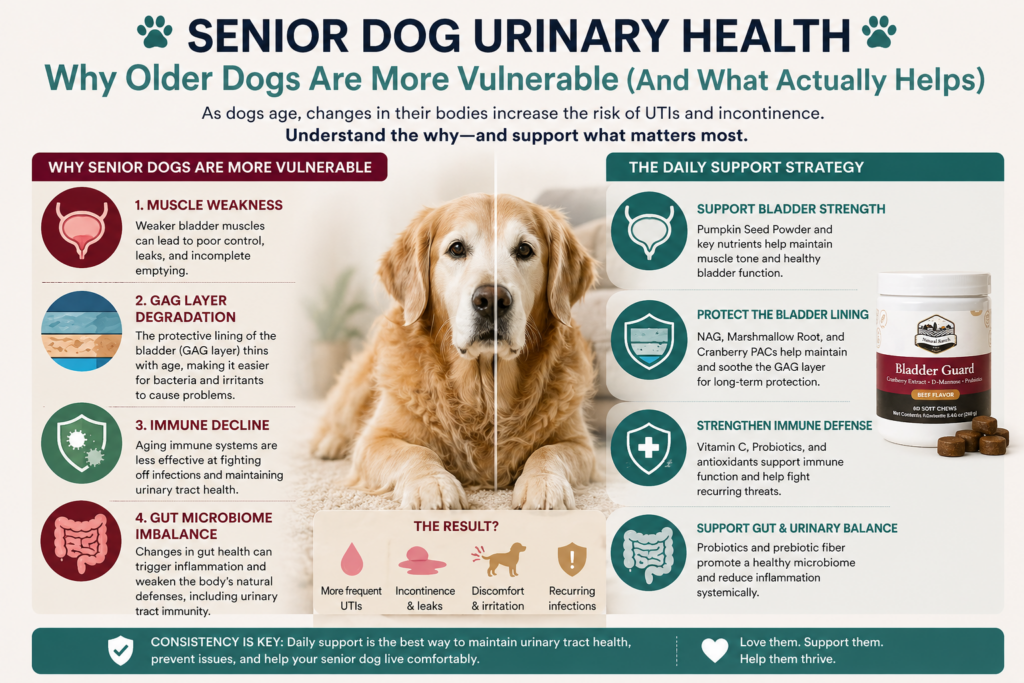
Why Senior Dog Urinary Health Becomes More Challenging With Age
Incontinence in senior dogs is quite common and tends to be more prevalent in females. Loss of bladder control may be due to deterioration of the muscles holding the bladder closed, cognitive decline leading them to forget their house training, or medical conditions such as UTIs.
But muscle weakness and cognitive changes are only part of the picture. Several converging biological factors make the senior dog urinary environment progressively more vulnerable — and understanding each one helps explain why a multi-system approach produces better results than addressing any single factor alone.
The 5 Reasons Senior Dogs Are More Vulnerable to Urinary Issues
1. Bladder Muscle Weakness
Like all muscles, the bladder and urethral sphincter lose tone with age. Dogs lose muscle tone as they age, including the muscles that help regulate urination. A weaker bladder or pelvic floor makes it harder for senior dogs to hold it in, so small leaks may become more frequent over time.
This is particularly relevant for senior spayed females. Urethral sphincter mechanism incompetence (USMI) is the most common cause of incontinence in senior dogs and is most often linked to reduced estrogen levels in adult and senior spayed females. While the mechanism is not entirely understood, lower estrogen levels seem to weaken the muscle that holds the bladder closed. Larger breeds tend to be affected more frequently, and obesity increases the risk.
Pumpkin seed powder is one of the most relevant ingredients for this specific issue — the compounds it contains support bladder muscle tone and urethral sphincter function, making it particularly valuable in senior dog formulas. This is one of the reasons Bladder Guard Soft Chews includes pumpkin seed powder as an active ingredient — not just for infection prevention but for the mechanical bladder control issues that become more common with age.
2. Increased UTI Susceptibility
Bacterial infection of the lower urinary tract is common in senior dogs, especially if they have concurrent incontinence, uroliths, or a history of frequent antibiotic therapy.
The connection between incontinence and infection is direct and often overlooked. When a dog leaks urine involuntarily, bacteria from the skin and external environment have more frequent access to the urethral opening — increasing the risk of ascending infection. Senior dogs dealing with incontinence are therefore at significantly higher risk for concurrent UTIs, which can then worsen incontinence, creating a reinforcing cycle.
Urinary tract infections in dogs are common, especially in senior dogs. The immune system changes that accompany aging — reduced immune surveillance, slower inflammatory resolution, and compromised gut microbiome — all contribute to this increased susceptibility.
For the full science on why recurring UTIs are harder to break in older dogs: Why Some Dogs Keep Getting UTIs (And What Actually Helps Long-Term)
3. GAG Layer Degradation
The glycosaminoglycan (GAG) layer — the bladder’s protective surface coating — degrades progressively with age and with each infection episode. Senior dogs who have had multiple UTIs over their lifetime may have significantly compromised GAG layer integrity, making bacterial adhesion easier and the bladder more sensitive to chemical irritation from concentrated urine.
This is why ingredients that support GAG layer maintenance — particularly NAG (N-Acetyl Glucosamine) — become increasingly important in senior dogs rather than just in dogs with active infections. Supporting the surface barrier proactively is far more effective than trying to restore it after repeated damage.
For the full science on the GAG layer: The Bladder’s Protective Barrier: Understanding the GAG Layer in Dogs
4. Systemic Health Conditions That Affect the Urinary Tract
Several conditions more common in senior dogs directly affect urinary health. Diabetes mellitus causes elevated glucose in urine which fuels bacterial growth. Cushing’s disease suppresses immune function making infections harder to resist. Kidney disease alters urine composition and concentration. Arthritis can make it physically painful to posture for urination, leading to accidents that aren’t true incontinence but are indistinguishable from it without a veterinary exam.
Kidney issues and urinary tract problems are often closely related in older dogs. UTIs that are left untreated can lead to long-term kidney issues as the infection reaches the kidneys.
This is why any senior dog with new or worsening urinary symptoms deserves a thorough diagnostic workup rather than just empirical antibiotic treatment. The underlying condition determines the most appropriate management approach.
5. Gut Microbiome Changes and Immune Decline
The gut microbiome shifts significantly with age — diversity decreases, beneficial bacterial populations decline, and the immune environment supported by that microbiome becomes less robust. For senior dogs who have been on multiple antibiotic courses over their lifetime, this microbiome disruption compounds significantly.
Since approximately 70% of the immune system is housed in the gut, these age-related microbiome changes directly affect the immune cells lining the urinary tract that resist infection. A senior dog’s first line of defense against UTIs is already operating at reduced capacity compared to a younger dog — making daily probiotic support particularly important rather than optional.
For the full explanation of the gut-urinary connection: Why Gut Health and Urinary Health Are Connected in Dogs
Signs of Urinary Problems in Senior Dogs to Watch For
Senior dogs are often stoic — they hide discomfort effectively, and changes that develop gradually are easy to normalize as “just getting older.” These signs warrant veterinary attention rather than watchful waiting.
- Wet spots on bedding or favorite resting places — particularly after sleeping
- More frequent requests to go outside with smaller amounts of urine each time
- Accidents in a previously house-trained dog
- Straining or vocalizing during urination
- Cloudy, dark, or strong-smelling urine
- Visible blood in the urine
- Excessive licking of the genital area
- Behavioral changes like increased restlessness, reduced activity, or unusual irritability
Accidents can happen more often in senior dogs, but frequent leakage or urination while resting is not considered normal aging. It is usually a sign of an underlying health problem and a vet visit is the best way to identify the cause and explore treatment options.
For a detailed breakdown of early warning signs: Signs Your Dog’s UTI Is Coming Back (And What to Do Before It Gets Worse)
What Senior Dog Urinary Health Support Actually Needs to Include
Given the multiple converging factors affecting senior dog urinary health, effective support needs to address more than bacterial adhesion alone. Here’s what a complete senior urinary health strategy looks like:
Bladder Muscle Tone Support
Pumpkin seed powder supports bladder muscle tone and urethral sphincter function — directly relevant to the leaking and incontinence that affects many senior dogs. This is one of the most frequently overlooked ingredients in urinary supplements, most of which focus exclusively on anti-infection mechanisms without addressing the mechanical bladder control issues that become prevalent in older dogs.
GAG Layer and Bladder Lining Support
NAG (N-Acetyl Glucosamine) supports the glycosaminoglycan layer that lines and protects the bladder wall. Marshmallow root provides direct soothing support for bladder lining tissue. Both become increasingly important in senior dogs whose GAG layer has been progressively compromised by years of inflammatory cycles.
Anti-Adhesion Daily Defense
Cranberry PACs and D-Mannose reduce bacterial adhesion to the bladder wall on a daily basis. For senior dogs with higher UTI susceptibility, maintaining consistent anti-adhesion support is more important than in younger dogs — not less. These ingredients work preventively and need daily consistent use to be effective.
Probiotic and Immune Support
Daily probiotic support helps maintain gut microbiome health and the systemic immune function it supports. For senior dogs on or recovering from antibiotic courses, probiotic support is essential for restoring the immune environment that protects the urinary tract between infections.
Foundational Nutritional Support
Senior dogs have increased nutritional requirements in several areas — B vitamins for cellular energy and immune function, zinc for tissue repair and immune cell activity, Vitamin A for mucous membrane integrity including the urinary tract lining, and Omega fatty acids for systemic inflammation management. A complete daily multivitamin addresses these foundational needs that urinary-specific supplements don’t cover.
This is why the Total Defense System — Bladder Guard Soft Chews combined with the Natural Ranch Daily Multivitamin — is particularly well suited for senior dogs. Bladder Guard addresses the urinary environment directly. The multivitamin, powered by cold-pressed Canine Royal Oil, addresses the foundational nutritional layer that immune function and tissue integrity depend on. Together they cover the full range of factors that make senior dog urinary health more challenging.
→ See Bladder Guard Soft Chews
→ See the Total Defense System for Senior Dogs
Daily Habits That Support Senior Dog Urinary Health
Daily management habits matter more in senior dogs than in younger ones because the urinary system has less reserve capacity to compensate for environmental stressors.
- More frequent bathroom breaks — senior dogs benefit from going outside every 3-4 hours during the day. Holding urine for extended periods increases bacterial exposure time and adds physical stress to already weakened bladder muscles.
- Consistent hydration — dilute urine reduces chemical irritation to the bladder lining and flushes bacteria more effectively. Adding warm water or wet food to meals significantly increases daily moisture intake for dogs on dry kibble diets.
- Hygiene maintenance — keeping the genital area clean and trimming long hair around it reduces the bacterial load at the urethral opening, particularly important for senior females with reduced immune defense.
- Warm, clean bedding — senior dogs who experience nighttime leaking need bedding washed regularly in hot water to prevent reinfection from urine residue.
- Weight management — excess weight increases pressure on the bladder and worsens urethral sphincter weakness. Even modest weight reduction in overweight senior dogs can meaningfully improve incontinence symptoms.
For a complete daily prevention routine: Dog UTI Prevention: Daily Habits That Actually Matter
When to See the Vet — And What to Ask
Any new urinary symptom in a senior dog warrants a vet visit rather than watchful waiting. The conditions most commonly behind senior urinary issues — USMI, diabetes, Cushing’s disease, kidney disease, bladder stones — all require specific diagnosis and management that daily supplements and habits can support but cannot replace.
When you go, ask specifically about urine culture and sensitivity testing rather than empirical antibiotic prescribing, imaging to rule out bladder stones, bloodwork to screen for diabetes and Cushing’s disease, and whether USMI is a likely contributing factor for your female dog’s incontinence.
Daily supplement support works best as part of a complete picture — alongside veterinary diagnosis, appropriate treatment for any underlying conditions, and the daily habits that support the urinary environment. For senior dogs especially, none of these elements fully substitute for the others.
For a practical evaluation of what to look for in a daily supplement formula for senior dogs: Best Dog UTI Supplement: What to Actually Look For
Why do senior dogs get more UTIs?
Senior dogs face several converging factors that increase UTI susceptibility — weakened bladder muscle tone, progressive GAG layer degradation from previous infections, systemic health conditions like diabetes or Cushing’s disease that affect the urinary environment, age-related gut microbiome changes that reduce immune function, and in spayed females, reduced estrogen that weakens the urethral sphincter and increases bacterial access to the urinary tract.
Is urinary leaking normal in older dogs?
Frequent leakage or urination while resting is not normal aging — it is usually a sign of an underlying health problem. Urethral sphincter mechanism incompetence (USMI) is the most common cause in senior spayed females, but UTIs, bladder stones, kidney disease, diabetes, and other conditions can also cause or worsen leaking. A veterinary exam is the best way to identify the specific cause.
What supplements help senior dogs with urinary health?
The most effective formulas for senior dogs address multiple mechanisms simultaneously. Pumpkin seed powder supports bladder muscle tone and sphincter function. NAG and marshmallow root support GAG layer integrity and bladder lining health. Cranberry PACs and D-Mannose provide daily anti-adhesion protection. Probiotics support the gut microbiome and immune function. A complete daily multivitamin addresses the foundational nutritional needs that urinary-specific ingredients depend on.
How often should senior dogs go outside to urinate?
Senior dogs benefit from bathroom breaks every 3-4 hours during the day. More frequent urination reduces the time bacteria have to multiply in the bladder and reduces physical stress on already weakened bladder muscles. Dogs who are experiencing leaking or accidents often benefit from even more frequent opportunities to void.
What is USMI in dogs?
Urethral sphincter mechanism incompetence (USMI) is the most common cause of urinary incontinence in senior dogs — particularly large breed spayed females. It occurs when reduced estrogen levels weaken the urethral sphincter, making it harder to keep urine sealed in the bladder. It often causes leaking during sleep or rest rather than during active urination, and is manageable with veterinary treatment and supportive daily care.
Can a senior dog UTI go away on its own?
No. Bacterial UTIs require appropriate antibiotic treatment based on urine culture and sensitivity testing. Untreated UTIs in senior dogs can progress to kidney infections or worsen incontinence. Senior dogs with urinary symptoms should always be evaluated by a veterinarian rather than managed with home remedies or supplements alone.
References
Kendall A, Byron JK, et al. “ACVIM consensus statement on diagnosis and management of urinary incontinence in dogs.” Journal of Veterinary Internal Medicine. 2024.
Byron JK. “Urinary Tract Infection.” Veterinary Clinics of North America: Small Animal Practice. 2019.
Flores-Mireles AL, et al. “Urinary Tract Infections: Epidemiology, Mechanisms, and Treatment Options.” Nature Reviews Microbiology.
Parsons CL. “The role of the glycosaminoglycan layer in bladder defense.” Urology.
PetMD Editorial. “UTI in Dogs: Signs, Causes, and Treatment.” petmd.com. Updated December 2025.
Chewy Editorial. “Understanding Senior Dog Incontinence.” chewy.com. November 2025.